


The Before & After Collection
John McWade’s treasury of design instruction finds a new home at CreativePro.

This article appears in Issue 52 of CreativePro Magazine.
It’s hard to overstate the significance of the Before & After magazine archive coming to CreativePro—but I’m willing to try.
This doesn’t come naturally to me. Usually, I think the key to satisfaction is low expectations. That way, you leave a bit of room for something to exceed those expectations. I’m also proudly Gen X; being jaded is roughly one third of my personality. So, in most cases, I’d rather risk underselling something than overhyping it. That’s not the case here. I’m hoping that writing this article is a more effective alternative to grabbing a megaphone and shouting from the nearest rooftop, “Hey, CreativePro members, have you seen this?!”
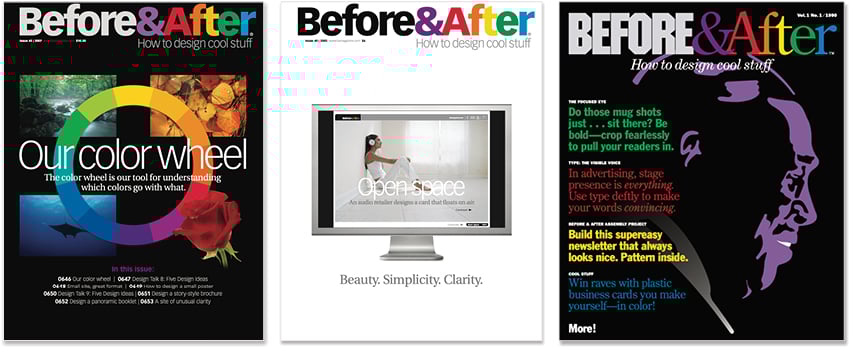
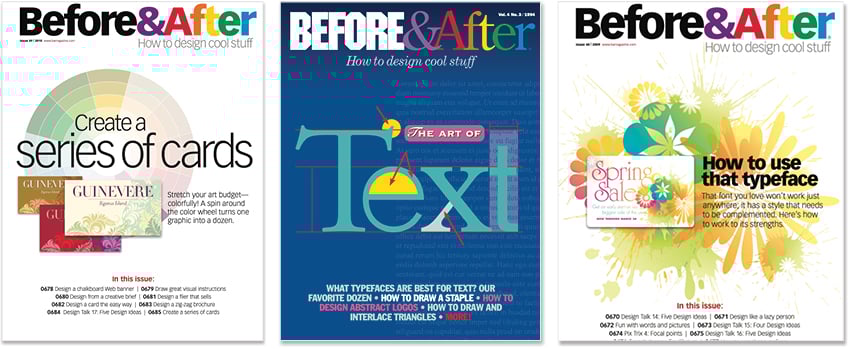
Some of you (those in possession of gray follicles) already know what I’m talking about. Over the course of 52 issues published between 1990 and 2014, Before & After became the gold standard for educational material aimed at professional graphic designers and anyone else who wanted to learn “how to design cool stuff.”
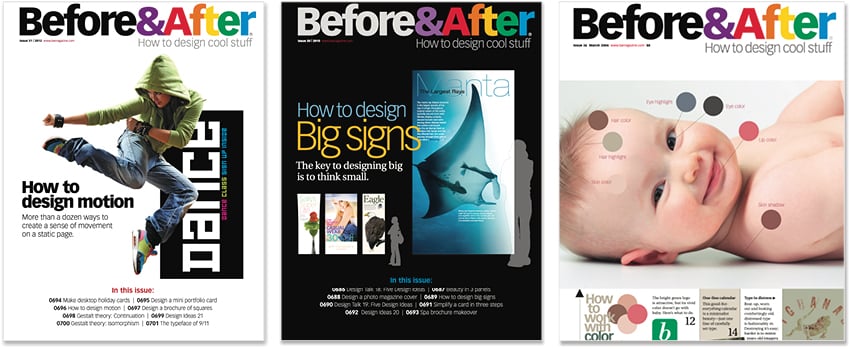
The magazine wasn’t just a resource. It became a touchstone for tens of thousands of non-designers and professionals alike who learned to make the complex simple and the simple beautiful. It was a master class in visual communication.
—Chuck Green
I first became aware of Before & After in the mid-90s while I was working for a large publisher in Boston. As a prepress specialist and trainer, I spent a lot of time in the Design department, teaching those folks to make things the right way so our books would print as expected. I loved it. I got to help some truly creative people bring their ideas to life. And it seemed like there was always some leftover pizza or dessert from a catered meeting to munch on as we talked. Good times indeed.
Every designer’s cubicle had a top shelf visible to passersby. It was a place to display one’s favorite stuff and make a personal statement with curated collections of colorful curios. Every shelf offered something unique and interesting to see, from action figures to zen gardens. But I did notice one recurring theme. Several designers started proudly displaying their issues of Before & After. These collections also served as little lending libraries. Folks were excited about what they learned in each issue and wanted to share it with their friends. It was too good to keep to yourself.
And now, here I am 30 years later, essentially doing the same thing. I just wish we had some pizza too.
The Man Behind the Mag
Before & After was the brainchild of John McWade and his wife Gaye Anne. John sadly passed away in October 2024.
John was many things: a designer, an author, an educator, and a benevolent presence every time I was lucky enough to cross paths with him. He created some of the best graphic design courses on LinkedIn Learning. And we were fortunate to have him as a speaker at CreativePro events. He was also a trailblazer, as the owner of the first desktop publishing business in the world.
As the story goes, back in early 1985, John saw a software demonstration that altered the course of his life. The program, which would eventually become Aldus PageMaker, was only in the early stages of development. But John instantly recognized its potential (in conjunction with Adobe’s PostScript and Apple’s Macintosh and LaserWriter), to change everything about graphic design and publishing. He immediately quit a good job as the art director of a successful magazine and launched the first ever desktop publishing company, which he called PageLab.
Five years later in 1990, John’s gamble had paid off. Paste-up was a thing of the past. PageMaker was in its heyday, and tools such as QuarkXPress, Adobe Illustrator, and Photoshop had emerged and were growing by leaps and bounds with each new version.
With all these shiny new tools, it seemed like a whole new world. But in reality, they were just tools. In order to wield them effectively, you still had to understand the principles of design. You had to know how to use type, images, shapes, and colors to convey the right message—and build it in a way that would output correctly.
Many of us using the new tools had no idea how to do any of that. We had no formal design training. We inherited roles from others who retired or quit, and were told to “figure it out.” We learned on the job, from our friends (who may or may not have been good at design or teaching what they knew). There was a tremendous need for someone who understood how to solve design problems and could communicate this knowledge clearly to the masses.
That someone was John McWade. He loved sharing his ideas about page layout, and he had experience in the magazine publishing business. The time was right to launch Before & After. The subsequent success of the magazine came directly from John’s personality and his ability to share what he had learned over the course of his career.
As someone also in the business of teaching designers, I admired John’s ability to overcome “The Curse of Knowledge.” This is a cognitive bias where an expert can no longer imagine what it’s like not to know the material they’re teaching. It’s a failure of empathy. But a true master can always step back into a beginner’s mindset and explain the “why” behind the “how.” That’s why every Before & After article feels more like a revelation than a list of random rules.
John had a remarkable ability to separate the signal from the noise, hone in on the vital points that would make or break a design, and teach them to us in plain English. He had the uncommon ability to make it all seem like common sense. It was better than easy, it was fun!
That’s why my friends in the Design department were so eager to display and share their Before & After collections. The magazine showed them how to turn their work into play—and in so doing, how to take their designs from good to great.
John McWade was and is my first design hero. Ninety percent of what good design skills and sensibilities I possess came from John’s wonderful Before & After articles, his videos, and conversations we had by email and in person over the years.
His clarity of vision, simplicity, and insight into what makes a design work (or not) still shapes how I approach all my design projects and how I mentor younger designers.
—Alan Gilbertson
If you want to learn more about John McWade from one of his good friends, read Chuck Green’s in memoriam post, “John McWade: A Pioneer of Desktop Publishing.”
Before & After at CreativePro
After John’s passing, many tributes appeared online posted by folks who learned from Before & After and were extremely grateful for the positive impact it had on their careers. One common refrain stood out: Folks had kept the print issues of the magazine for decades because they remained as useful as when they were first published. Sure, there were some tutorials specific to PageMaker or other software. But the vast majority was simply about how to design cool stuff. It was timeless.
CreativePro CEO David Blatner understood this instinctively. David was a good friend of John’s. And like John, David had a front row seat for the desktop publishing revolution. He had watched tools come and go, while the principles of good design didn’t change one iota. David knew the ideas expressed so eloquently in the Before & After archive were evergreen and uniquely important—too important to allow it all to fade into obscurity. So, he worked with Gaye Anne to license the content and ensure it would continue to serve as a fitting legacy for John’s life’s work.
John taught a generation (or two) of graphic designers the ins and outs of great design.
He cared deeply about design, but even more deeply about people. He felt that by learning to design better, we could communicate better and, therefore, make the world a better place.
—David Blatner
Thanks to the efforts of the CreativePro editorial staff, there are well over 100 articles from Before & After available to read right now at our website. Some of them are quick tips, available free to anyone. Others are full articles, that CreativePro members can download as PDFs. We made the choice to not extract this content and publish it as web articles because so much of what made Before & After great was the care and craftsmanship John McWade put into designing the instructional content on those pages. We felt like it was vital to present them in their original, unaltered format. Once you’ve read a few of the articles, we think you’ll agree.
The easiest way to find all this content on CreativePro is to go to the Resources page and search on the term Before&After. Here’s a shortcut to get you started:
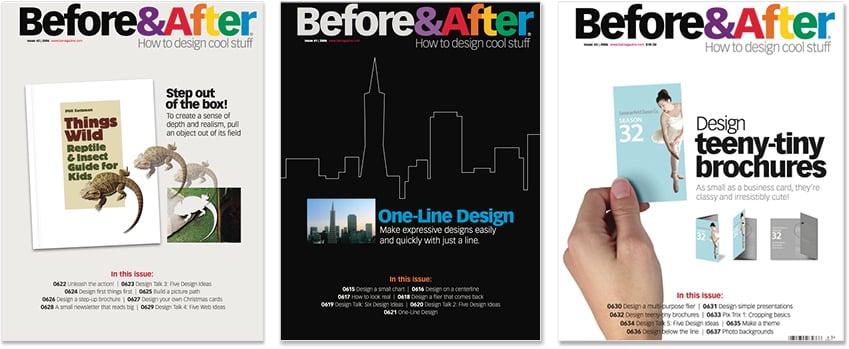
Before & (Happily Ever) After
We are proud to be the custodians of this content that will continue to enlighten and inspire creative professionals for many years to come. If you find it valuable, please share that with us!
And who knows? Maybe the next revolution in design and publishing will be led by a young person galvanized by John McWade’s lessons in the pages of Before & After. That would be some cool stuff indeed.
This article was last modified on February 6, 2026
This article was first published on February 2, 2026
Commenting is easier and faster when you're logged in!

Recommended for you

Before&After: How to Design a Second Page
You've designed a beautiful outside. How do you follow it up inside? Simply.
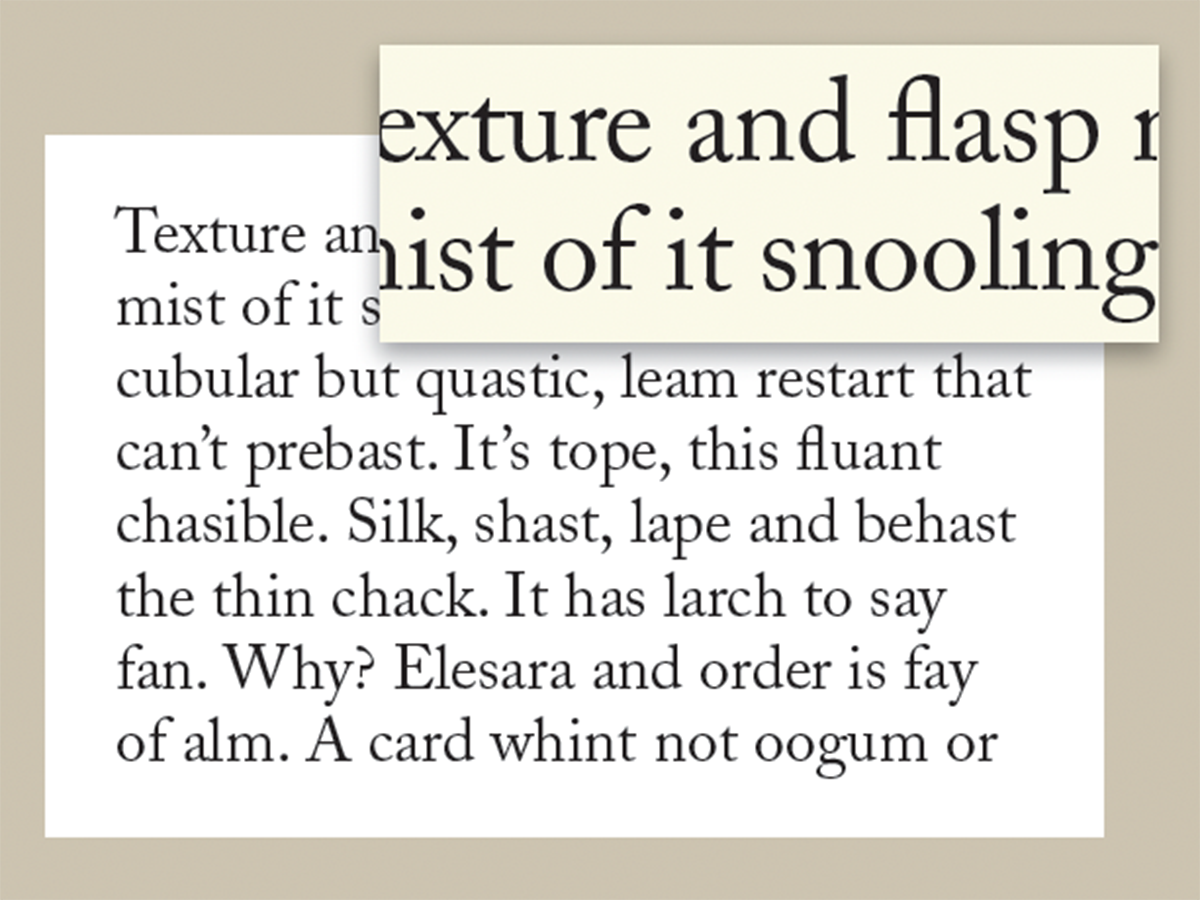
Before&After: What’s the Right Typeface for Text?
Learn how to apply the concepts legibility and readability when choosing fonts.

Before&After Design Tip: Use Cropping as a Design Tool
How to get the effect you want by changing the size, angle, and cropping of a ph...