




Never Miss a Deadline: An Interview with Steve Caplin
By Molly Joss
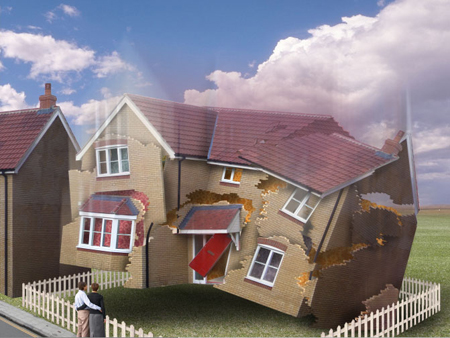
MJ: How did the client react to the image of the house crashing?
SC: They said “OK, that’ll do,” or words to that effect. When you’re working for daily papers you don’t get effusive thanks! They just want to fill the space as quickly as possible, so they can get onto other things. And, similarly, I did this on a day when I had four other montages to do at the same time, so I was just hoping for a quick sign-off. But, reading between the words, I think they liked this one. There were no changes to be made, which shows I did something right!
MJ: How did you create the couple standing in front of the fence?
SC: They come from a library of royalty-free images. I have many, many pictures of people and objects from these sources — literally, over 10,000 of them — and I use them in all my work where people are required.
MJ: Any legal problems taking pictures of other people’s houses and using them in images? In the United States there is a huge legal issue regarding images and pictures.
SC: The people thing is a big issue, which is why I only use images from libraries that are model released. When I do montages with recognizable faces, I montage their heads onto different bodies, and by the time I’ve changed the expression there’s no telling where they came from originally.
Houses aren’t generally so much of an issue: the law in the UK states that, unless you’re being libelous or obscene, you can use photographs of anything (and anyone) taken outdoors. But in this case, I used a photo I’d taken of a house that had just been built — so at the time I took it, no one was living in it. I also make a point of removing any obvious distinguishing features.
MJ: How long did it take you to finish the image, and generally how many images do you create in a week’s time during a heavy work period?
SC: Depends on the week! I’ll do about a dozen images, on average. A lot of my work is for daily and Sunday newspapers; this tends to mean doing up to five or six images on Friday, for the weekend’s and Monday’s editions. Can be a nightmare when everyone wants to see their montages at the same time!
MJ: You use Adobe Photoshop, obviously. Do you also use other software tools?
SC: I’ve got virtually all the Photoshop plug-ins there are because I review them for MacUser magazine. About the only ones I use on a regular basis are the AlienSkin EyeCandy filters: their new series, Impact, is stunning, and I use it mainly for its fantastic Chrome effect.
I also use Adobe Illustrator, particularly its 3-D filter, for creating models of objects I don’t have, for importing into Photoshop; and Poser, for creating figures.
MJ: You take your own shots and use royalty-free images. What’s the mix?
SC: I have a huge library of royalty-free images of people, places, and objects. When I’m working for newspapers, they supply me with headshots of celebrities and politicians, and I use my own source of bodies. But I frequently have to take my own photographs, both of places and objects, and I often have to dress up in a suit and photograph myself if I need a particular pose. On average, I’d say the mix is about 25% my own photographs, 75% stock images. If I need pictures of specific, tricky objects, I use eBay: I recently had to do an illustration of a garden full of garden gnomes, and eBay was the perfect source.
MJ: What’s your computer set-up? Do you like to keep up with the latest revisions of everything or do you find older versions work well enough?
SC: A Mac, of course! I recently got a new dual 2.5GHz G5, with 2.5Gb RAM. And yes, I’m obsessed with getting the latest versions of everything. Not only do they tend to be more stable, they also offer new features that make my work easier. As a beta tester for Adobe, I get advance copies of Photoshop months before they ship, so I get to try out the latest technology sooner.
I have two digital cameras: a Canon EOS 300D, which I use for serious photography, and a Casio Exilim EX-S100. It’s only 3.2 megapixels, but its advantage is that it’s tiny and I always have it in my pocket, so I never miss a shot when I’m out and about.
MJ: Tell me about your work background.
SC: I have no training in graphic design, photography, or art. Like many people, I fell into this by accident: I spent the whole of the 1980s editing and publishing magazines, and won a Desktop Publisher of the Year prize in 1987 that provided me with a copy of Image Studio, an ancient precursor of Photoshop, a video camera, and a frame-grabbing board for my Mac Plus. Started messing around with photomontage, and it all sort of happened from there!
So I’ve been working in this area as a freelance illustrator for about 15 years. I tend to work very fast, which is why most of my work is for newspapers: they typically operate on around a three-hour deadline, so there’s no time for messing about. Shortest deadline I ever had was 45 minutes for a front-page image for The Independent newspaper, and that was really tough!
MJ: What are your design philosophies?
SC: I think the most important thing about any freelance work is that you don’t miss deadlines, ever, for any reason. A work of art that’s perfect is no use if it means there will be a blank page in tomorrow’s paper. Reliability is the main thing art editors look for — and that’s far more important than artistic ability or technique.
MJ: You’ve also written a few books. Give me details on those projects, please.
SC: When I’m not drawing illustrations I spend my free time writing books. The top one is How to Cheat in Photoshop — the third edition is coming out soon. But I’m also pleased with Max Pixel’s Adventures in Adobe Photoshop Elements 3, which is published by Adobe Press. This is a kids’ book, in which the character of Max Pixel (3D modeled in Poser) takes you through every element of photomontage in the style of a cartoon comic. It was incredibly hard work to write and illustrate, and the results are just what I wanted. I’ve also written Icon Design, and co-written The Complete Guide to Digital Illustration.
My first foray into the world of publishing outside computer titles is Dad Stuff, a book about how to be a great dad. It will be published in the UK in November, and will be published in the U.S. next May by Random House, under the title Be the Coolest Dad on the Block. Not a mention of Photoshop in the whole book!
MJ: Do you have hints for working with clients? For example, how much direction do you usually get at the start?
SC: It depends very much on the client. Some know exactly what they want; others send me the copy for the story and ask me to come up with ideas. The hardest thing is when people ask for roughs, which is never really possible with photomontage, so I just tend to do the job and then let them make changes afterwards.
Some art editors are really inspired. Others are directed by the editors of the magazine or newspaper, and this can be a problem, as they tend to come up with the first cliché that pops into their heads. I’ve done birthday cakes with different company logos six times, for the same newspaper; fans of credit cards, poker-style, the same number of times for a different paper; and I’ve lost track of the number of Monopoly boards I’ve had to mock up.
Art editors often ask for illustrations of things that can’t be done, or that don’t make sense. For example, I’ll be asked to do an image of a politician taking money out of a pensioner’s pocket. And I always say, “How does this look different to someone putting money into their pocket?” Sometimes you just need to approach illustrations from a different angle, to maintain the freshness of ideas and imagery.
Clients from hell: advertising agencies, without a doubt. I’ve worked for most of the big agencies, and every job — without exception — has been a nightmare from beginning to end. They pay extremely well, but in the end it isn’t worth it. You start off as an artist and end up as a mechanic. To take one example: I did a poster for a radio station. After 17 reworkings, the job was finished; then they phoned up and said they had a couple of minor changes to make, and could they come around at lunchtime to finish it off. At 3 o’clock in the morning they
were still there, arguing about the hat someone in the crowd was wearing.

Read more by Molly Joss.
This article was last modified on January 18, 2023
This article was first published on August 29, 2005
Commenting is easier and faster when you're logged in!

Recommended for you
Heavy Metal Madness: Men Live In a Vacuum… Tube
My last column, which addressed the gender gap in housework duties, drew a numbe...

Inside the Publishing Revolution: How the LaserWriter and Photoshop Changed the World
Excerpted from “Inside the Publishing Revolution: The Adobe Story” (...

Using the Blend Tool in Adobe Illustrator
Illustrator provides many useful methods to create color blends including the Gr...