

Interview with Matisse Hamel-Nelis, Accessibility Consultant and Author
Learn how one mortifying mistake started a journey to authoring a book about accessible communications.

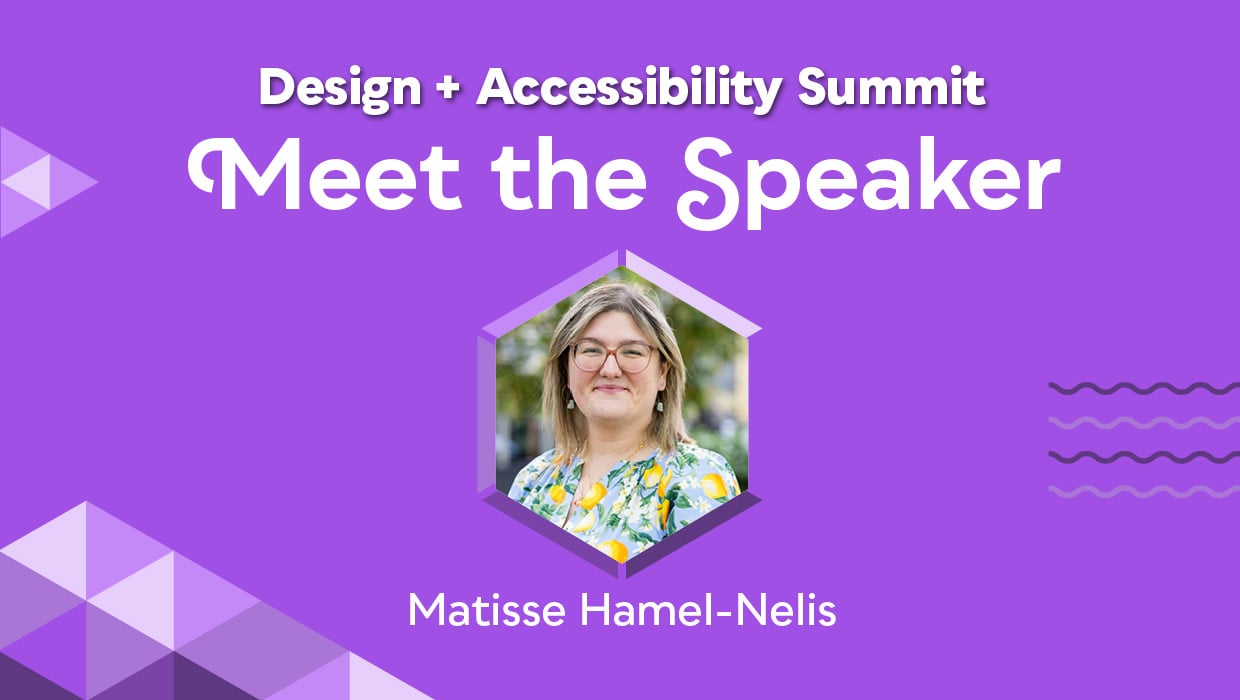

Matisse Hamel-Nelis is an award-winning communications and digital accessibility consultant based in Toronto. She is speaking at the The Design + Accessibility Summit 2026, which takes place online October 20–23, 2026. We thought it would be fun to get to know her better with some Q&A.
You’re new to the CreativePro community, and we are excited to have you speaking at the Design + Accessibility Summit. Your background is in communications. How did that lead you into the world of digital accessibility?
It actually started with a pretty mortifying moment. I was brand new out of school, two days into my first job as a corporate communications specialist at a national sight loss organization in Canada, when I was asked to put out a quick tweet using the hashtag #DYK.
I sent it off without a second thought. About ten minutes later, a colleague who has sight loss called me. He was so kind about it, welcomed me to the organization, and then gently asked if I had just tweeted. Turns out screen readers read hashtags that are acronyms as one word, not as separate letters. So instead of “D, Y, K,” his screen reader read my hashtag out loud as a very different word.
I was supposed to be a communicator, someone whose whole job was reaching people clearly, and I hadn’t even known this basic thing about how screen readers work. That question is really where my accessibility journey began, and I’ve been learning and sharing what I learn ever since.
What do you wish more designers understood about the relationship between accessibility and effective communication?
I wish more designers understood that it’s really the same goal wearing different outfits, if you will. Good design and good accessibility both try to answer one question: “Will this actually land for the person on the other end?” I think a lot of designers were taught to see accessibility as a checklist that shows up at the end, something you run through right before launch to make sure you’re covered. But when it lives at the end, it stays a compliance step forever, something you’re doing to a design rather than something baked into it.
The biggest shift I’ve seen in designers is when they start asking accessibility questions at the same point they ask their other design questions. Not “does this look good and is it accessible,” but just “does this work,” full stop, for the actual range of people who are going to encounter it.
Once that click happens, accessibility stops feeling like a constraint on the craft and starts feeling like part of the craft. Same as typography, color theory, or white space. Nobody thinks of those as boxes to check. I’d love for more designers to hold accessibility to that same standard.
You and Lisa Riemers recently published Accessible Communications. Was there a particular problem or knowledge gap that made you think, “Someone needs to write this book”?
Honestly, we kept bumping into the same wall over and over again, just from opposite sides of the Atlantic. There was no shortage of technical accessibility guidance out there, and there was definitely no shortage of general communications advice. What didn’t exist was something that connected the two in a way that actually made sense for the people doing the work day-to-day: the comms managers, marketing specialists, and PR folks who genuinely wanted to do better but had no idea where to even start.
We kept hearing from people who felt overwhelmed by the rules and regulations around accessibility, like it was this technical minefield they’d need a certification to safely walk through. So we wrote the book we both wished someone had handed us when we were first starting out, one that treats accessibility as something you bake into your work from the start rather than bolt on at the end.
For someone who already adds captions to their videos and thinks, “I’ve got accessibility covered,” what might surprise them in your session, Press Play for Everyone?
Captions are a genuinely great start, and I never want to talk anyone out of doing them. But captions are really just one piece of a much bigger picture, and that’s usually the biggest surprise for people in this session.
For one thing, not all captions are doing the same job. Closed captions that a viewer can turn on or off are different from open captions burned permanently into the video, and both are different again from a proper transcript. Each one has situations where it’s the right call and situations where it quietly falls short, and a lot of people are using whichever one their platform defaults to rather than the one their audience actually needs.
Then there’s the piece almost nobody thinks about, which is audio description. Audio description is what fills that gap, either built into the video itself or offered as a separate track, and it’s the piece that turns “you can read what people are saying” into “you actually know what’s happening.”
What’s something you love doing outside of work that people probably wouldn’t guess from your professional bio?
At home, life revolves around my husband Peter and our nine-year-old Old English Sheepdog, Edith. We’re also slowly working our way through renovating our house. If I had to pick the real passion, it’s cooking. I love trying new recipes and playing around with flavours I haven’t used before.
This article was last modified on September 7, 2026
This article was first published on September 7, 2026
Commenting is easier and faster when you're logged in!
Recommended for you
Interview with Monika Gause, Print Designer and Illustrator Expert
Q&A with Monika Gause, who is presenting at the 2026 Design + AI Summit for Crea...
InDesigner: Pratt Institute Grads
Jeff Witchel speaks to three recent graduates and shares samples of their impres...

The Women of InDesign
Anne-Marie Concepción interviews four women who have been instrumental in the de...