


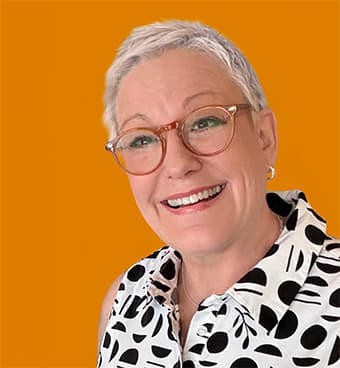
Karen Larson is a brand strategist and fine artist who helps companies build impactful marketing workflows.
She is speaking at the Design + Marketing Summit 2026, which takes place online September 14–15, 2026. We thought it would be fun to get to know her better with some Q&A.
Your work brings together branding, design, and marketing strategy. How do you describe what you do, and what connects those different parts of your work?
I’m a co-partner at ClearBrandStrategy.com, a small two-person agency. We help organizations figure out who they are and then make sure that shows up everywhere — visually, verbally, strategically. Sometimes that starts with positioning, sometimes it starts with a logo that isn’t working, and sometimes it starts with marketing that should be converting but isn’t. The entry point varies, but the goal is always the same: build a brand people understand quickly and trust over time.
What connects branding, design, and marketing is alignment. Branding sets the direction — what you stand for, who you’re for, what makes you different. Design makes that visible. Marketing makes it actionable. They’re not separate disciplines to me. They’re parts of one system.
After 40 years in the business, what I’ve learned is that when a brand is aligned, everything gets easier.
You’re presenting Making Canva Work as a Professional Designer. What do you hope professional designers will feel more confident about after your session?
I want designers to walk out feeling like Canva doesn’t have to be the enemy — and that using it doesn’t mean lowering your standards. Used intentionally, Canva can be a practical part of a professional workflow, especially when the real-world need is speed, collaboration, and content production at scale. You can use it without sacrificing craft or brand consistency. That’s the confidence I want people to have.
I also want designers to feel clearer about boundaries. When is Canva the right tool? When isn’t it? How do you protect the integrity of a brand system either way? That might mean locked templates, a solid brand kit, typography and color set up correctly, and clear do’s and don’ts a client team can actually follow. Basically treating Canva as a controlled environment instead of a free-for-all.
But the big one? I want designers to feel like they can lead the process rather than react to it. If a client is going to use Canva anyway — and a lot of them are — you can either fight it forever or design the system that makes it successful.
Canva can bring out strong opinions in professional designers. What has shaped your own perspective on using it in client work?
The last couple of years, I’ve chosen to use Canva as part of our production process. It’s fast and reliable.
The question isn’t “Is Canva good design software?” The question is: “How do we make sure the brand stays consistent when a designer isn’t in the room for every piece of content?” For many clients, Canva is already part of their reality, whether designers like it or not. I’ve also seen what happens when Canva is used without a system behind it — when non-designers are asked to make design decisions. Fonts drift, colors shift, layouts get inconsistent, and suddenly everything feels messy, even if the brand started out strong. That’s where the frustration makes sense. But to me, that’s not a reason to reject Canva. It’s a reason to bring professional thinking into how Canva gets set up, taught, and managed.
Canva will either dilute a brand or support it, depending on the setup and strategy behind it. When the foundations are strong — clear positioning, a coherent identity, good templates, simple rules — Canva becomes a production solution that helps us/clients and keeps things moving. It’s not replacing design expertise. It’s extending the brand into everyday execution.
You’ve been working in design and marketing long enough to see significant changes in technology. How do you navigate those changes, and what has remained constant in the way you work?
I stay super curious. That’s the main thing. I pay attention, I test new tools, and I try to figure out what problem the new tool actually solves. Not every new platform is an improvement. I love technology, and being open-minded is key.
The basics haven’t changed. Whether I’m building a brand identity, a website, or designing a print brochure, the same questions drive everything: What are we trying to accomplish? Who is this for? What do they need to feel, understand, or do next? Those questions haven’t changed in four decades — that’s why the work and processes still hold up even when the tools don’t look anything like they used to.
How do you express your creativity when you’re not working on a brand or marketing project?
I play and make — I really never stop. Personal creativity is where I get to explore without having to justify every decision. That might mean experimenting with watercolor and other media, collecting inspiration, or making something just because I’m curious. Just like with design tools, I enjoy experimenting with all kinds of art tools — analog and digital.
Recently I posted on LinkedIn that I miss design. So much of what we are working on is strategy and consultation. So, I’ve begun playing with design, color, and typography using quotes and sharing the graphics on my feed a few times a week. It’s been fun to explore, and the response has been positive.
The personal stuff is part of what keeps me sharp professionally. It keeps my brain flexible. It reminds me that creativity isn’t just a deliverable — it’s a way of thinking and solving problems. When I make room for that outside of client work, I come back with more energy, better ideas, and a stronger point of view. I’ve learned that’s not optional. It’s maintenance.
This article was last modified on August 25, 2026
This article was first published on August 24, 2026
Commenting is easier and faster when you're logged in!
Recommended for you
Editor’s Picks for The Design + Marketing Summit 2026
Our Editor in Chief lists his must-see sessions for The Design + Marketing Summi...

Q&A with Steve Laskevitch: Rocket Scientist, InDesign Guru, Pizza Snob
Q&A with Steve Laskevitch, who is presenting at The InDesign Conference 2025
Interview with the InComparable Anne-Marie Concepcion
Q&A with Anne-Marie Concepcion, who is presenting at The InDesign Conference 202...