


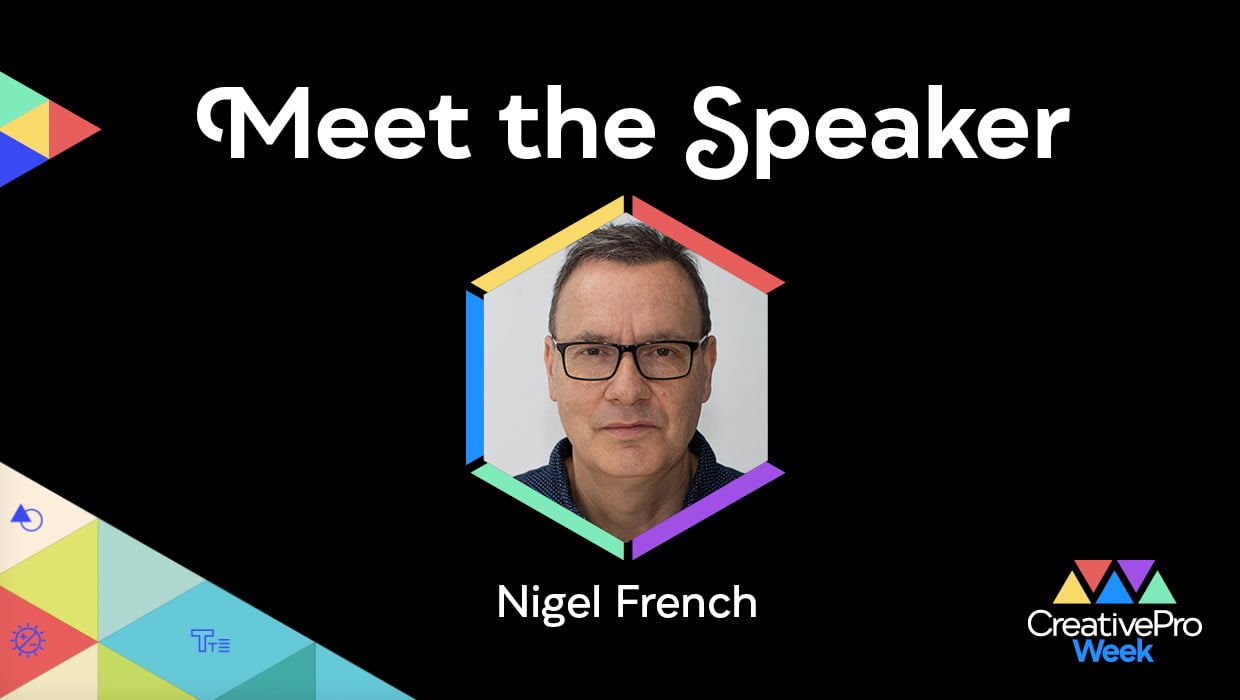

Nigel French is a graphic designer, photographer, and design teacher. He has authored several books on design and typography, and created over 50 courses on Photoshop, InDesign, and Illustrator at LinkedIn Learning.
Nigel is speaking at our CreativePro Week 2026, which takes place June 29–July 3, 2026 in Nashville, Tennessee. We thought it would be fun to get to know him better with some Q&A.
CreativePro Week celebrates 10 years. You’ve spoken at every one, traveling across continents to be there. What keeps you coming back? Do you have a favorite memory?
CreativePro is one of the highlights of my year, and I feel genuinely lucky that it’s become such a constant in my calendar. What keeps me coming back, more than anything, is the people. There’s something special about catching up with old friends and making new ones in a space where everyone just gets what you do. In my day-to-day life, not many people are particularly interested in typography or layout, so it’s a rare treat to be able to properly geek out without having to explain why it matters.
It’s also one of the most welcoming and generous communities I’ve been part of. People are open, curious, and happy to share what they know, which creates a really supportive atmosphere.
As for a favorite moment, it’s hard to pick just one, but I always look forward to 3 Minutes Max. That said, some of the most memorable moments happen outside the sessions—over dinner, or a drink, or a conversation that wasn’t planned. The talks are fantastic, but it’s those in-between moments where the real connections tend to happen.
Your expertise spans photography and typography. Do you approach each differently, or do they come from the same creative mindset? Can you pick a favorite?
I’ll diplomatically avoid picking a favorite, although I will admit it’s generally easier to make a living from graphic design than photography.
In terms of mindset, they feel very connected to me. Whether I’m working with type or with images, it’s really about paying attention—looking closely, noticing detail, and refining things over time. Both are quite solitary pursuits, which suits me, and both have made me much more observant of the world around me. I can’t really switch that off—there’s always some bit of lettering to admire (or quietly critique), or a composition forming in my head.
They’re also both rooted in repetition. I tend to work by doing something over and over, gradually improving it until it feels right—or until time runs out. Some people seem to arrive fully formed with talent; for the rest of us, it’s mostly about showing up and putting the hours in.
At this year’s CreativePro Week, you’re teaching InDesign typography, Photoshop and Illustrator cross-app workflows, and taking part in a live design critique. What ties all of that together for you?
For me, it all comes down to attention to detail and an appreciation for nuance. Those are the things that quietly make the difference, especially over time.
I also really enjoy solving everyday problems—finding a cleaner, clearer, or more efficient way to do something that people struggle with. There’s a lot of satisfaction in that.
And I tend to anchor everything in a bit of design history. I find it both humbling and reassuring to be reminded that most of what we’re doing builds on ideas that have been around for decades. There’s comfort in that continuity, and it helps put the work into perspective.
You’re a drummer in several bands. When and how did you get started playing the drums?
I’ve been playing since I was a teenager. Like a lot of people, I started out wanting to be a rock star and somehow ended up as a graphic designer—which, all things considered, has worked out quite well.
I wouldn’t claim to be an amazing drummer, but I am the best I’ve ever been right now, which feels encouraging. It’s a nice reminder that progress is cumulative. The more you do something, the better you get—slowly, sometimes almost imperceptibly, but it does add up.
It’s the same principle as design, really. Practice, repetition, a bit of patience—and over time, things start to click.
This article was last modified on April 13, 2026
This article was first published on April 13, 2026
Commenting is easier and faster when you're logged in!

Recommended for you
Interview with Valentina D’Efilippo, Creative Director and Data Designer
Data designer Valentina D’Efilippo explains how to look beyond spreadsheets to u...

Interview with Rob de Winter, AI Trailblazer and Educator
Q&A with Rob de Winter, who is presenting at The Design + AI Summit 2025

InDesigner: Hal Leonard
If you’ve ever bought sheet music, there’s a good chance you have something publ...