


How to Be a Better Designer: Think Like a Designer
Develop your creative craft through active observation, practice, and embracing constraints.

This article appears in Issue 58 of CreativePro Magazine.
Good designers are storytellers and problem-solvers.
The strongest design work is more than just a visual arrangement of type, image, and space. It’s a narrative. And every decision you make—typeface, color, composition, scale—is a part of that narrative. Our designs are about more than what they look like. They pose the question: Why? Of all the myriad possibilities, all the directions not taken, why has the designer chosen to make it look like this?
Underpinned by the foundation of a clear narrative, a design gains depth and credibility. It becomes more than decoration. Even if the narrative is not explicit—or if only a few will appreciate it—the story is embedded in the decisions that shaped the work. Admittedly, it’s hard to quantify how this enriches the design, but a compelling backstory provides an invisible structure, giving the design coherence. It also gives you, as the designer, a way to navigate the process, following one connection to the next. Instead of pinballing from one arbitrary choice to another, you relate each choice to a prior choice, in the same way that the position of each object on a page relates to the position of some other object on the page. Each decision is tested against an evolving idea. While it may sound grandiose, the design is connected in some way to all other designs that have preceded it.
Choosing a Theme
An effective narrative rarely arrives fully formed. More often, it emerges through patient chiseling, exploration, and iteration. One useful approach is to work in themes. A group of things often has more impact than a single thing. Over time, you notice recurring interests in your work: certain metaphors, visual rhythms, or conceptual approaches. These are not limitations; they are signals. They point to ways of thinking that feel natural to you, and they can help you build a framework for decision-making.
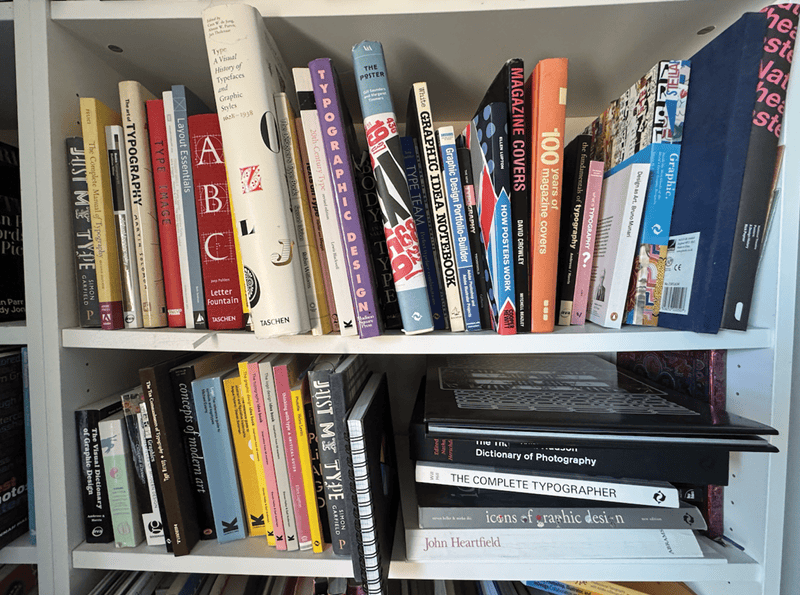
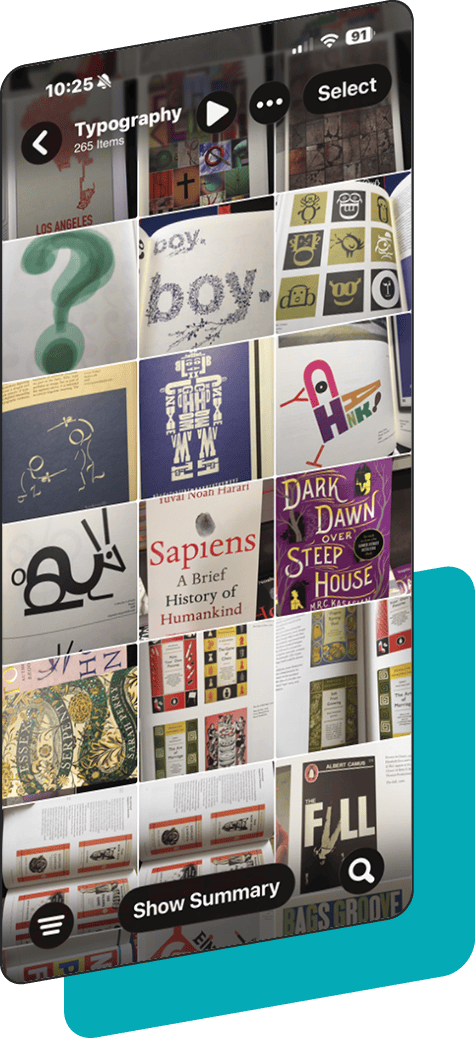
Following these themes may lead you down rabbit holes, but also into collecting. These collections can be digital or physical, structured or loose (Figure 1). You might gather screenshots, photograph found typography, keep packaging, or note fragments of overhead conversations. The point is not accumulation for its own sake, but connection. Over time, patterns emerge, strengthening and elaborating your themes. A color combination in a vintage magazine might echo something contemporary. A piece of signage might suggest a layout system. These relationships, once noticed, become part of your design thinking.
Synthesis, Awareness, and a Bumper Sticker
Thinking like a designer also means becoming comfortable with synthesis. The most interesting work often comes from what David Bowie refers to as a collision of ideas: the blending, or mashing up, of different styles—historical and contemporary, digital and physical, refined and raw. The narrative emerges through reconciliation, as you shape multiple inputs into a coherent whole.
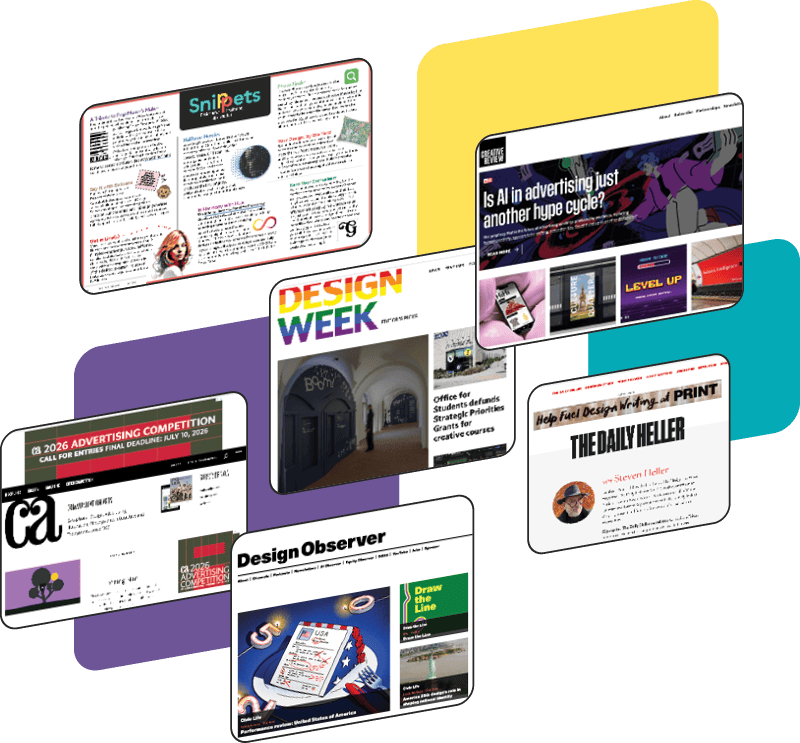
As part of this process you’ll want to stay engaged with the wider design conversation. Reading the design press—CreativePro Magazine, Design Observer, Design Week, Creative Review, Communication Arts, Print—is not about chasing trends, but about awareness. Understanding what others are making and thinking makes it easier to position your own work (Figure 2). Knowledge builds confidence, and confidence allows you to make decisions with intent rather than just stumbling upon them.
Acting with intent puts you at the center of the narrative, and there is a psychological shift that comes with this. Saying “I am a designer” can feel like a bold statement, especially early on. But identity can follow behavior. While it may sound like bumper-sticker wisdom, there’s a truth to Fake It Till You Make It. The more you act like a designer—questioning, refining, connecting—the more natural that identity becomes. Confidence, in this sense, is not performance. It is clarity, even if you occasionally fall prey to a bout of impostor syndrome.
Just Do It
Self-belief alone won’t bring in the clients. While you’re waiting for the phone to ring or for that amazing job prospect to land in your inbox, don’t lose time.
Self-initiated projects are one of the most effective ways to develop both skill and voice (Figure 3). If your portfolio lacks a particular kind of work, create it. Design the annual report no one asked for. Reimagine a magazine that needs a makeover. Invent a brand and explore it fully. These projects give you the freedom to push ideas further than a paying client brief might allow. Don’t know how to get started? Ask your favorite AI agent to write a design brief for you—and while you’re at, ask it to generate fictional clients and text assets, too.
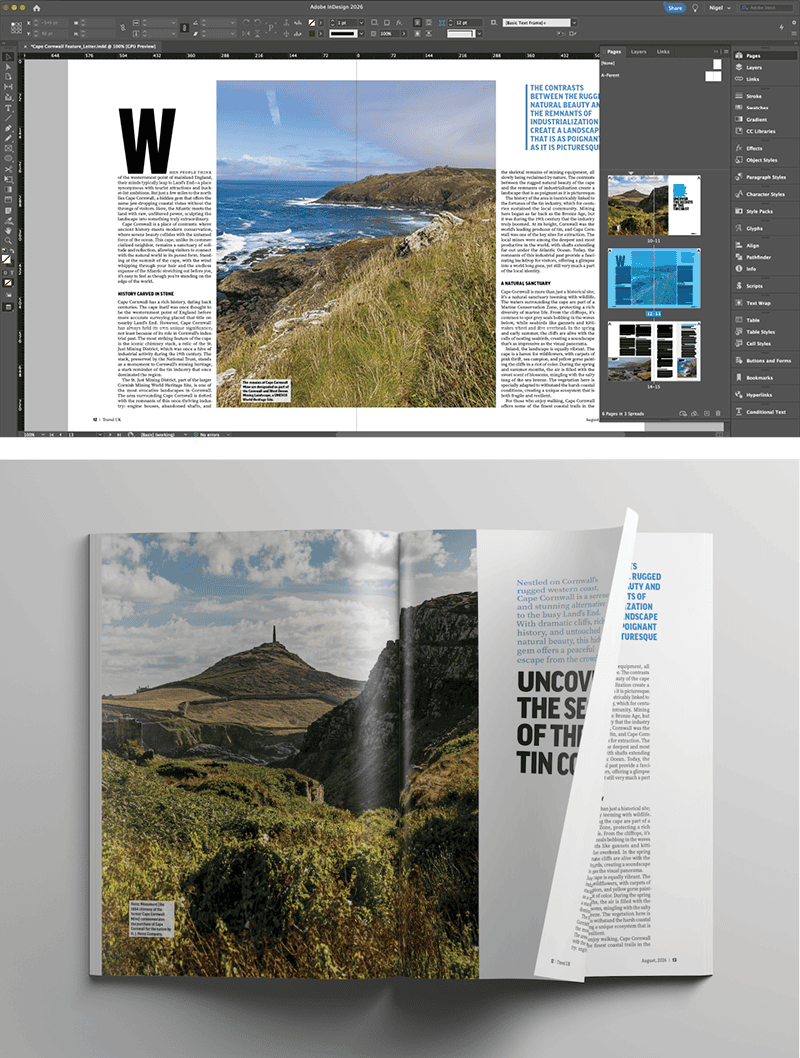
When you’re finished, print-on-demand services make it possible to produce professional-looking books in very small quantities. This means that personal work can move beyond your screen to become something tangible with gravitas. A single, well-made book carries more weight than a collection of unfinished experiments.
These projects are not distractions from real work. They are real work—and sometimes they can be where your most interesting ideas develop. Without the pressure of client approval, you can explore narrative more freely, test systems more rigorously, and take risks that might never get the approval of conservative clients.
Observe, Don’t Overlook
Thinking like a designer also involves observing (Figure 4). Designers are, by nature, attentive and inquisitive—even, or especially, when it comes to the mundane. The hierarchy of a railway timetable, the spacing of a shop window, the rhythm of street signage—these are all lessons in communication. By noticing them—Why do they look the way they do?—you build a mental library of structures and systems, as well as develop a design vocabulary. Both can be drawn upon later.
Constraints Can Clarify
Generating ideas is only part of the process. Editing those ideas is crucial. Knowing what to leave out and sometimes what to (reluctantly, but necessarily) remove can be as important as what to include. Early concepts might be brimming over with ideas, but they can also be unfocused. The challenge is to refine them without losing their energy. This requires judgment, and judgment develops over time through exposure and reflection.
Constraints can help. A limited palette, a strict grid, or a reduced typographic system can sharpen thinking rather than restrict it. Try designing editorial text using a single font at one size; you’re compelled to find other ways to signify difference and hierarchy. Constraints force decisions. They reduce noise. Within those boundaries, your narrative must work harder, and as a result, it often becomes clearer.
Informed Inspiration
It is also worth recognizing that design doesn’t happen in isolation. Even when working alone, you’re responding to a broader culture of ideas. Influences are inevitable, but they can be made conscious. Instead of passively absorbing what you see, you can actively position yourself in relation to it. Ask questions rather than simply admire outcomes. Try to articulate exactly what draws you to a particular designer’s work. Is it the typography, the use of space, the visual rhythm, the conceptual thinking, or the way complex information is made clear? By identifying the specific qualities that resonate with you, you move from imitation to understanding.
You can also be positively influenced by work you dislike. Knowing what feels overworked, predictable, or inappropriate will help you avoid the same pitfalls. Every micro critique of every piece of design you encounter becomes a point of reference, helping you define your own preferences and priorities.
Over time, this process creates a distinction between inspiration and imitation. You’re not collecting styles, but ideas, approaches, and ways of thinking. The goal is not to become a jumble of your influences but to develop a coherent point of view informed by them.
Care a Whit About Wit
Amidst all this seriousness, it’s important not to take yourself too seriously.
A sense of humor can be a powerful tool in design (Figure 5). It can create connection, disarm an audience, and make work more approachable and more memorable. Some of the most effective design carries an element of wit or irreverence—something that rewards attention and invites engagement.
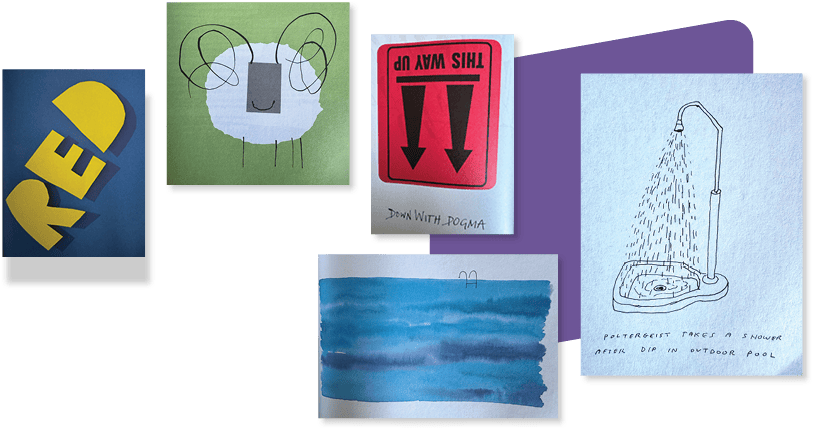
Just keep in mind that humor doesn’t always travel or age well. What feels sharp or playful in one context may be confusing or inappropriate in another. When working for global audiences, it’s important to test assumptions and understand how meaning shifts across cultures. When in doubt, err on the side of restraint.
Make Better Mistakes
Finally, there is the question of failure. This is about when, not if.
Taking risks means that you will inevitably make mistakes. Sometimes a mistake is a mistake and no amount of justification can spin it otherwise, but sometimes it’s more a sign that you’re pushing beyond the obvious. Each mistake contains information about what doesn’t work, and that information is valuable. Just be sure to reflect and to not repeat the mistake. If you make the same error repeatedly, it stops being experimentation and becomes carelessness. Growth depends on attention.
Think It Through
To think like a designer is to balance structure with curiosity. To build narratives while remaining open to unexpected outcomes and plot twists. It is to be informed, but not rigid—to recognize that every problem contains multiple solutions and that the one you choose is meaningful because of the story that supports it.
The more consciously you engage with that process, the more your work will develop—not just in how it looks, but in how it thinks.
Commenting is easier and faster when you're logged in!

Recommended for you
From Type to Table: Different Medium, Same Design Eye
Our longtime typography expert explores how the core principles of design transl...

How to Be a Better Graphic Designer: Do It Yourself
Doing it yourself pushes you to move beyond your usual tools and deepen your und...