


Eye on the Web: Booths, Bunnies, and Business Deals

I was reading a Dilbert cartoon a couple years back, in which Dilbert was attending a technology trade show (as you likely know, Dilbert has a job as an engineer at a company that produces some undefined technology product). Dilbert was walking along on the trade show floor when suddenly, darting out from a nearby booth, was a product manager with a tractor beam! Dilbert tried to resist (with standard tactics like averting his gaze, and picking up his pace), but it was no use: He was drawn to the booth and had to sit through the product demo. The thing is, with the exception perhaps of the tractor beam, Dilbert’s experience is a familiar one for any flesh-and-blood human being who has ever attended a technology trade show.
Three-Ring Expo
A trade show can be a fascinating experience, as I was duly reminded by this week’s Seybold show in San Francisco. Besides the glut of new products and announcements (which, if you’re a big geek like me, can often get the adrenaline running higher than you’d probably like to admit), and the conference sessions discussing this year’s next-big-thing, there are the booths on the exposition floor. Let me tell you, the booths are a good half of the attraction.
Back one day in the distant past, when I was working as the low person on the editorial totem pole at a consumer technology magazine, word came down that I was to attend a trade show (a Seybold show in San Francisco as a matter of fact) and cover the wide-format printer market news. Swell, I thought. This should be interesting. I had heard there would be booths, and I was imagining the fold-up-and-go set-ups you see advertised in the back of in-flight magazines. I couldn’t have been more wrong.
When I arrived at the show I was shocked to find an expo floor that looked more like a circus, with colored lights, massive architectural installations, legions of uniformed booth staffers, and a forest’s worth of four-color product leaflets. It took me a good couple of hours before I could concentrate on the actual products at the show (and before I had regained enough outward sanity to be invited to any produce demos). And this was Seybold, a professional show that doesn’t put a whole lot of stock in bells and whistles.
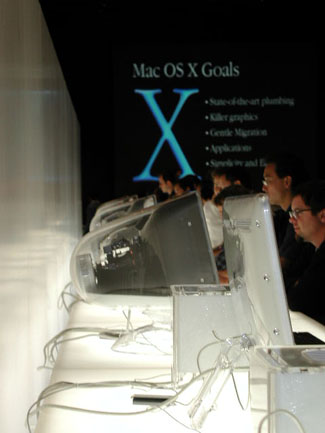
When I attended my first consumer-focused technology show, a Macworld Expo (admittedly a small show by many standards), I was further surprised to witness the sheer number of tchotchkes one could collect — from giant Crayola crayons to little clicking toys, even to stuffed animals. Almost every booth had large bowls of candy for the taking and free T-shirts for anyone who would sit through a product demo. This show also had legions of teenagers (no one under 18 is admitted to Seybold) bedecked in Apple logo-ware and toting shopping bags full of free gifts (as at concerts, more street cred was given to those with T-shirts from past events).
All of this is nothing compared to a show like PC Expo where there are actual dance numbers, comedy shows, hoards of women paid to dress in scanty clothing (known, sadly, as booth bunnies), and even full-on Cirque-du-Soleil-style circus acts. Still, one can manage to squeeze a product demo in edgewise, thanks to tenacious marketing and PR specialists.
The Booth Indicator
Interestingly, the size and design of a company’s trade show booth can often become an indicator, at least for the next three days, of how well that company is doing. You’ll often hear talk like this on the trade show floor: “Did you see Company X’s booth? It’s only ten by ten. You’d think they were a startup.” Or “I don’t see company Y here at all. Maybe they’re not doing so well.”
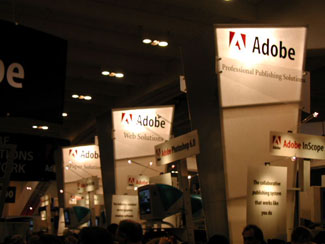
At this week’s Seybold show, Adobe had numerous booths, and even sponsored a number of partner pavilions (which are collections of small booths for small companies with the sponsoring company’s logo pasted to the top), which caused the general impression that Adobe is doing quite well. Quark, on the other hand, had a smaller booth with a somewhat dated design, fostering the impression of the publishing software maker as tired and beleaguered. And no booth was more ostentatious than the massive theater and promenade barely filled with products that Apple Computer set up. As creativepro.com Editor-in-Chief Pamela Pfiffner observed, just as white space in a print magazine denotes success, so blank space in a trade show booth says, “We’re so successful we can buy more space than we’ll actually use.”
Thanks for the Memories
Going to a technology trade show can be like stepping onto another planet. (I’ve never been to any other sort of trade show, despite trying feverishly to get invited to various food shows, so I’m not sure if they are similar.) For the three or four days the show lasts, you’re dazzled with bells and whistles, you get inordinately excited about the smallest software updates, and you generally feel pretty darned warm and fuzzy about technology. Which, I guess, is the point.
Andrea Dudrow was part of creativepro.com’s editorial team that covered the Seybold show. Read her reports and more.
This article was last modified on January 8, 2023
This article was first published on September 4, 2000
Commenting is easier and faster when you're logged in!

Recommended for you

Making Calculations in InDesign
Scripts and other solutions to take the pain out of dealing with math in InDesig...
The Search for Buried Treasure on Quark.com
Based on an article originally published in the DesignGeek e-zine. Assume that t...
Before&After Design Tip: Position Text for Quicker Reading
When words are critical, put them at the center of the design.