


America 24/7: Shoot-to-Plate in Real Time


Rick Smolan is justly famed for his ambitious use of leading-edge technologies in the service of top-notch coffee-table books. His latest adventure was a stress-test of photojournalism workflows, custom book production, and the coordination of thousands of pro and amateur photographers.
As I sat down today to write this story, I first listened to a voice mail from Rick Smolan time-stamped 9:30 pm. He said that his team had just finished the first phase of the project: the selection of images and the design for the first book in the America 24/7 series, the national edition.
“We finished the book in ten days,” Smolan said in his message, “with the smallest staff, largest selection of images and fastest production [using InDesign automation] that has ever been done. Not bad for a project that has been nine months from start to execution. My wife says she feels abandoned. I’m going to get killed when I finally get home tonight!”
America 24/7 (www.america24-7.com) is Rick Smolan’s latest, most ambitious and, some would say, most audacious “whole world” photo shoot. It represents what Smolan has called “the largest collaborative photo project in history.” On this project, like many of his other ones, Smolan collaborated with his long-term partner David Elliott Cohen. When I visited their command center at Cnet, the two of them shared an alcove-cum-office around the corner from the editing areas.
The plan. As Smolan and Cohen conceived their latest project, a thousand top newspaper and magazine photojournalists, including 34 Pulitzer Prize winners, as well as several thousand more professional, student, and amateur photographers, would capture their personal visions of American life each day during the May 12–18 digital shoot. After each day’s shooting, they’d upload the images to the project servers. Then, following an orchestrated selection by professional photo editors, the images would be published in 53 high-quality book sets, one for each state, the cities of New York and Washington DC, and a national volume. The project would also reproduce images for photographic exhibits around the country, as well as sell images via the project’s Web site.
Digital-image workflow. To accomplish such a massive, fast-paced, rich-media project, some of the best digital-image technology was selected and tightly woven into an integrated workflow across a consolidated multi-system platform. User-appropriate tools were to be made available at each stage of production, creating a marriage of consumer- and professional-level image management. Nevertheless, everyone understood that this untested, custom workflow platform was being used to attempt a difficult feat: to enable collaborative image management for millions of digital photographs.
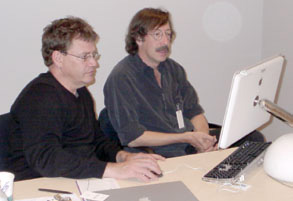
Project creators. Rick Smolan (right) and David Elliott Cohen (left) led the team that pulled off one of the most ambitious workflows to date.
What this meant in practice was, to a certain extent, affected by the sponsor choices. For example, both the servers and workstations were provided by Apple, which led to such workarounds as having to borrow an IBM Linux server at the last minute because the ProFTPd server daemon had problems on the OS X Server platform.
The project was kicked off by a multi-month promotion campaign to get professional and amateur digital photographers to sign up. Smolan’s friendship with Sergey Brinn, co-founder of Google, led to that company’s sponsorship, which brought tens of thousands of photographers to register on the project’s Web site.

The big picture. The America 24/7 project set up a digital workflow to support collaboration by many thousands of pro and amateur shutterbugs during a week-long shoot.
During the America 24/7 week, the contract photographers and other pros uploaded images directly to the project’s servers, while the amateurs uploaded their shots to Snapfish servers. Snapfish is a popular digital-image printing and hosting service that serves more than three million consumers, offering personal online photo albums for image sharing, editing, arranging and printing. For the America 24/7 project, Snapfish not only received the images, but also captured participant-contact information, shoot location and captions through a simple online form.
Selected images were automatically exported with related user data and metadata to a Preclick processor that translated user data and EXIF metadata into IPTC (International Press Telecommunications Council) format. IPTC is an XML schema for image categorization and encoding information such as caption, subject, headline and copyright holder.
Contract Photographers, the Project’s Ringers
In addition to tens of thousands of amateurs, the project contracted with one thousand professional photojournalists to submit up to 250 images each. The pros were each provided with Olympus C-5050 digital cameras (donated for the occasion by Olympus), which create 5.2-megapixel images. Lexar Media CF cards and readers were also provided.
Thousands more professional photographers and photography students registered and sent in up to 50 images each. All of the pros were invited to download Camera Bit’s Photo Mechanic from the America 24/7 Web site to edit and caption their work. Photo Mechanic displays thumbnails in contact-sheet display with controls for layout, size, thumbnail titles, page headers, and footers. It can rotate, preview, copy, delete, tag and rename images, adding IPTC keyword information individually and in batch. (There are about 60 IPTC metadata variables that enable customized workflows and image cataloging.) Photo Mechanic can print contact sheets, export to HTML or pass images to Adobe Photoshop for retouching.
Most of the pros were already familiar with Photo Mechanic. Nonetheless, the project ended up having to get a tweaked version from the program’s author because of the way Photo Mechanic filtered various OS X Open dialogue-box choices based on file permissions-issues that had not been encountered in previous Mac OS versions. Each folder’s permissions were defined on the machine where it was originally created. As a result, it couldn’t be opened when it was moved to an editorial workstation, typically a Mac running OS X. In fact, OS X’s Unix heritage cropped up more than once to get in the way of the workflow the project had put together, largely because no one had anticipated that dealing with Macs would mean dealing with Unix issues.
This article was last modified on January 3, 2023
This article was first published on September 10, 2003
Commenting is easier and faster when you're logged in!

Recommended for you

How to Make a Terminator Robot Effect in Photoshop
Arnold Schwarzenegger’s iconic robotic endoskeleton was a defining feature...

Working with Albums and Collections in Lightroom, Part 2
How to use filters and smart collections in Adobe Lightroom to organize your pho...

Designing A Logo for Every Size & Usage
Designing a typographic logo, or word mark, isn’t as simple as coming up with on...