


The Nike Olympics

The Sydney 2000 Olympics have just begun and already there are the usual grumblings about poor TV coverage, along with reports that viewership is down 25 percent from the Atlanta 1996 Olympics. This year, NBC has decided that the 18-to-21-hour time difference between Sydney and the U.S. is too difficult to schedule, and so no events are being broadcast live. This creates quite an opportunity for the Web to attract a sea of sports enthusiasts happy to surf the lists of the latest winners from pool, gym, and track.
From where I sit, the Web has dropped the ball and blown its opportunity to compete with television. There are plenty of places to find the results of every event long before NBC chooses to broadcast them, but I’ve yet to find any live coverage — not streaming video, not streaming audio, not even a taped replay. There are plenty of interviews and lots of footage prepared before the games began, but the Web isn’t much better than the nightly TV sports casts where this Olympics is concerned.
It all seems to be the fault of the International Olympic Committee (IOC) and its broadcast partner, NBC. The IOC and NBC film everything and maintain very tight control over all of it. The official Web sites of this pair — msnbc.com, cnbc.com, nbcolympics.com, and olympics.com — are without live coverage. There are a couple of Java applets, one written by IBM for olympics.com and the other by Quokka Sports for nbcolympics.com, that give updated results as events happen. But these are numeric data streams that provide no better than crude, disappointing information. Plus, there’s no video.
Frankly, I was really hoping to see badminton and table tennis, two sports I’m particularly fond of but that the networks ignore. I guess I’ll have to wait another four years to find a site that gives me the Olympics I want to see.
The Missed Olympic Moment
It falls short of my Olympic dream, but Nike has created a more exciting Web experience with its World Body site and what amounts to the Nike Olympics. Though Nike hides the URL, you can get to the site by surfing to www.nike.com/2000. Or, from the Nike home page, click on the nike.com/2000 link — the animation in the middle of Nike’s home page. Either way, when you enter the World Body site, you’ll find a sophisticated Flash movie that introduces Nike’s World Body concept, one of the universality of experience, including the Olympic experience.
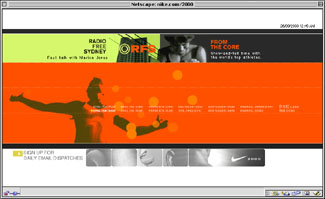
Interestingly, even though Nike is a huge Olympic sponsor, nike.com is not an IOC-sanctioned Web site, so the Olympics are never mentioned by name, and the Olympic logo, with its distinctive five color rings, is absent. Rather than make World Body an Olympic Web site, Nike has created a celebration of some Olympic athletes (Nike-sponsored athletes, one assumes), and has turned this into a celebration of mankind.
Oh, the Humanity!
Impressively, the World Body site and all its content are available in eight languages, including Japanese and Korean. A team from nike.com and its partners at Blast Interactive, in Vancouver, Canada, reports every day from Sydney, and every word is translated eight times before posting. This is a huge task, especially considering the quantity of daily reporting.
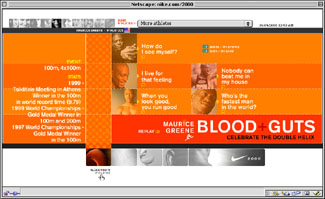
The primary navigation for this site comprises six grayscale images that take on color when rolled over. The images relate to body parts, starting with the Blood + Guts link. The metaphor is perhaps a bit too literal, but Nike’s point is to show real flesh-and-blood athletes rather than to glorify and sanitize the Olympic moment. It’s the equivalent of TV’s “Up Close and Personal” interviews with athletes, but a lot hipper.
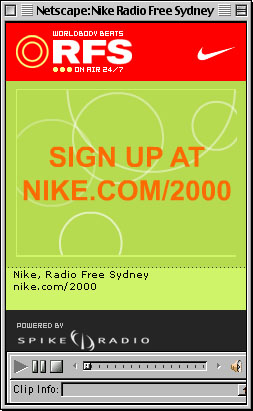
The Ear icon links to Nike’s Radio Free Sydney page, an obvious play on Radio Free Europe that likens the IOC to the organizations that controlled information in the old Iron Curtain countries of Eastern Europe. Where the IOC controls what comes out of the Olympics, Nike presents the real sounds of Sydney — crowd noises, ad hoc interviews, conversations among the athletes, talk in the locker rooms. Remember, this is in-your-face reporting, not the watered-down hyperbole we’re fed on TV.
World Body is an audacious undertaking. It’s Nike’s way of attaching its own brand to the Olympics. Given its tight relationships with its spokespeople, Nike may have a better idea than the IOC of what motivates athletes and how they view the world and the Olympic experience. At the same time, the company has created a site with a classic hierarchy that lets users find information in a logically clear way that encourages browsing. The color scheme is not only stylish, but also consistently used throughout the site. And the World Body metaphor is really quite brilliant as used in the imagery and navigation interface, and as a theme for the content.
Although focusing on the presentation of content, the site is clearly intended to sell product: Though subtle, a little Nike swoosh appears on each page. And for all its openness to political diversity and the brotherhood of man, the site remains a glorification of big-dollar athletes. Such is the present-day reality of Olympic sports, which despite the pressures of commercialization remain tremendously exciting in a way that really does unite people across cultures.
Nike.com’s World Body site is still not my dream Olympic experience, but it is the most creative Olympic site I’ve found and is a truly remarkable Web undertaking. To use a somewhat tired sports cliché, it really does set the bar higher for future sports sites. As for my ultimate dream, I think we’ll just have to wait for greater bandwidth on the Internet and more openness on the part of the IOC before the Olympic spectacle becomes a truly global event for Web viewers.
Creativepro.com welcomes new contributing editor Clay Andres, the author of “Great Web Architecture” and the forthcoming “Great Web Branding,” both by IDG Books. He also operates a Web design firm.
This article was last modified on January 8, 2023
This article was first published on September 22, 2000
Commenting is easier and faster when you're logged in!

Recommended for you
Designing with Gradients
Techniques for enhancing your page designs with attractive color blends.

Why Don’t Arrow Keys Work Next to Blank Fields?
Why are the text formatting fields sometimes blank and don't allow you to use th...

PaperSpecs Webinar Roundup
Among the offerings at PaperSpecs.com, the leading online paper database, is a s...