


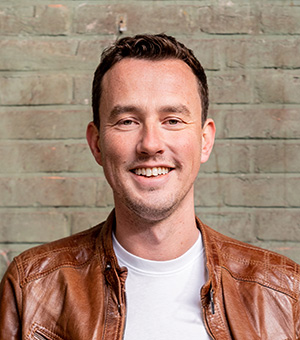
Rob de Winter is an author, speaker, designer, and photographer with a passion for sharing cutting edge techniques.
He’s also speaking at The Design + AI Summit 2025, which takes place November 13–14 online, with a session on Adobe’s latest AI tools.
We thought it would be fun to get to know him better with some Q&A.
You’ve built a career around design and teaching. How has AI shifted your career? Has it changed the way you think about design and creativity?
AI has changed both my teaching and my own design practice. In the classroom, it makes Photoshop (and other software) easier to learn. Beginners can now get past technical hurdles much faster with tools like smart selections, recoloring, and background removal. That gives me more time to focus on the creative side of design, instead of spending hours explaining complex tools and manual steps. Personally, I went into AI with an open mind and simply started experimenting. I loved discovering that a simple sketch could be transformed into a design, or that I could suddenly build my own plugins and scripts for Photoshop and InDesign. It has broadened my world, not by replacing my creativity, but by expanding the ways I can learn, teach, and create.
Many designers feel overwhelmed or skeptical about AI. What’s your best advice for getting past the fear and overwhelm?
I completely recognize that feeling. For many people it’s simply hard to keep up because you’re busy with your daily workflow and don’t have much time to explore new technology. I’m fortunate that teaching gives me sometimes space to experiment (that’s also necessary to be able to teach the newest technologies in the best possible way), but I know not everyone has that luxury.
When you feel overwhelmed, my advice is to start small and treat it like play. Don’t begin with the most advanced tools. Just open something you already have, like Adobe Firefly, and try the Text to Image box. Type in a few prompts, see what happens, and click through the settings or info buttons. You’ll find that it’s often not as overwhelming as it looks from the outside. You don’t have to know everything to start playing.
Also, don’t get distracted by the noise around AI. Headlines often suggest that a new model means “the death of Photoshop” or the end of design as a profession, but that’s just attention-grabbing. Designers are still very much needed. In fact, when a skilled designer uses AI, the results are almost always stronger and more original than what a non-designer could produce. So don’t let fear hold you back, just start experimenting with the tools you already have and see what new possibilities they open.
What do you see as the biggest opportunity AI brings to professional designers today?
One of the biggest opportunity right now is idea development. AI makes it much easier to iterate, create quick moodboards, or, for example, test out different styles or combinations of typography. Even when the direct output isn’t perfect, it often sparks new directions you wouldn’t have thought of otherwise.
Another big opportunity is to expand your skillset. If you are curious about areas like video, motion, or 3D, AI lowers the threshold to start experimenting. You can take your designs and bring them to life in new formats, which opens up different ways to present ideas and connect with clients and audiences. For me, it even led to building my own plugins, something I would not have imagined doing a few years ago.
And maybe most importantly, it gives designers the chance to show their unique value. AI can generate fast drafts, but it is the designer’s eye for quality, non-destructive workflows, and storytelling that turns those drafts into something professional.
When you experiment with AI, where do you get your ideas from? Do you approach it more like play, problem-solving, or something else?
Most of my ideas come from my network. I use LinkedIn a lot, and by filtering through the noise I often spot something that feels genuinely new or promising. That might be a new AI model, a script, or an unusual experiment that sparks my curiosity.
When I try something out, I always start with play. I like to see what the tool can do, without pressure. Over time, as I run into limits or unexpected results, it naturally turns into problem-solving: figuring out which prompts work best, or how to adapt my approach for that specific model. If it doesn’t feel right, I move on quickly, but sometimes there is a moment where I think, “This is interesting,” and then I dive deeper. For me, play is always the starting point, and problem-solving is what keeps it going.
You travel and speak often—do you have a ritual or habit while traveling that helps you stay grounded?
Traveling for conferences always feels intense. At big design events, you suddenly realize how many people know you, while you hardly know them. It’s exciting, but also easy to get carried away by all the attention. What keeps me grounded is coming home to my small village in the Netherlands, where nobody really knows what I do, except one man who works in the local supermarket, and is a photography enthusiast at the same time. We always talk about new developments, lenses, and many other things when I’m getting my groceries. That contrast always reminds me that everything is relative.
In the plane I also have simple rituals: I listen to music on the plane, read novels, books about psychology, research papers, reflect on what has happened, and then sleep. By the time I land, life feels normal again and I’m ready to focus on what’s next.
This article was last modified on October 21, 2025
This article was first published on September 24, 2025
Commenting is easier and faster when you're logged in!

Recommended for you

How Resolution Affects Image Proxy Quality
When working with images into your InDesign layouts, did you ever notice how som...

Celebrating 30 Years of Photoshop
Looking back, it’s easy to see that the year 1990 was a turning point in h...

InDesign Magazine Issue 97: Find/Change
We’re happy to announce that InDesign Magazine Issue 97 (May 2017) is now availa...