

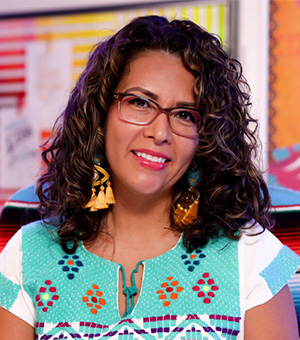
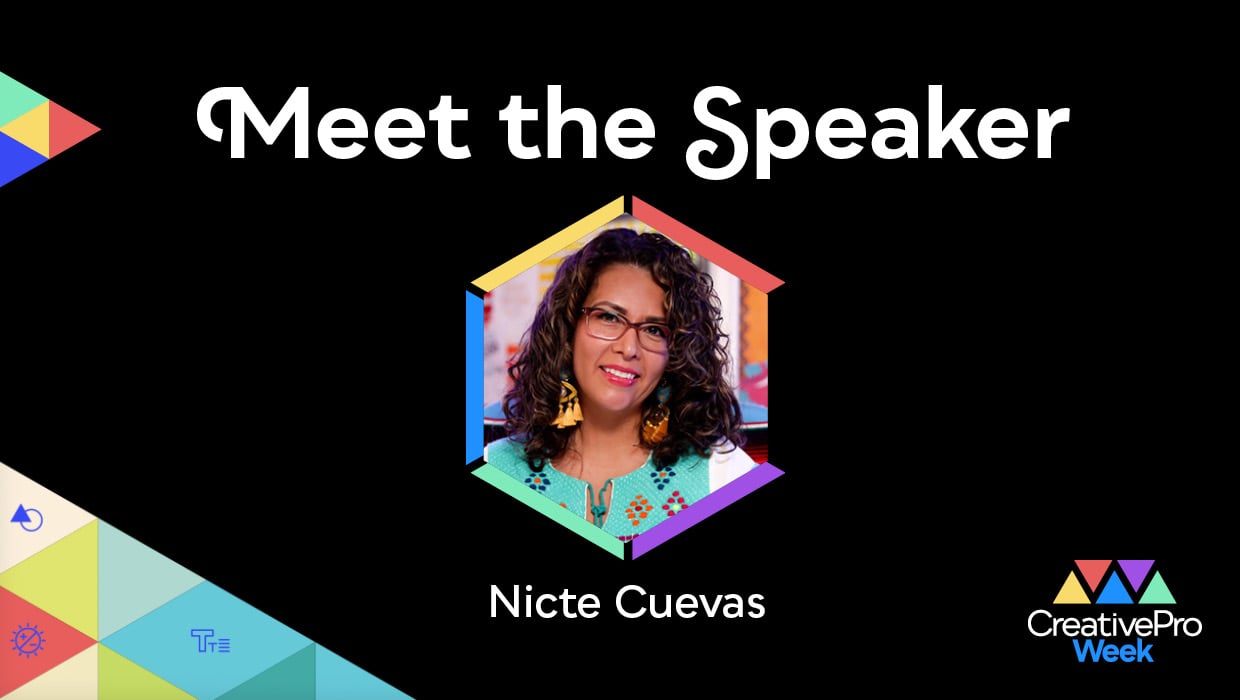
Nicte Cuevas is an award-winning bilingual Brand Strategist and Designer, and owner of Nicte Creative Design. She connects color, culture, and design into a purpose-driven brand strategy for visionary companies.
Nicte is speaking at CreativePro Week 2026, which takes place June 29–July 3, 2026 in Nashville, Tennessee. We thought it would be fun to get to know her better with some Q&A.
You led CreativePro’s 2023 rebrand and are now returning for your third CreativePro Week as a speaker. How has your relationship with this community evolved, and what impact has it had on you as a designer and strategist?
When I led the rebrand, what deepened my connection to the work was that I wasn’t designing for a client I was getting to know—I was designing for a community that I belonged to. Getting to leave your mark on something you’re part of carries a different kind of meaning. It’s not just a project—it’s a legacy. And the people who make up CreativePro, who are generous, brilliant, and the kind of professionals that remind you why this industry is worth showing up for, made that responsibility feel even more personal.
What’s stayed with me since, is watching the brand live and breathe long after the work was done. Every time I attend an event, I see how the team has kept it thriving. And I can still trace how every component connects back to the people it serves and the shared purpose that brings everyone together to learn and grow.
CreativePro has become a place that feels like home. It’s a community where curiosity is welcomed, and honest conversations happen, and where some of my most meaningful professional friendships have formed. Returning as a speaker for the third time isn’t something I treat as routine. Anytime I’m delivering something for this community, I hold nothing back because I believe we all grow through shared knowledge.
I feel honored to speak alongside design legends. And being part of this community continues to sharpen my view of our industry and where the real impact needs to happen.
You’re covering both brand consistency and AI-driven document workflows this year. How do these two topics connect in your day-to-day work?
As designers, we’re often the ones asked to fix what got out of brand control, on top of an already growing list of projects. That mental overload affects our creativity. I’ve seen a big difference in how my team works since we stopped trying to figure out which template went where and built a real brand management system instead. And I apply that same process for my clients. Because here’s the problem: when people don’t have the right design asset, they make one. A new event comes up—a new design is created. A quote graphic is needed—another design is made. Over time, you end up with a mishmash of assets that barely resemble each other. And then I hear what clients keep telling me: “We got bored of the same design, so we made a new one.” The answer isn’t more designs. It’s starting with a system, one that identifies the core needs first, then designing to support them. Each asset stands on its own and still functions cohesively within the brand. They can look different and still be unmistakably the same brand. When that’s in place, teams stop asking “which design do we use?” and start asking how do we use these assets to hit our goals? That shift from cleanup to strategy changes everything.
AI fits into that same thinking. I’m not interested in it for novelty. I’m interested in it because the right tools, in the right places, buy back time. Imagine working on a major campaign or course launch, and you’re pulling from meeting notes, research, data, and marketing goals. Suddenly, you’re staring down hundreds of pages of reference. Finding the one insight you need could take hours. I’ve been testing workflows that cut through that, and internally we’ve reduced production work on our assets by 30 to sometimes 50%. That’s bought us time to focus on areas of the business that were once neglected. And on a personal level, I’m no longer working overtime—I’m spending that time with my family. That matters to me.
You describe your work as building purpose-driven brand strategies. What does that mean to you personally, and how has that definition evolved in your own work?
Purpose and mission get used interchangeably, but to me, they’re not the same. Mission tells you what you’re doing. Purpose is why you keep going when the market gets tough, when you hit a wall, when you need to pivot. The brands with the most impact build from that deeper place. And that’s the standard I hold my own work to.
For me, purpose-driven work reaches beyond aesthetics. I’m not here to make pretty things. I’m here to shape words into visual meaning and build brands that communicate with intention. Color is central to that. It’s not decoration—it’s the thread that connects every piece of a brand into something cohesive. What I see too often is teams producing individual assets in isolation. Each piece gets made, but they don’t come together. There’s no visual harmony because there’s no strategic process to hold them together.
Color, when used intentionally, does that work. It aligns with purpose, carries emotional weight, and creates the kind of visual energy that drives growth and connects with specific areas of a brand story. That’s how my approach has evolved. Early on, I was focused on making things look good. Now, I’m building systems where every visual decision, color included, aligns with the brand and marketing goals.
Your background spans multiple cultures. How does that shape the way you see and build brands?
It wasn’t until I moved to the US that I truly embraced all these beautiful pieces of my cultures that made me whole. Unfortunately, when I was growing up, I often heard my Colombian family say they were better than my Mexican family. This caused me to feel embarrassed about my Mexican heritage for some time, and I didn’t connect with my Colombian side because of what I heard growing up. But when I finally started loving all my heritage, I learned how to honor where we come from in a way that is also welcoming of others.
This philosophy is how I shape brands at the heart—they honor who they are at the core, connect deeply with their ideal customers, and never exclude others at the point of mockery. I see brands as a family home—whoever you invite in, you want them to feel comfortable and leave with good memories.
What shaped your creativity that the CreativePro community might not know about?
I’ve had to pivot a lot over the years to keep my business alive, and when the market is tough, I always try to reflect on how much I’ve grown and remember that I have what it takes to survive and thrive.
I’m a military spouse and have faced a lot of challenges with frequent moves, deployments, and navigating a lot with little family support. I started my business two weeks before my husband got a short-notice 6-month deployment.
I built my business foundation in the middle of fear—not business-building fear, but fear for his safety and for where he was (we had no communication for a month at one point and he had to make a long line to use Skype for 15 minutes). I navigated all of this while learning the military lifestyle and how to start a business.
A few years later, when my son was born three months early, he spent nearly four months in the NICU and had several life-saving surgeries. I had to learn how to run my business from my mobile phone because no laptops were allowed. All of these experiences have made me incredibly resilient, calmer in chaos, strategic with resources, and well, really good at packing and unpacking our household goods.
This article was last modified on July 6, 2026
This article was first published on May 16, 2026
Commenting is easier and faster when you're logged in!

Recommended for you

Ten Ways Dungeons & Dragons Has Made Me a Better Graphic Designer
I had always been curious about Dungeons & Dragons, but I didn’t start playi...
InPerson: Roger Black
David Blatner caught up with world-renowned designer and font entrepreneur Roger...

TypeTalk: The Typographic Expressions of Stefan Sagmeister
Stefan Sagmeister is an award-winning designer known for his bold, innovative wo...