


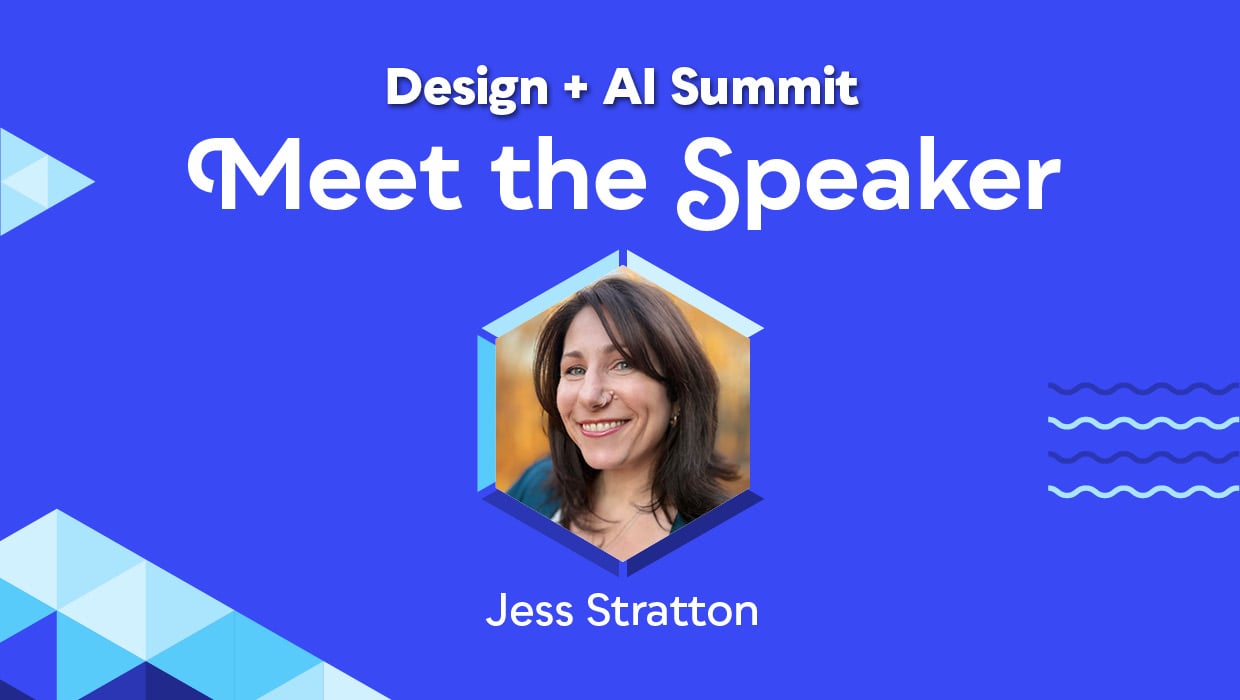

Jess Stratton is a technology coach, TEDx speaker and frequently requested live trainer, presenting on topics such as Microsoft 365 and Copilot, Google Workspace, and productivity tools.
She is speaking at the Design + AI Summit 2026, which takes place online September 17–18, 2026. We thought it would be fun to get to know her better with some Q&A.
You’ve spent much of your career helping people learn new technology. How do you help them move from feeling overwhelmed or intimidated to feeling empowered?
I always start by validating their feelings! This is brand new technology that changes in a finger snap with outdated documentation everywhere, so of course they are going to feel overwhelmed or intimidated. Even I feel that way sometimes! My instructional design experience helps me create a natural learning progression, so by the end of the course, people often realize they are far more comfortable with the technology than they expected—and that realization is incredibly empowering. They have a great sense of accomplishment for finally tackling something that they’ve been meaning to for awhile.
You are presenting Copilot and Creative Workflows Across Microsoft 365 at the Design + AI Summit. What do you hope attendees will feel more confident about after your session?
I would like them to walk away feeling like they can use Copilot as a natural part of their everyday workflows, whether it’s researching new design techniques, answering questions about a current project objective, or using Copilot to help with design assistance. There are concrete ways to get better, more targeted responses, and I’ll be giving examples of those during the session so they can become habit-forming.
There can be a lot of pressure to use AI simply because it is available, or even to use it for everything. How do you decide which parts of your work are worth handing off to AI and which ones you want to keep for yourself?
Yes! This is so important. The pressure is real, and it’s constantly reinforced every time you scroll through LinkedIn. One very important aspect I try to drive home during my training is not to give into that pressure. AI is there to assist you with tasks you have trouble with; not tasks you enjoy doing or are already efficient with. I love to write, so I very rarely use AI to draft text. Sometimes it’s not so professional, so I use it occasionally to refine a paragraph that could be written better, for example to make sure training objectives are written in active voice. Do you have trouble staying organized? Use AI to for that. Do you create all your own images? Don’t feel like you need to use AI for that. Do you need some inspo? AI can help! It’s all about personally recognizing where it can help you.
Many creative professionals don’t think of Microsoft 365 as part of their creative toolkit. What might they be overlooking?
Microsoft PowerPoint has come along way in the past three years. Microsoft Copilot has completely changed in the past three months! These apps are serious productivity tools that are easy to use and can produce amazing output. PowerPoint presentations can be edited directly with Copilot, so if you don’t know how to use PowerPoint that well, you can just ask Copilot to do it instead. There’s also no longer a need to keep track of a company’s brand files: They can be incorporated directly into a brand kit for easy presentation creation. I’ll be showing that, along with better and more concise ways to ask for what you are looking for.
In addition to coaching new teen drivers, you also like to do motorsports yourself. What do you love most about motorsports, and where did that passion begin?
Aside from the fact that driving manual transmission cars is so much fun; I love the mental aspect of it. Track and autocross events are puzzles to solve. The shortest point around a course is not necessarily the fastest—it’s all about turning curves into lines. There’s also so much physics involved when it comes to weight transfer and how that affects how a car turns and stops. In short: it’s a sport that is perfect for us nerds! I got into it when I bought my first MINI Cooper. It was a 2002—a first-year production of the new refreshed model. I went to a fund-raiser autocross event and got hooked.
As designers, you’ll all appreciate this one—I just got a brand refresh, and my logo was thoughtfully designed to include motorsports aspects. The logo fonts are motorsports-inspired, and even the circle around the logo has a slight pattern that’s a subtle reference to a tire tread.
This article was last modified on July 17, 2026
This article was first published on July 17, 2026
Commenting is easier and faster when you're logged in!
Recommended for you

InDesigner: Seattle Met Magazine
Pam Pfiffner takes a look behind the scenes at Seattle Met magazine.
Interview with Karen Larson, Brand Strategist and Artist
Discover how Canva can fit into impactful, professional workflows.
Better first proofs. Fewer review rounds. Introducing PreProof™
Most designers are already familiar with Preflight — checking a document for tec...