


Illustrator How-To: The Art of Creating Sumi-e


If you were to take a painting of a subject, remove all color, shadows, highlights, the background and all lines that don’t have any movement or necessity, what you have left is artwork called Sumi-e. In Japan this is defined as black ink painting.
The Sumi-e style of art, shown in figures 1 through 3, was carried to Japan from the Zen priests of China in the 13th century and has now become a worldwide art form. Using rice paper and sumi ink, usually after meditation, Sumi-e artists begin to paint. They paint only the strokes of the subject that move or are alive. In this article, we’ll look into the world of Sumi-e and see how you too can create similar artwork using the computer.
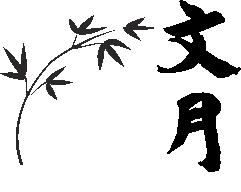
Figure 1
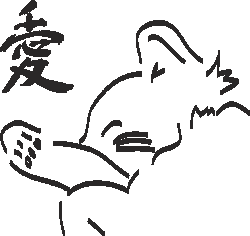
Figure 2

Figure 3
Step 1: Select the paper. Traditionally, this technique is done using a special hand-ground ink and rice paper. Because we’ll be re-creating this technique on the computer, you can use regular printer paper or experiment with printing on different textured papers for a much more natural approach.
Step 2: Meditate. After selecting your paper, if you want to really get in touch with the cultural aspects of Sumi-e, take some time to relax and meditate. Traditionally, the meditation process is done while grinding the ink. But, because our ink is all ready to go, this step isn’t required.
In any case, meditation is an important step in creating Sumi-e. By sitting and blocking out all that’s around you and thinking only of your subject, you can begin to imagine your painting and how it will flow.
Step 3: Begin to paint. Once you’re relaxed and focused on what you’re going to paint, launch Illustrator. Create a new document to work on. Then select the Paintbrush tool and choose a nice round or oval brush to work with. The brushes highlighted in light yellow in figure 4 work well for this technique. Figure 5 shows a simple stroke we created with each brush.
Once you’ve decided on a brush, use sweeping strokes to create your artwork. Focus on the motion strokes that appear in your mind as essential. It’s important to not work on any detail. The goal of Sumi-e is to evoke the emotion and spirit of the subject. The painting should be free from shadows and highlights so as to set it apart from any time or place and capture only the subject in its timeless, basic form.
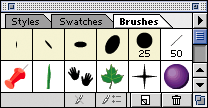
Figure 4

Figure 5
Step 4: Add color. When your painting is complete, try adding a little bit of color. Although many traditional Sumi-e paintings are black and white, some do include splashes of color. For example, in figure 6 we made some of the leaves green. Experiment a bit and see what works with your image.

Figure 6
Step 5: Include Japanese writing. Another common element found in Sumi-e paintings is Japanese writing. You can include this in your imagery as well. If you aren’t sure of any symbols or how to write in Japanese, you can find many examples online or even in clip art books. Just trace the symbol in Illustrator using the same techniques used to create your imagery and place it to the side of your image, as we did in figure 7.
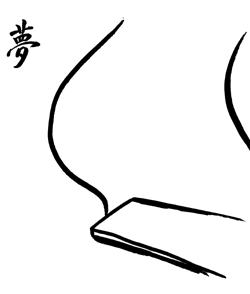
Figure 7
The Sumi-e Society of America
If you’re interested in seeing beautiful Sumi-e paintings, check out the Sumi-e Society’s Web gallery. The Society was created in New York by Professor Motoi Oi to foster and to encourage an appreciation of oriental brush painting. This is a great support base for anyone from the beginning Sumi-e artist to the professional. Their Web site is located at www.sumiesociety.org. They have links to local chapters, exhibits and further information on Sumi-e painting.
This story is taken from “The Design Authority” (Element K Journals).

Creativepro.com readers can subscribe to Element K Journals at a discount. Click here to learn more.
This article was last modified on January 3, 2023
This article was first published on December 20, 2002
Commenting is easier and faster when you're logged in!

Recommended for you

Neenah Swatchbook Gives You Multitude of Packaging Options
Press Release Packaging papers are nothing new to Neenah Paper. What is new is t...
A Faster Find Change
Learn the fastest way to use the Find Change feature in InDesign with these two...
Free Script Identifies Word Stacks
At the 2015 Print and Electronic Publishing Conference (PePcon) last week, the I...