

Members Only

Designing with Adobe Stock

Conrad Chavez shows how CC Libraries give Adobe Stock key advantages over other sources of imagery.

This article appears in Issue 82 of InDesign Magazine.

A new dividend from Creative Cloud

Adobe recently created the new Adobe Stock service by combining their recent acquisition of the Fotolia stock agency with Adobe Creative Cloud. Adobe took the time to rethink how a stock image service could work within a cloud-driven production workflow involving Adobe applications, and this gives Adobe Stock certain unique advantages. Using any service’s stock photos in Adobe InDesign is not much of a challenge; just download the images and place them. How could it be any better? For Adobe, the answer was in using its Creative Cloud Libraries (or CC Libraries) to simplify how you try, buy, store, and import stock images. You can buy Adobe Stock images individually or as part of a subscription plan; as I write this, Creative Cloud subscribers get a discount on the 10-images-a-month plan. To see this integration in action, we’ll use a sample InDesign document that’s a fictitious electronic newsletter (Figure 1), like the kind that a health care provider would send to its members.
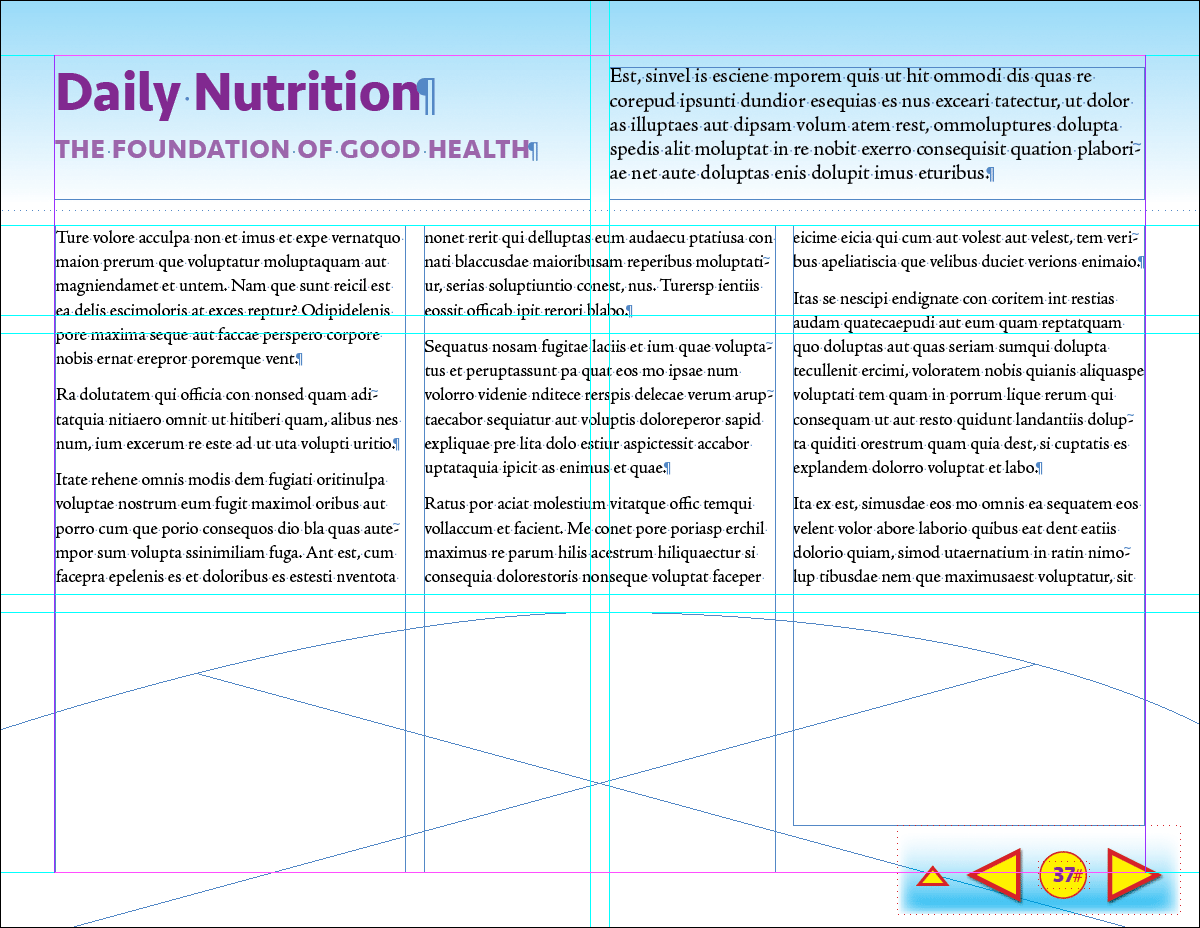
Figure 1: This newsletter story needs a graphic to go in the placeholder frame at the bottom of the page.

Figure 1: This newsletter story needs a graphic to go in the placeholder frame at the bottom of the page.

The layout is coming together, but it needs an image for the first page of an article on good nutrition. Let’s see what Adobe Stock can do.

Find the Right Image

The usual way to find stock images is to visit a stock agency’s website in your web browser, search the  site for the images you need, and download them. If you’re using Adobe InDesign CC, you can find Adobe Stock images without leaving InDesign, because Adobe Stock is built into the

CC Libraries panel (Figure 2).
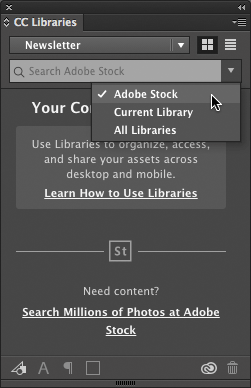
Figure 2: You can add Adobe Stock graphics or your own content to the CC Libraries panel, which is accessible from other InDesign documents and CC applications.
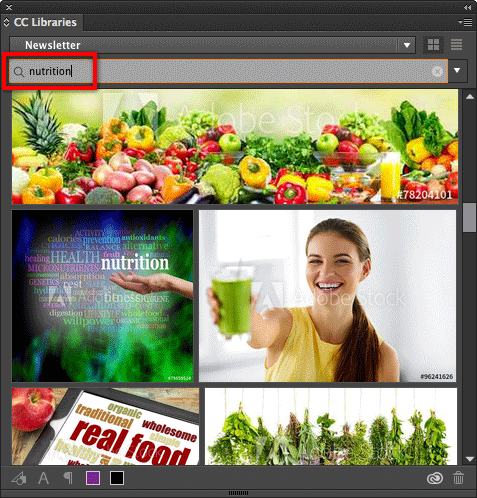
Figure 2: You can add Adobe Stock graphics or your own content to the CC Libraries panel, which is accessible from other InDesign documents and CC applications.

To find an image, type a keyword like “Nutrition” into the Search Adobe Stock field at the top of the CC Libraries panel; you don’t have to press Enter or Return. (If the search field doesn’t say Search Adobe Stock, click the triangle to the right of the search field, and choose Adobe Stock.) The CC Libraries panel fills with Adobe Stock search results (Figure 3). You can see more at the same time if you enlarge the panel.
Figure 3: Enlarging the panel shows more search results at once.
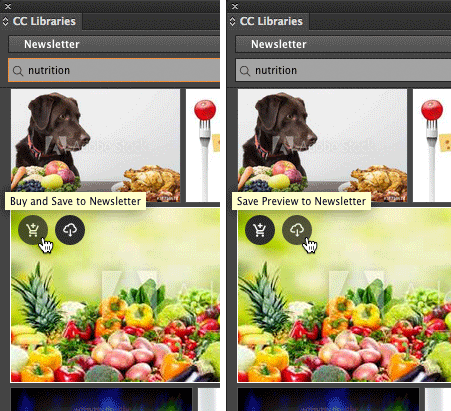
Figure 3: Enlarging the panel shows more search results at once.

These search results haven’t been added to your CC Libraries yet. As you move the pointer over each image, you see two icons. The shopping cart icon means “Buy and Save to (the active library)”; the cloud icon means “Save Preview to (the active library)” (Figure 4).
Figure 4: To download a preview to your CC Libraries panel, click the second icon. Click the first icon only when you’re ready to buy an image license.
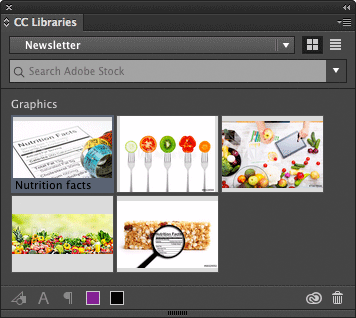
Figure 4: To download a preview to your CC Libraries panel, click the second icon. Click the first icon only when you’re ready to buy an image license.

Because Adobe Stock saves to the active library, before you save any images be sure to check the top of the CC Libraries panel to see which library is active, and change it if needed. (Though you can always copy or move the image to another library later, if you need to, by right-clicking the library item and choosing Move to or Copy to.) Alternately, if you want to create a library for the current project, click the pop-up menu at the top of the CC Libraries panel, and choose Create New Library. After you name the new library and click Create, it becomes the active library. In the search results, when you see an image you want to try, click the cloud icon to save a preview to the current library. In our example, the image is saved to my Newsletter library (which I created and selected in advance). The preview is a watermarked, low resolution, for-position-only (FPO) image. Previews are free, so download as many as you like, especially if you need to present alternatives for approval by your art director or client. I chose several candidates for my layout (Figure 5).
Figure 5: My candidates for the story image.
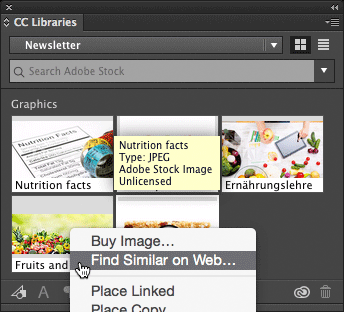
Figure 5: My candidates for the story image.

Searching Adobe Stock in the CC Libraries panel isn’t a perfect process. A limited number of search results are shown; when you get to the end, a “See more results on the web” button appears, and clicking it switches you out of InDesign and into your web browser. Sometimes I download a duplicate of a preview I already have because the CC Libraries panel can’t show search results and existing library items at the same time. And after you download an image, it doesn’t remember recent searches if you want to find more images using the same terms. One thing you can do to find more images is to right-click an image in the CC Libraries panel and choose Find Similar on Web (Figure 6). This jumps from InDesign to your default web browser, displaying the new search results on the Adobe Stock website.
Figure 6: Close but not quite? Right-click an image, and choose Find Similar on Web.
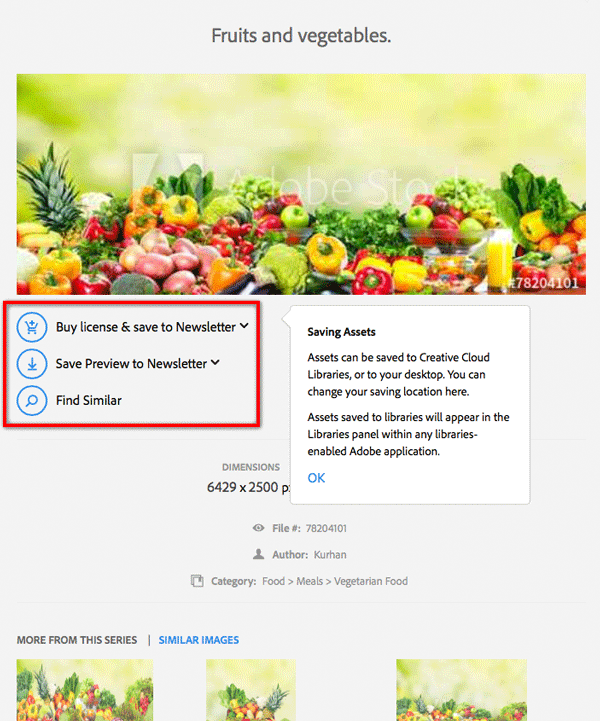
Figure 6: Close but not quite? Right-click an image, and choose Find Similar on Web.

Fortunately, when you jump from the CC Libraries panel to the web, you’re usually automatically signed in to the Adobe Stock website with your Adobe ID—so from your web browser you can save images directly to one of your libraries or to your desktop (Figure 7). When you switch back to InDesign, images you saved from the Adobe Stock website to a library now appear in the CC Libraries panel.
Figure 7: It’s just as easy to add images to libraries from the Adobe Stock website.
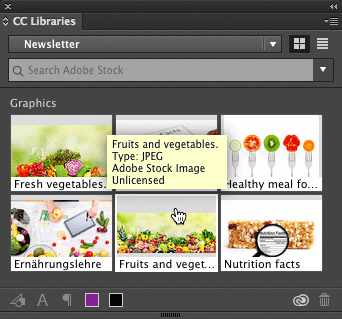
Figure 7: It’s just as easy to add images to libraries from the Adobe Stock website.

Tool tips in the CC Libraries panel provide useful information about Adobe Stock images, such as their licensing status (Figure 8).
Figure 8: A tool tip provides information about the image under the pointer.

Figure 8: A tool tip provides information about the image under the pointer.

Try It

You can drag any image out of the CC Libraries panel to load it in your Place cursor (which lets you place it in your InDesign layout). I had already created a placeholder graphics frame for the image, so for me it was faster to select the frame, right-click the image in the CC Libraries panel, and choose Place Linked (Figure 9).
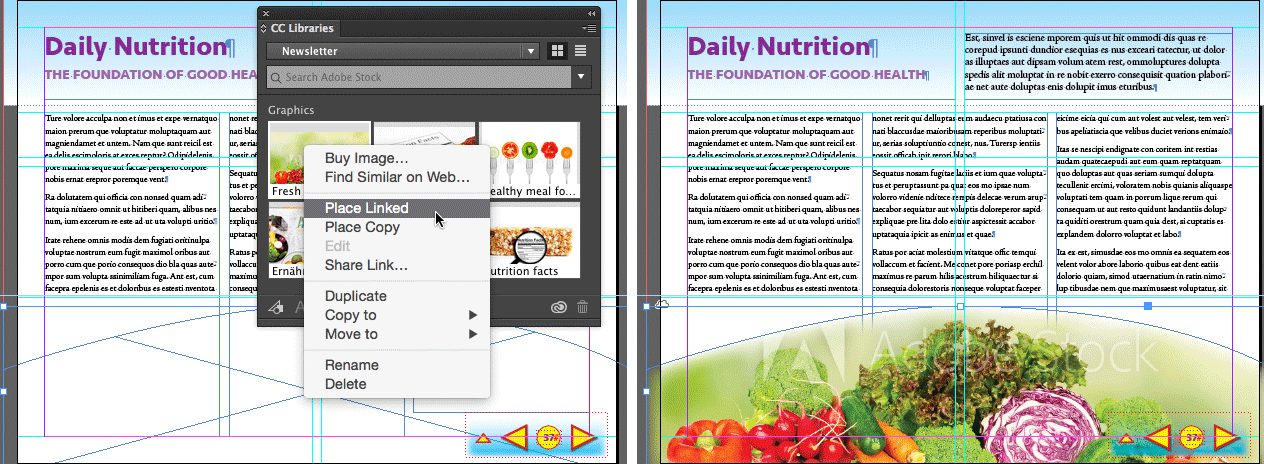
Figure 9: Right-click an Adobe Stock image (left) to place it directly into a selected frame. The frame then displays a cloud icon (right).

Figure 9: Right-click an Adobe Stock image (left) to place it directly into a selected frame. The frame then displays a cloud icon (right).

That places the image directly into the selected frame. After the image is in the layout, you can work with it the same way you would with any placed graphic; for example, you can resize it or crop it. If you use Adobe Stock images in an InDesign document and package the document, the Adobe Stock images will be included. But if you haven’t licensed the images, the package will include only the watermarked low-resolution previews.

Inspect It

You might notice a few subtle differences between a placed Adobe Stock graphic and a graphic you place from local storage. For example, instead of seeing a link icon at the edge of the graphics frame, you see a cloud icon to remind you that the graphic is linked to a Creative Cloud library (Figure 10).
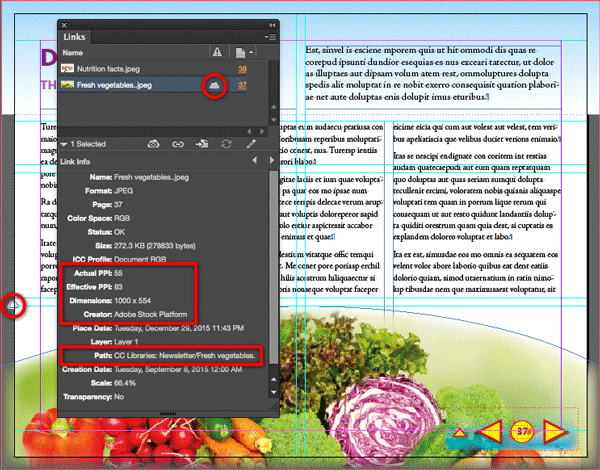
Figure 10: A cloud icon on a graphics frame tells you that the graphic is linked to a CC library, and the Links panel displays the metadata for a selected Adobe Stock image.

Figure 10: A cloud icon on a graphics frame tells you that the graphic is linked to a CC library, and the Links panel displays the metadata for a selected Adobe Stock image.

You’ll see more differences if you open the Links panel and select the image to see its link information and metadata. For example, the Path entry leads to CC Libraries instead of local storage, and the PPI (resolution) and Dimensions are low when you select an Adobe Stock preview instead of a licensed image. You also can’t use the Edit Original command with an Adobe Stock image unless you copy it locally (see “The Local Option” below).

Careful with color

I should warn you that there is currently a problem with Adobe Stock images that could, in some circumstances, make them appear incorrectly on screen. It’s a color management problem, so it is kind of technical, but the quick version is that the unlicensed (preview) images don’t seem to have embedded ICC profiles—or if they do, InDesign can’t see them. Therefore, the Links panel reports that the ICC Profile of an unlicensed (preview) Adobe Stock image is Document RGB, which means InDesign displays that image’s colors using the same profile assigned to the InDesign document. And even though licensed (paid) Adobe Stock images do contain embedded sRGB profiles, for some reason the Links panel still reports them as Document RGB (this is probably a bug and may be fixed by the time you read this). Fortunately, you probably don’t have to be concerned about any of that if the RGB profile assigned to your InDesign document is sRGB, as it is by default for many InDesign installations (Figure 11).
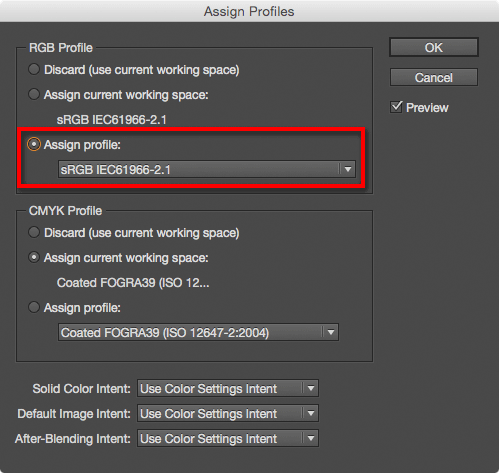
Figure 11: The RGB document profile assigned to this InDesign document (in Edit srcset=

Assign Profiles) is sRGB, so Adobe Stock image colors should appear as expected.” width=”499″ height=”473″> Figure 11: The RGB document profile assigned to this InDesign document (in Edit > Assign Profiles) is sRGB, so Adobe Stock image colors should appear as expected.

But be aware that if you change the InDesign RGB document profile to something other than sRGB (such as Adobe RGB), colors of Adobe Stock images may not appear as expected. In that case, if you want the colors of Adobe Stock images to appear more accurately, you can assign sRGB to them. Select an Adobe Stock image on the layout, choose Object > Image Color Settings, choose sRGB from the Profile menu, and click Choose. Unfortunately there is no quick way to do this to all of them at once, so you must manually select each Adobe Stock image in the document.

Buy It

After you settle on a final image, you can buy a license for it. If your library contains many more Adobe Stock images than you used in your InDesign document, you can use the Links panel to make sure that you pay for only the images you actually used. In the Links panel, select an Adobe Stock image, and choose Reveal in CC Libraries from the Links panel menu (Figure 12), which selects the image in the CC Libraries panel.
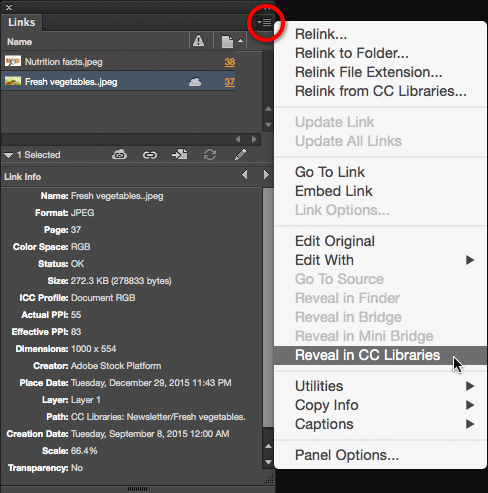
Figure 12: The Reveal in CC Libraries command shows you where a cloud-linked document item exists in your libraries.
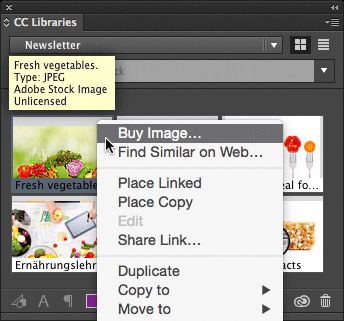
Figure 12: The Reveal in CC Libraries command shows you where a cloud-linked document item exists in your libraries.

Because you selected that image from the document, you know it’s safe to right-click that image in the CC Libraries panel and choose Buy Image (Figure 13).
Figure 13: To license an Adobe Stock image, right-click it in the CC Libraries panel, and then choose Buy Image.

Figure 13: To license an Adobe Stock image, right-click it in the CC Libraries panel, and then choose Buy Image.

If you have an Adobe Stock subscription, the entire transaction happens in the CC Libraries panel. If you don’t have a subscription, you’ll jump to the Adobe Stock website to complete payment. After you buy an image, all linked instances of the image that you added using the low-resolution preview version are automatically updated to the high-resolution version, and the watermark goes away (Figure 14).
Figure 14: After purchasing the image license, the high-resolution version looks great and the watermark is gone.

Figure 14: After purchasing the image license, the high-resolution version looks great and the watermark is gone.

The Local Option

Earlier I mentioned that you can save Adobe Stock images locally; here’s how. Select any or all of the Adobe Stock images in the Links panel (remember, they all have cloud icons), right-click any of the selected images, choose Copy Link(s) To (Figure 15), select a local folder or drive, and click OK.
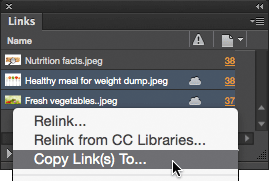
Figure 15: To save library-linked Adobe Stock images locally, right-click one or more of them in the Links panel, and choose Copy Links To.

Figure 15: To save library-linked Adobe Stock images locally, right-click one or more of them in the Links panel, and choose Copy Links To.

InDesign copies the images to the location you chose and updates the link path to match. The cloud icons disappear, because the images are no longer linked to your Creative Cloud library. You’re now working as if you placed those images from local storage. In fact, it’s possible to work with Adobe Stock images without going through Creative Cloud libraries at all. Use your web browser to go straight to the Adobe Stock website, sign in, download previews and licensed images straight to your local drive, and place them in your InDesign layouts as you do with other images. This is also how you’d use Adobe Stock images if you’re using a version of InDesign earlier than InDesign CC, because those versions can’t use Creative Cloud Libraries.

Stock Up on Graphics

Adobe Stock isn’t just about photographs; you can also use Adobe Stock to find illustrations and vector graphics. (Adobe Stock also has video, although as I write this, importing video to InDesign from the desktop works better than adding video from the CC Libraries.) If Adobe Stock has the media you need, its integrated searching, storage, and billing makes it the most seamless stock service to use with InDesign and other Adobe Creative Cloud applications.

Bookmark
Please login to bookmark Close

Not a member yet?

Get unlimited access to articles and member-only resources with a CreativePro membership.

Become a Member

Comments (1)

Leave a Reply

Your email address will not be published. Required fields are marked *

Loading comments...