



I Won’t Give It Back
Nikon shipped a prototype Coolscan LS4000 scanner to me last summer as part of an arrangement that involved my creation of the help system for the software. I started the thing up, and the software crashed immediately: It was early alpha software, the explosive stage before the still-dicey beta.
Over the months that followed, Nikon software engineer Steve Fuchs sent new versions of the software. Each time the new software arrived I was excited, because Steve would have “turned on” another feature or two in the scanner. One day the manual focus function worked, and I was elated. A few weeks later the Curves and Levels controls worked, and I was able to make a few good scans from nice originals.
Toward the end of the development cycle, with most of the help system complete, Steve sent an almost-beta copy of the software. All features were now working, he noted, including ICE, GEM, and ROC. I installed it and went to work testing and documenting the ASF technologies.
With the prototype software finally working, I returned to my old shoebox of family slides and dug through it to find some good candidates for testing Digital ICE-cubed (I had raided the box once to come up with two samples we used at ASF to try out ROC). I found some seriously faded glass-mounted slides taken by my father in the 1940s. I unmounted them and scanned the film. And, to put ICE to the test, I did before-and-after tests, as we had done at ASF.
The slides were made with Kodachrome film, which tends to “fade” to black and also shift to a brownish color over time. Underexposed Kodachromes seem to have faded more than those with “normal” exposures.
On my first attempt, I scanned a photo of a Douglas DC-3 airplane bearing United Airlines markings. My father rode on this plane in 1942 to reach Antofogasta, Chile, where he was stationed to defend that country’s copper mines and sea port. The original image is so dark that it’s almost unintelligible.
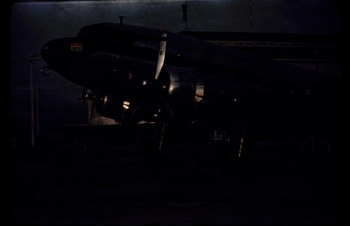
A conventional scan of discolored 1940s Kodachrome slide
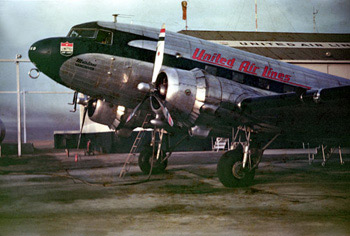
Scan with Applied Science Fiction’s ICE-cubed technology
Without ICE, ROC, and GEM, the scanned image is similarly unintelligible — no surprise. But, when I turned on these features, the magic of ASF technologies combined with the Nikon scanner’s optics and sensors became evident. Like turning straw into gold, the image popped up on my screen looking completely different. Words like “stunning” and “unbelievable” were racing through my head. The truth is that the images are very good and usable with this technology; without it the images are hopeless.
A Good Team
Nikon has incorporated a very bright LED in this new scanner, and matched it with a very-high dynamic range CCD sensor array (they claim a Dmax of 4.2). This dynamic range allows the scanner to penetrate the darkest parts of faded Kodachromes or the high density of duplicating films without overexposing highlight information.
Minolta also has two scanners on the market with embedded ASF technology. The Dimage Scan Elite has Digital ICE (scratch and dust removal). The Dimage Scan Multi II has both ROC and GEM, but not ICE. Applied Science Fiction’s Mike Conley explained that manufacturers can implement ROC and GEM with software modifications, whereas ICE requires changes in hardware, which must be carefully mated with the software to work effectively.
Maybe They’ll Forget I Have It
When you write and consult about technology for a living, you see a lot of products and technologies, and after a while it’s only natural to become a little jaded. But even the most hype-hardened photographers are likely to find themselves wide-eyed when seeing ASF’s ICE-cubed technologies work their magic. With manufacturers such as Nikon and Minolta integrating ASF technologies into their scanners, chances are good that you’ll benefit from this impressive technology either directly or indirectly in the not-so-distant future.
This article was last modified on January 18, 2023
This article was first published on March 1, 2001
Commenting is easier and faster when you're logged in!

Recommended for you

Sleuthing With Snippets
Mike encounters a strange Story Editor symbol from the Far East, uncovers its id...

InDesign How-to Video: How to Bring the Control Panel Back and Keep It
In this week’s InDesignSecrets video, Anne-Marie Concepción explains what happen...

Using Neural Filters in Photoshop
This AI production sports some superstars and a few not quite ready for primetim...