



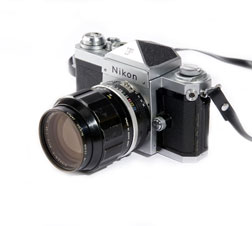
6804136. That’s the serial number of my first Nikon F camera, purchased new in 1968 when I was a senior in high school and that number is imprinted in my memory (see Figure 1). It was my first professional camera, and I used it for years to record images all over the world. I still own it and will never, ever sell it.
 Figure 1: 6804136
Since that first Nikon, I have owned perhaps a dozen other Nikon cameras, small and large, and have come to love them as working tools that give me the technological edge in image-making.
With the move to digital cameras, I bought a Nikon D1, the first professional digital from that company, and then a Nikon D1X, my current working camera (see Figure 2). The D1 was imperfect, but a good first effort, and the D1X is spectacular. I use it nearly every day. The D1 and D1X both feature a CCD sensor that is slightly smaller than the normal frame area of a 35mm camera (24 x 36mm); this results in a “lengthening” of all lenses by a factor of about 1.5. To counter this effect, Nikon has made some impressive wide-angle zoom lenses. The first was the 17-35mm, and more recently the 12-24mm. With these extremely wide zoom lenses, the smaller-than-normal sensor issue is essentially moot.
 Figure 2: My Nikon D1X professional digital camera fitted with a 60mm macro lens.
When, in 2003, Canon introduced the EOS-1DS, with a full-size sensor, and oodles of resolution, I expected Nikon to follow quickly with a response. A full-size sensor Nikon was inevitable, as Nikon and Canon have always been at parity when it comes to professional cameras.
But, Nikon didn’t respond, and through 2003 I noticed more and more white lenses in the pits at sporting events, indicating that professional photojournalists were switching to the Canon digital cameras (Nikon’s really long lenses are mostly black). At this year’s Photo Marketing Association convention in Las Vegas, I again expected new announcements. Canon showed the Mark II version of its pro digital camera, and Nikon and Canon both were showing their latest consumer cameras — the Canon Digital Rebeland the Nikon D70. Still no full-size sensor camera from Nikon. I was disappointed, but I still love my D1X.
Opportunity Clicks
I was recently given an opportunity to test a Canon EOS-1DS professional digital camera and several lenses for that camera. I accepted the offer and started shooting. It was lucky that in the two-week window I had to test the Canon I had two air-to-air photo assignments, and about 50 studio photos to take for some documentation I am producing.
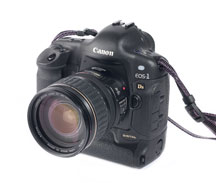 Figure 3: The Canon EOS-1DS professional digital camera equipped with 28-135mm lens.
We Nikon guys have always held that the Canon camp does everything backward. Whether or not it was true, their lenses seemed to go on the wrong way, focus the wrong way, zoom the wrong direction, and so on. It seemed heretical to put a lens on a camera clockwise!
The EOS-1DS proved this axiom to be essentially correct for this Nikon user, but I quickly learned how to zoom and focus, and I was almost unaware of the lens mounting-dismounting issue within a few minutes. I discovered that it’s no big deal which way you turn a lens — especially when the lenses work so well.
The Canon’s menus are clear and easy-to-read. Controls are logical and work as expected, and the camera creates huge digital images — just over 31 MB each when opened on the computer.
I spent Monday afternoon of the second week bouncing around the sky above Mojave, California, wedged in the back of a Beech Duchess twin-engine plane (no door, no safety harness), trying to photograph an experimental jet flying 100 feet off my port side. Turbulence hampered my ability to position myself for good photography, but the camera behaved perfectly when I could get a moment to shoot.
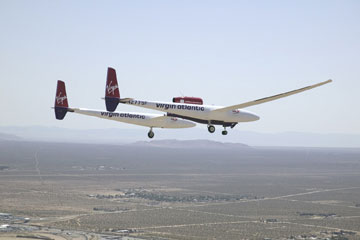 Figure 4: The Virgin Atlantic GlobalFlyer photographed with the Canon EOS-1DS over Mojave, California.
I also had my Nikon D1X aboard, and I tried to shoot with both. My idea was that I could shoot equivalent photos on both cameras and compare them. No luck on that front, but what was interesting was that I was suddenly bicameral – I could shoot with both cameras alternately without any difficulty. The controls had become familiar enough that the minor differences in their operation vanished.
Tuesday through Thursday found me and my collection of cameras in my small studio, a space that alternates between serving as a garage, a woodshop, and a photo studio. I switched back and forth between the various devices at hand, and used them with equal ease. Several times I had to read the Canon manual to learn how things worked in detail. The resulting images are excellent, and I really like getting higher-resolution images from the Canon camera.
Look and Feel
The Canon looks like a brute of a camera — just as the Nikon D1X does. I don’t carry big, heavy cameras for looks; I carry them because they are made out of metal. A metal camera will sustain the bangs and bruises that I put cameras through. I’ll put up with several pounds of camera if it will survive. Obviously the Canon qualifies on this standard. The Canon feels nice; it has properly positioned controls and ergonomically correct buttons. This camera has the feel of a precision machine. I am quite impressed with its design and feel in my hands.
There is no difference between the Canon and the Nikon in terms of usability. Both cameras are seasoned tools, ready to go to work in cold, damp, dusty, windy, rugged conditions. They also work well on nice, warm spring days where nothing can go wrong. Canon’s LCD panels, on the back of the camera, are more prone to damage from normal wear-and-tear than the Nikon. I speak from experience here. I carry my camera on a shoulder strap, hanging either off my shoulder or around my neck.
When on my shoulder, the camera hangs dangerously close to the Killer Rivets that Levi’s attaches to blue jeans (the official uniform of the professional photographer). These copper rivets will destroy an LCD panel very quickly.
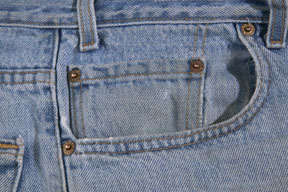 Figure 5: Levi’s jeans with Killer Rivets – brass points that will scratch your camera’s LCD panel.
Nikon, with years of experience making journalists’ cameras, planned for this by adding a set of notches on the back of their D1 and D1X cameras to hold a protective cover plate. Canon, with years of experience making journalists’ cameras, seems to be oblivious to the potential damage that a pair of jeans can do.
On both of my Nikon digital cameras I have mounted a Mr. Hoodman clear plastic LCD protector (See Figure 6), and boy have those gotten scratched (saving the LCD underneath)! This is good design on Nikon’s part, and I wonder why Canon has not matched this feature.
 Figure 6: My D1X, sporting its Mr. Hoodman protective LCD cover plate. (Notice the scratches!) It’s eazsier to replace the Hoodman than an LCD screen.
The Missing (eye)Piece
On Friday of the second week I bumped into my friend Don Kelsen, a photographer for the “Los Angeles Times.” Don was a longtime Nikon photographer, so it was something of a surprise to see him carrying two Canon 1DS cameras. After a few minutes of chitchat, I said, “You know what I hate about the Canon?”
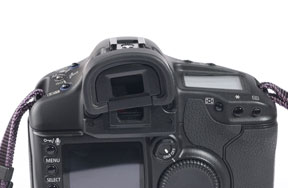 Figure 7: The viewfinder on the Canon 1DS comes off far too easily. I lost it on the first day.
I reached for one of his Canon cameras to point to the viewfinder eyepiece (my least favorite feature). I was going to tell him that I hate how the viewfinder comes off so easily. I was going to tell him how, within minutes of having the camera, the eyepiece fell off (pushed by the change pocket on my jeans below the Killer Rivets). But, Don’s Canon had no eyepiece! He had lost it long before this day. The far-too-easily removed part on the back of the Canon is an inexcusable design flaw in my opinion. If I end up getting a Canon, I will super-glue that in place to prevent its quick departure (or maybe I’ll just lose it and be done with it).
Image is Everything
Beyond look-and-feel, the images captured with the Canon camera are very good. The high resolution is extraordinary. At over 30 MB per image, this camera can easily produce photos for print in commercial publications. A two-page spread is easy with a single horizontal image from the 1DS.
The raw images written by the camera to disk are about 8.3 MB each, compared to raw files on the Nikon D1X at about 7.3MB each. That’s a great use of card space by Canon, and does not tax my storage media much compared to my traditional workflow. On a 1 GB card, of which I carry three, I can get 120 images with the Canon, and 136 on the Nikon. Transferring the images to my PowerBook is equally easy with both cameras.
As with the Nikon D1X, the Canon has the ability to shoot in sRGB color space, or in the more ample Adobe RGB (1998) space. The differences are visible and, to me, critical. Brilliant, beautiful color does not come easily from cameras set to sRGB. I learned how to set the color space, and left it there for the whole two weeks. In general, the appearance of color from the Canon is more subtle – perhaps muted – compared to the color from the Nikon. I think I prefer the Nikon’s color rendering of scenes. But, this is a subjective statement, and I am confident that both cameras deliver excellent color. The Canon just delivers more of it.
Digital noise – the analogue to visible grain in conventional photography – is very common on my Nikon D1X when I use the higher ISO speeds. On the Canon, I discovered such noise when repairing underexposed images and when using higher ISO speeds. The Canon seems to have slightly less noise when compared pixel-to-pixel (the two cameras are so different in terms of overall resolution that a direct comparison would be unfair). I am not disappointed by either camera on the noise-front, but noise is a factor on both when shooting in low light.
The focus and the image quality on the viewfinder are stunning on the Canon. The super-fast auto-focus lenses will pick a spot on which to focus, and then indicate in the viewfinder what is in critical focus. My photographer friend Don Kelsen says it’s “a career-saver.” This is brilliant engineering on Canon’s part, and I found it a feature that ensured that I was always getting the shot. While bouncing nearly out the door of the airplane, I knew my shots were in focus – or I didn’t push the shutter button. This focus indication is the greatest advantage that Canon has in the camera marketplace today.
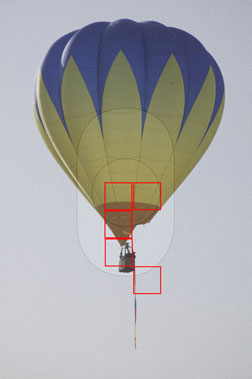 Figure 8: Red indicators illuminate the part of the image that is critically-focused (simulation).
Both the Nikon and Canon cameras have large, high-capacity batteries. The Canon battery seemed to last longer than the Nikon’s, though that may have been an issue of age rather than quality. I like Canon’s battery charger better, as it can charge two batteries simultaneously.
I am not sure how many photos I shot during my two-week trial period. But, hundreds of photos later I found myself liking the Canon camera a lot, and asking myself an all-important question.
Lotta Pixels, Lotta Dollars
The question on my mind, especially as I watch other photographers change from Nikon to Canon for their professional digital photography, is: What would it take to get me (Mr. 6804136) to put down my Nikon camera permanently and pick up a Canon? I weighed the pros and cons. This is difficult for me because not only am I an avid Nikon camera owner-user, but I have also worked as a consultant and writer for Nikon, developing and delivering training programs, writing documentation and building help-screen systems for that company. I have wonderful friends there, and I don’t want to alienate them or damage my professional relationship with the firm. This decision would tear me up emotionally.
To get me to switch, the Canon has to have several advantages that are significant improvements over the Nikon cameras. To get me to switch, the Canon has to produce visibly superior images. To get me to switch, the Canon has to feel good in my hands, and behave like a member of the team when I am using it.
Price is also a factor. The Nikon D1X body costs $3,899 at B&H Photo in New York City; the Canon body is listed at $7,999. That’s a lot of money! To buy a complete system including a series of lenses for both wide-angle and normal photography would take me closer to $12,000 — which is an awful lot of money. But it’s sure a nice camera system.
Has Canon succeeded, with the EOS 1DS, in getting me to put down my Nikon and learn a new serial number? Watch this column for breaking news.
This article was last modified on December 13, 2022
This article was first published on May 4, 2004
Commenting is easier and faster when you're logged in!

Recommended for you

Create Stunning Slideshows with FotoMagico
If you’re a Mac-using photographer looking for a way to showcase your work in pr...

Making Lightweight Animated GIFs in Photoshop
Still images can look great on websites – but moving images are more atten...

CreativePro Tip of the Week: Using the Navigator panel in Photoshop
This CreativePro Tip of the Week for Using the Navigator panel in Photoshop was...