


Around the World in Pictures

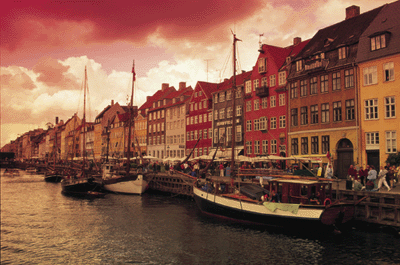
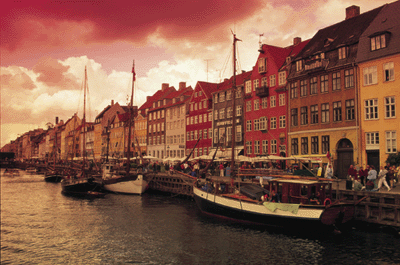
You might say that Jack Hollingsworth is Indiana Jones with a camera, excavating exotic images instead of ancient relics. From life aboard a merchant marine vessel to a graduate degree in theology, Jack’s life experiences have led him around the world in search of the perfect shot. His vibrant, colorful photos have captured life in more than 50 countries, and all but two continents.
Although largely self-taught through his travels and business choices, Hollingsworth has tried hard to develop his own style and ethos about his work. His signature style is splashed in color, awash in the waters of foreign shores, and often exposed to give an alien, unreal touch.
Jack works out of his home in Dallas, Texas, where he works to keep his Hollingsworth Studios Web site well stocked with his World In Focus travel photography: In addition to working for Corbis and Getty Images, Hollingsworth peddles his stock photography through his own site. He also writes a column for Shutterbug magazine.
creativepro.com: When did you first become interested in photography?
Jack Hollingsworth: I think my introduction to photography was back in 1973 when I was a dishwasher in a galley of a merchant marine ship that went from Cape Cod to Europe and back. My dad thought it would be good if I had pictures, so he bought me a Minolta 101. I think in hindsight that it was the start of two loves — one, for photography and, two, for travel, neither of which have changed over the years.
creativepro.com: Did you just make one trip with the merchant marines?
Jack Hollingsworth: Yeah, just a summer — two or three months over in Europe. I was wide-eyed. I had never been out of the country before, so it was kind of a cool experience. We did all the Baltics and Scandinavian countries, Dublin and London, Sweden and Denmark, and on and on.
creativepro.com: How did you begin shooting professionally?
Jack Hollingsworth: Although I call myself a self-taught photographer I have some formalized training. I have a Masters in instructional technologies from Indiana University with a minor in photography, so I have some formal schooling. I was also a voluminous reader. From ’73 on, I read everything in sight.

Image courtesy of Hollingsworth Studios
creativepro.com: So you returned from Europe, enrolled in college, and got a minor in Photography?
Jack Hollingsworth: No, actually, I have a very strange educational path: I graduated from high school and then went to Concord College to study Forestry. I was kind of a hippie back in ’72, and I thought that was kind of a cool thing to do, because I was a kid without direction and focus and discipline. (Laughs.) I’d worked as a forest ranger for four previous summers.
I lasted about a year in that program and then became a pretty active Christian. I went from radical hippie to radical Christian and decided at that point that I would travel around the world in a minibus and pass out Gospel tracts. Then I came down from that and graduated from a Bible school, believe it or not, with an undergraduate degree in Christian education. From there I met a girl, got married, moved to Texas, and the rest is history. I’ve been in Texas for 20 years.
During the ’80s I was a co-owner and creative director of a production agency, which is kind of a cross between a production company and an advertising agency. We were very big and did very well — maybe 20-plus employees. On staff we had writers and designers and graphic artists and audio technicians and videographers; we were the hands-on people. I was the principal photographer in addition to being the creative director, so during the ’80s I kind of developed the art-buying sensibilities of photography. Up to this point it had been kind of a hobby.

Image courtesy of Hollingsworth Studios
So in the ’80s I shot for my own agency, and then I bought a lot of photography, I looked at tons of portfolios, and I got familiar with stock because we were big stocks users at the time. And I thought if I don’t do this anymore — agency business — I think I’d like to be a full-time stock photographer. So in ’91 I left the agency, I left my role as artistic director, and started all over again. I reinvented myself. I decided I don’t want any more of this; I’d worked seven days a week and I was burned out. I decided I wanted to chill. So in ’91 I became exclusively a stock photographer.
creativepro.com: Why did you choose stock photography instead of contract work or work for hire?
Jack Hollingsworth: I probably didn’t actually choose to be a stock photographer in ’91; that’s a little misleading. I was, like everybody else, an assignment type. I had editorial clients, I had advertising clients, and I had corporate clients; so up until about ’94 or ’95 I was like everybody else just trying to make a living, doing what I could. I had a handful of travel clients, which basically filled my files, and I continued to develop the passion and interest I had for travel in photography.
So I guess my vision and focus were being refined back in the early ’90s. And at the same time I was developing a business acumen for stock and some skills there for negotiating and for selling my own work and developing agency relationships. And then enter royalty free — around ’94, ’95 — when it was kind of a bad word, I was one of those early adopters. I saw the writing on the wall, so I bit the bullet and never looked back. And so here I am.

Image courtesy of Hollingsworth Studios
creativepro.com: So how did Hollingsworth Studios come about?
Jack Hollingsworth: I knew you’d ask that. I’m trying to think when I actually signed my first royalty-free contract. It was with PhotoDisc. I just found everything about PhotoDisc at the time — back in ’96 — just wonderful. They were pleasant to deal with, professional, organized, ambitious; they provided time for me, and guidance; they were everything I wanted in an agency. So I learned that game, submitted tons of work, did quite well early on and got a lot of images accepted into the General File. I saw my revenues increase steadily, almost 10 to 15 percent per quarter, and kind of learned the royalty-free business early on. I got a lot of heat from my peers and associates. They thought I was the devil incarnate, that I’d sold my soul. But it worked for me.
Then in ’96 or ’97 I did the same thing with Corbis. That was when it was OK to have multiple agency relationships and play the game with two big players. So I jumped on the bandwagon with Corbis and did extremely well with them, too. I think over a two-year period I did submission shoots, where I financed the shoots with my own money and submitted them and made money back long-term. I also did production shoots for them, where they actually financed shoots of a lifestyle nature. During those first two or three years I really learned a lot. I was like, “Hey, I understand this business. I know what it’s about.” I’d get 30 or 40 pages of royalty reports a week from PhotoDisc and Corbis, which I was studying and analyzing. I’d say, “Hey, that sold well”; “Gee, that’s a surprise”; “Golly, here’s a whole batch of images that moved quickly.” So I thought, hey, I’ll try it on my own. I maintained the Corbis/Getty contracts and decided I’d open for business on the Internet and call it Hollingsworth Studios and unload my travel inventory. It’s weird, while I had traditional licensing relationships with stock agencies, I never gave them my heart — the travel inventory. I had two strands of specialties. There’s the lifestyle stuff — that’s my commercial stuff — births, deaths, weddings. That’s the stuff you see if you pull out my name on the Corbis and Getty sites. But my love, my passion, my interest, is travel, and over the years I never gave that stuff to anyone. I hoarded it. Giving it away seemed — I don’t know — spooky.

Image courtesy of Hollingsworth Studios
creativepro.com: In all the years you’ve been shooting, you seem to have been around the world several times. How many countries have you been to?
Jack Hollingsworth: I never counted them. I would say it would have to be in the 50-to-75 range.
creativepro.com: I didn’t notice any shots from Australia in your collection.
Jack Hollingsworth: No. No Australia, and no New Zealand. I’ve got a trip there coming up in November, actually. No Antarctica either. (Laughs.) You want to send me?
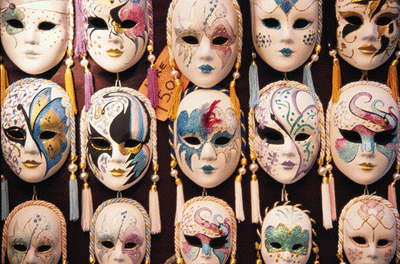
Image courtesy of Hollingsworth Studios
creativepro.com: What has been your most interesting experience in capturing a shot?
Jack Hollingsworth: Gosh. What comes to mind is a book project I did on China for a Hong Kong publisher. It was a coffee-table type book, very nice, five color, 11-by-14 size, lavish bleeds, great reproductions. I remember being gone for 46 weeks doing one end of China to the other, from Beijing all the way down to the Silk Road. That was probably my most memorable trip. I’ve been fortunate to have many of that type of trip over the years.
creativepro.com: Did you ever find yourself in an awkward situation where people didn’t understand you?
Jack Hollingsworth: Oh, yeah! Almost everywhere I go! That’s actually part of the magic of it.
creativepro.com: Judging from your portfolio, vibrant colors seem to be your signature. Is this true?
Jack Hollingsworth: Oh, it definitely is. That is my signature style for sure.

Image courtesy of Hollingsworth Studios
creativepro.com: Do you do any digital retouching?
Jack Hollingsworth: No digital retouching. I use a lot of filters. My wife, by the way, is a graphic designer — an artist in her own right. She is proficient with Photoshop, so if I need that I have access to it. But for the most part I don’t ask for it. In World In Focus there’s only one shot in over a thousand that was digitally enhanced.
My photo persona is bent toward the warm end of the spectrum, so I lighten all the reds and the yellows and the saffrons. To get all that, I use all the 81 [filters], I double them up, I triple them up, whatever. I use Fuji Velvia stock, ASA 50, and then I use the Ektachrome100 SW stuff and polarize the heck out of almost everything, then spot meter and underexpose. That’s my trademark: polarizing, spot metering, and underexposing. That’s basically what I do.

Image courtesy of Hollingsworth Studios
creativepro.com: How long has it taken you to amass the 1,000-plus images you now have available on your Web site?
Jack Hollingsworth: I would guess that’s probably about a decade of my stuff. Some of it doesn’t necessarily have rhyme or reason; it’s just what turns me on.
creativepro.com: Over two thirds of your images are of people. Do you prefer shooting people or is there simply a greater demand for such shots?
Jack Hollingsworth: I think there’s probably a much bigger demand for people shots, but really that’s my personality. I love making connections [with people]. Some people are good at making connections with landscapes, some are good with products, and some are good with a process. On occasion I hit a home run with any of those. But for the most part photography is about people, so I like capturing people, being challenged to enter their world, to understand it, to listen, to be a sympathetic observer. I find more passion, I guess, in shooting people. Now, it happens to be commercially viable, but I never go out and say, “Gee, I’d like to make my money shooting pictures of this market.”

Image courtesy of Hollingsworth Studios
creativepro.com: Are many of your shots candid or do you ask people to pose for you?
Jack Hollingsworth: They have the appearance of being candid, but rest assured, the majority of them are set up. The World Innocence and World Portraits volumes, for instance: 90 percent of those are not candid. I’m not a kamikaze, you know, one of those guys that walks around with a 300mm lens, with a doubler or tripler, that stands across the street with a big piece of glass and a tripod and binoculars and tries to pick out random slices of life. I hate that. Right now most of my work is shot with a 15mm lens.
You know, to get those shots I have to be in somebody’s face. You either have to be good at nonverbal communication or you have to hire a guide, an interpreter who speaks that language, and you explain your story. I would never go anywhere now on an assignment, even on a speculative stock shoot, without a guide, a driver, and an interpreter. Those would be my key three players.
I sit down [with a potential subject] and explain what stock [photography] is and that I need to get releases; we have them in foreign languages. Then I enter into a dialogue with them. If they’re vendors I buy something from them. I ask them, through the interpreter, about their families. I bring a pack of pictures of my own family, to humanize me, so they won’t think that I’m coming in and exploiting them and taking advantage of them and that they’ll never see me again.
You know, I go through different zones. Sometimes I’m really, really fired up about people. At other times I feel reclusive, shy, and introverted. I don’t want to deal with people and I don’t want an interpreter. I just want to go; you know, go see color or experience something privately on my own.
creativepro.com: What percentage of your time would you say you spend traveling?
Jack Hollingsworth: Prior to having children — we have a four-year-old and a six-week-old — my wife traveled with me. I used her as an art director. She has incredible photo sensitivities and art-direction skills. And of course she brings that womanly intuition to shoots. We just love traveling and being together. It wasn’t uncommon for me to travel, on an average, at least four months of the year. I can remember two years before our first child we traveled together seven months of the year. Right now, I probably don’t travel more than two or three months of the year.

Image courtesy of Hollingsworth Studios
creativepro.com: So where do you go from here? Will you just continue to add to your library of images or do you have other projects planned?
Jack Hollingsworth: Good question! You know, because I’m only a stock guy, I’m sort of an unusual bird. Having come from the assignment business I know that I probably don’t want to go back to that, because there are such tremendous freedoms in what I do now. I think I’ll probably just keep shooting for my own stuff. Of course, I will absolutely keep shooting production lifestyle stock for Corbis and Getty. And right now I’m kind of exploring going back to traditional stock. I’ve kind of come full circle. But I’m definitely going to stay in stock and I’m definitely going to stay in Travel and Lifestyle.
creativepro.com: So how many new images do you make available on your Web site each year?
Jack Hollingsworth: What you’re seeing is really only our first year. You’re looking at about a thousand so far, and then about another 1,500 this year; my guess is another thousand or 1,500 next year. It just depends on what mood I’m in or how much I want to invest or how much time I have — to drum scan it, to clean it, to Photoshop it, to keyword it, to make it Web-friendly and Web-ready for commerce, and so on.
creativepro.com: Have you considered digital photography, or will you?
Jack Hollingsworth: I’ve done so little. I mean, I own a little Nikon CoolPix; that’s the extent of my digital photography! So, yeah, I’m friendly toward it. I’m actually kind of psyched about the idea. I’ve had no experience, but it seems like a natural. That’s probably one of my two goals for the next two years. I want to learn a little bit more about digital photography and then I’ll probably start shooting some large format, some four-by-five stuff. We’ll see. Who knows? If you call me next week I might have a different answer!
Jack Hollingsworth’s images can be seen and purchased at Hollingsworth Studios. Five volumes are available on CD ($299) and more than 200 images are available for one-off sale online ($49 to $149, depending on size).
This article was last modified on March 13, 2022
This article was first published on May 8, 2001
Commenting is easier and faster when you're logged in!

Recommended for you

This Week in InDesign Articles, Number 92
Here's a few links to keep you on your toes and keep your interest piqued!
10 Photoshop Efficiency Tips from CreativePro Week
Use these quick tips to increase your efficiency and enjoyment in Photoshop.
Putting Images on a Stroke
Ily wrote: Is there any way to create an image (say a globe) in Photoshop and th...