



On the Cutting Edge (of Rumors)
The hullabaloo over the announcement (beyond Apple and IBM not talking about each other) dealt mainly with the 970’s 64-bit nature and its origins.
The current POWER4 is dual core, meaning that it has two processors inside a single chip (see figure 3). This is different from a dual-processor machine that uses two separate chips mounted on a card, such as the latest Power Macs. The internal communication between the two integrated processors is very quick indeed.
This capability has long been a talking point of Mac rumor sites. Years ago, sources said that dual cores were in the long-range roadmap for the PowerPC. In spite of this, the plans were scrapped as the market changed, as both IBM and Motorola focused their PowerPC efforts into the embedded markets. And today, the greatest use of the PowerPC can be found in automobiles.
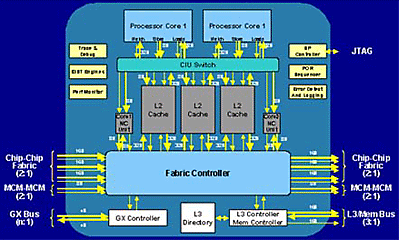
Figure 3: This is an engineering diagram of the POWER4 processor. The two processor cores are the blue boxes (what else for Big Blue) at the top, which communicate with the three integrated Level 2 caches in the middle. Below is a fabric switch that can communicate with other processors in a multi-multiprocessing computer. The 970 has a single core and just one L2 on its die.
Several analysts at MPF said with its POWER4 foundation, it was natural evolution for the 970 to gain dual cores. However, that would come in a second-generation design, at the earliest a few years from now.
The outlook is similar for 64-bit computing. While the 970 is a 64-bit processor, the Mac of today is 32-bit all the way and Apple has made no mention of any plans to support 64-bit computing in OS X — naturally since there wasn’t a 64-bit PowerPC on the horizon. Now there is.
"Apple will bring 64-bit mainframe-class part to the high-end desktop," MDR General Manager Kevin Krewell predicted. "For the content creation world, this [announcement] is really something. Apple is getting a real jump on 64-bit addressing over Intel."
However, Diefendorff was of the opinion that Apple would move slowly into the capability. "There’s little advantage for Apple to go to 64-bit addressing right now. But it’s there. [Higher] frequency is the story here now."
Timing the Market
So, how should Mac users evaluate this announcement? Should we put off all purchases until the new processors arrive? Or look for application developers with 64-bit experience?
Just as it’s foolish for speculators to "time" the top or the bottom of the stock market (even though it’s tempting to do so), it would be inappropriate for Mac content creators to make the 970 chip a part of purchasing decisions at this time — a year from now, maybe. If you need a faster machine now, buy one now.
Indeed, I suggest readers consider buying the best that’s currently available rather than settling for an older model. That faster machine will provide more productivity for a longer period of time than will a slower, older model. Of course this seems self-evident, but many people end up with a low-end machine because they’re on sale, rather than factoring in the long-term productivity to be had from high-end models.
This is especially true with a dual-processor Mac. There’s no guarantee that Apple will continue its dual-processor strategy once this new chip hits the streets late next year. The highest frequency processors may be offered in single-processor models, or only in servers. So, the value of a current dual-processor model will hold its value, certainly more than an older single-processor that is still being sold in the aftermarket nowadays.
The same holds true for 64-bit addressing. Until Apple commits to a 64-bit version of OS X, there’s no need to even think about 64-bit applications. But I agree, it’s nice to dream.
With all that I’ve said, why do I consider this announcement so important to Mac users?
The PowerPC 970 marks a new trend in desktop processors: the movement of technology from the very high end of the market down towards the midrange, where we graphics professionals live. This bucks the practice of the past five or so years, as processor vendors have focused on the entry-level segments of the market. Or even worse, as we’ve seen from IBM and Motorola, a concentration on the embedded application market.
The needs of a desktop or workstation processor are different than those of an embedded device. Or a notebook. Or a $300 computer. Or even a $1,500 computer. There was no way that these recent efforts could produce the best possible architecture for our content creation applications.
I’m not pointing my finger just at the PowerPC developers — the same situation holds true in the Windows camp. I will discuss Intel and AMD’s strategy for high-performance desktops and 64-bit computing in my next column.
In the long-ago past, high-performance technology was migrated to mass-market products. This was true for all kinds of devices, from scanners to computers. But the consumer and telecommunications markets appear to have distracted the purveyors of our processor technology, leading them to focus on entry-level, inexpensive products; or vertical applications in devices such as switches.
There’s an old Jewish saying: "A goat has a beard — but that doesn’t make him a rabbi." The same is true for microprocessors. Technology should flow downstream, like the PowerPC 970, to the benefit of creative pros.
Read more by David Morgenstern.
This article was last modified on January 6, 2023
This article was first published on October 31, 2002
Commenting is easier and faster when you're logged in!

Recommended for you
Using Affinity’s Distortion Filters
Distort your images with ease in Affinity with Steve Caplin!

TypeTalk: Font Sizing Guidelines Part 1, Design Characteristics
Q Are there any guidelines for selecting fonts for use at a range of sizes? A. I...

Adobe InCopy CC Price Drop
Last week during the PePcon conference, I was speaking to a colleague who remind...