



Until recently, I didn’t know that the Indian rupee is a different currency than the rupee or rupiah used by other countries like Pakistan and Nepal. All I knew was that to identify a monetary amount in rupees, you’d use the abbreviation “Rs.” I’m guessing the situation is similar to how both the US and Canada use dollars and the same “$” symbol.
Last week, the Indian government announced a winner in their year-long contest to design a currency symbol specifically for the Indian rupee (background info). The new symbol ? a combination of the roman capital R without the vertical stem and the Devanagari letter “ra” is pretty cool looking:

You won’t find the newborn symbol in any of your current typefaces, of course, but you can expect to see it added to Open Type fonts over the next few years (or new versions of the fonts you already own), just as the Euro symbol was added to most typefaces over a short span of time.
In the meantime, Indian design firm Foradian Technologies released a free, cross-platform TrueType font, Rupee Foradian, that has the new Rupee symbol in its otherwise basic set of glyphs. They decided to map the symbol to the grave accent key (aka the tilde key, in the upper left corner of most keyboards) since the key is seldom used, they say on their web site.
After you install the font, you can add the currency symbol to your text by switching to the Rupee Foradian typeface and hitting the tilde key (grave accent) once. Be sure to switch back to your previous typeface before you continue typing. Or, just type the grave accent glyph as a placeholder, then go back, select the accent, and change the typeface to Rupee Foradian.
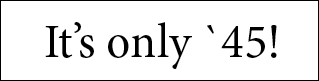

The symbol looks quite clunky next to the delicate Minion Pro typeface above, I think. But until type designers jump on board, it’s the only version of the glyph we have to work with.
A more streamlined way to access the Rupee glyph is to add it to a custom glyph set in your Glyphs panel. Assuming you keep the Glyphs panel open (or at least easily accessible in the panel dock), you could just double-click the glyph to insert it into the the text stream on the fly.

[For more information on creating and working with custom Glyph sets (which have been around since CS2), see the online help page about them, or watch this excellent videocast Michael Murphy did on the subject a few years ago.]
The fastest and most reliable method, though, would be to add a GREP Style (available in CS4 and CS5) to the paragraph styles(s) you’re using for the text containing the Rupee symbol. That way, whenever there’s a lone grave accent (that is, not being used a diacritic above a letter), InDesign will automatically change it to a Rupee currency symbol.
To do this, create a character style whose only attribute is that is uses the Rupee Foradian typeface. Then, in the paragraph styles where you’d be using it (such as Body Text or Item Description), add a GREP style that applies the character style you just made to the grave accent character:

When you use the grave accent “for real,” that is, to accent a letter, it remains an accent. It’s only when the accent stands on its own that the GREP Style kicks in and changes it to a Rupee currency symbol (via the character style font change). If you actually needed an occasional stand-alone grave accent in your text, you could refine the GREP expression so that only grave accents followed by one or more digits would be affected.
The new Indian Rupee symbol is not without its detractors and, as usual, is accompanied by some controversy, but mostly about how the winner was chosen. Still, I think it’s here to stay – if Wikipedia says so, it must be true. ;-)
This article was last modified on December 20, 2021
This article was first published on July 19, 2010
Commenting is easier and faster when you're logged in!

Recommended for you

Tab Stops in InDesign Tables
Mercier wrote: Is there a way without using indent to align table text in a colu...
Art and Design Inspired by Mexico
Happy Mexican Independence Day!! What’s that I hear you saying? “It...

Not Much Needs To Be Said When You Lay Out A Good Photo Spread
Unless you work for a one-man (or woman) operation, chances are you’ve oft...