



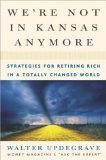
Here’s a sobering statistic: 40 percent of Americans are counting on the lottery, sweepstakes, getting married, or an inheritance to fund their retirement, according to Walter Updegrave, author of We’re Not In Kansas Anymore: Strategies for Retiring Rich in a Totally Changed World.

Hopefully you’ve married well or have rich parents, because the statistical odds of winning the lottery — well, no need to go there. Most creative professionals are not preparing adequately for their retirement. Understandably so; it’s hard enough to afford life in the present without worrying about funding yourself in the distant future.
But retirement planning isn’t about solely about retiring. Money socked away provides immediate tax benefits and can also act, as a last resort, as emergency money for a rainy day. Here are few retirement planning tips:
- Do the math. Have you ever calculated how much money you’ll need for retirement? Given our increased life expectancy, it’s a good idea to know how much money to save each year to meet your retirement goals. Check out an online retirement calculator to find out.
- Know your options. Three retirement vehicles are the most popular for the self-employed or small business employee:
- Simplified Employee Pension Plan, commonly known as a SEP-IRA, is a retirement plan designed for the self-employed and small-business owner. It’s the only one of the plans that can be started after the tax year for which a deduction will be claimed. SEP accounts can be established at any time up to the due date of your tax return, including time for extensions (if you’ve extended your returns, you’re in luck). Likewise, contributions to an existing SEP can be made until the return due date.
- A Self-Employed 401(k) may substantially reduce your current income taxes because you generally can deduct the entire amount of your plan contributions from your taxable income each year. If your business is unincorporated, you can deduct contributions for yourself from your personal income. If your business is incorporated, you can generally deduct contributions as a business expense.
- The SIMPLE-IRA Plan was designed to make it easier for small businesses to offer a tax-advantaged, company-sponsored retirement plan. The SIMPLE plan is a flexible, easy-to-administer retirement plan for businesses with 100 or fewer employees. SIMPLE plans are funded by employer contributions and can be funded by elective employee salary deferrals.
- Get professional help. If you’re self employed or run a small business, find out about retirement plans from the likes of Janus, Fidelity, American Express. Or better yet, hire a fee-base financial planner who doesn’t have a vested interest in selling you retirement plans. If you’re employed, even in a small firm, talk to the owner about bringing in a retirement consultant for an employee-participatory plan. Not only can contributions lower your income taxes, but the money also grows tax free until you withdraw it at retirement.
- Start saving now. Here’s an example of the power of time: If you’re 20 years old and wise enough to put away $100 a month into an IRA at eight percent annual interest, you’ll retire at age 65 with $500,000. If you wait until you’re 30, you’ll wind up with $215,000. Delay the plan until you’re 40, and count on no more than $100,000 when you reach 65. Unfortunately, younger workers, ages 18 to 34, who have the most to gain, are far less likely than older workers to invest in a retirement fund, according to a study by American Express.
- Make it automatic. Few of us have the discipline to make voluntary deposits. So even if you can only sock away $25 or $50 month, arrange to have the funds automatically withdrawn from your paycheck or bank account.
- Take the money. Many employers provide some sort of employee match or contribution with their 401(k) plan. The more you participate, the more your employee puts up. Contribute to the limit; it’s the best deal you’ll ever make.
- Never cash out. No matter how small the balance, it is important to keep your retirement savings tax deferred. Employees who cash out are assessed a 10 percent early withdrawal penalty, plus state and federal income taxes. They also will not reap the potential benefits of compounded savings over time. Surveys reveal that most people who have cashed out regret it and would not make the same decision again. On the flipside, it’s nice to know the funds are there, should a dire emergency leave you with no option.
- Keep track. One out of every four workers leave their retirement assets invested in their former company’s plan. But you can roll over a company-based 401(k) into an IRA, if you choose. IRAs allow you to choose and diversify your investments, provide continued tax-deferred growth, and consolidate your retirement accounts for easier tracking and control.
- Stay tuned. Keep abreast of changing options for retirement savings, keep track of changing laws and regulations, and revisit your plan year to year or at least biannually. Don’t relegate important decisions to someone else. It’s your life.
To learn more, surf these sites: https://retireplan.about.com, www.quicken.com, and https://money.cnn.com/retirement.
Be well, live creatively, and retire worry-free.
Read more by Eric J. Adams.
This article was last modified on January 6, 2023
This article was first published on June 22, 2005
Commenting is easier and faster when you're logged in!

Recommended for you

Add Calendar Dates to Each Page in an InDesign Document
How to quickly add all the days and dates on a calendar you're making in InDesig...

Using the Curvature Tool in Adobe Illustrator
In Adobe Illustrator, one of the more challenging tools for beginners (and even...
Add Undo to Your Script
Your first script runs just fine; but what if you run it by accident? Find out h...