


Reinventing Quark: Teaching an Old Dog New Tricks


Mix and Match Quark
These are but some of the many system modules that Quark has crafted for both the professional and enterprise publisher. These modules can be mixed and matched to devise a number of custom systems tailored to specific workflow requirements. While at Quark I saw the prototypes of a Marketing Collateral System that includes a number of modules enabling a national brand manager to publish ads to be localized for specific markets via advertising teams working on the local level. For example, a whiskey ad showing a New England covered bridge could be adapted by a local marketing team to substitute a New Orleans’ bistro, and modify the copy to go with it, very quickly using a Web browser. Expect to see other custom system configurations for specific markets offered by Quark and its system integrators using the QCM and QPS “kit-o-parts” (see Figure 6).
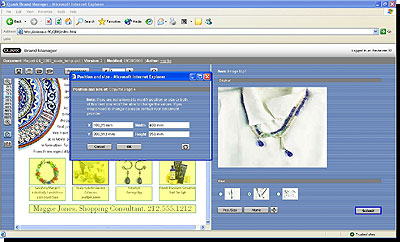
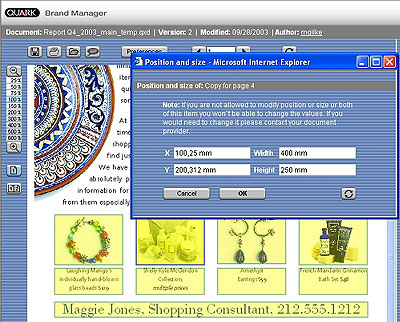
Figure 6: An example of a custom publishing portal built with Quark Brand Manager (overview, top: detail, bottom). In this case, images can be changed, sized, moved through a simple browser interface. The rest of the document is protected. It can be configured to give different capabilities to different users.
Priced Per Pound?
Quark’s pricing model is based on industry standards for enterprise systems. The base price depends on the database configuration, number of users, and specific modules purchased. Customers pay an annual maintenance fee, and receive all the upgrades that are released during the maintenance period. The annual cost of the maintenance fee is a percentage of the system’s list price and in the same percent range as other enterprise support agreements. Quark is on a 12-to-18-month development cycle, so customers who pay maintenance may receive more than one upgrade in any year. For instance, Quark released two upgrades to Quark Content Manager in the last 12 months.
The theory is that most customers find it easier to budget for software under the maintenance model, and the fee is structured so that customers who are committed to Quark pay less than customers who choose not to pay maintenance but who may want to upgrade at a later date. For example, a customer who pays maintenance on a 25-user system receives upgrades for 50 percent less than those who pay for a regular upgrade.
As to what each product and module costs, let’s just say they will be enterprise worthy.
Take Another Look
Well, that’s it, folks, the end of our brief guided tour of Quark’s multi-channel publishing workflow systems. I’ve only scratched the surface of what these systems are, and can do. You owe it to yourself to check out what Quark is building — even if you think you never want to talk to the company again. I’m afraid that antagonism toward the old Quark will prevent some from taking a look at the new Quark and therefore miss exactly how far down the road to providing a sophisticated, near-complete multi-channel publishing system Quark has come.
Can Quark do it? Can it turnaround customers’ anger and resentments by delivering better support and customer service? Will it really deliver on its enterprise workflow vision? After all, it committed to the systems business once before with QPS, and then pulled back. It’s now re-committing with QPS and a suite of big-ticket enterprise products. Will Quark stay the course?
In Quark’s defense the company argues that it has not wavered on supporting its QuarkDMS technology targeted at the enterprise since it was introduced in January 2000. Quark spokesman Glen Turpin argues that it has been behind QuarkDMS “100 percent from Day One. Granted, we have pulled back a couple of components for re-engineering and will re-release them this year.” He continues, “We’ve made better enterprise integration a priority and our customers will benefit as a result. And we now have hundreds of engineers working on our suite of enterprise products: We’re porting key servers to Mac OS X, developing new add-on modules targeted at a variety of vertical markets, and enhancing support for open standards such as XML. And we have hundreds more engineers dedicated to improving the QuarkXPress product line. Our commitment to both desktop and enterprise publishing should be clear from the level of our investment in the market which in terms of percentage of revenues invested in R&D, is probably larger than any other company.”
So like someone whose significant other cheated on you but is now asking to get back together, do you trust the new Quark to keep its promises? Does Quark deserve one more chance?
I think so — but you must decide for yourself. The stakes are higher this time around, because enterprise solutions are non-trivial to purchase and implement. That Quark has spent the last four years developing an impressive suite of enterprise products argues that you should — if you can just believe in Quark one more time.
Read more by Craig Cline.
This article was last modified on January 18, 2023
This article was first published on April 6, 2004
Commenting is easier and faster when you're logged in!

Recommended for you
How to Extract Images Using Photoshop’s Refine Mask
Adjust Edge section The Adjust Edge section lets you fine tune your mask in a nu...

Welcome to The Digital Art Studio
Digital Art Studio 1: Customizing Photoshop shortcuts This is the first post in...

The CreativePro Guide to Graphics File Formats
Learn about graphics file formats, their pros and cons, and how to choose which...