



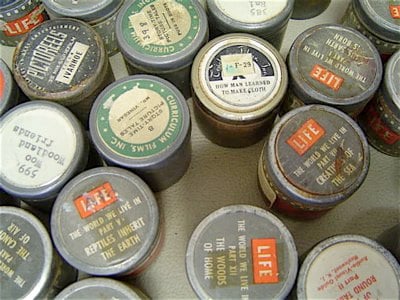
At the garage sale of a retired teacher I recently came across a very large basket of little 35mm film canisters, each with a label indicating a subject, and each containing an educational filmstrip of the sort used in schools in the era before cheap video recorders and in-classroom Net connections. These inexpensive products were the poor-man’s movie — cheap enough for a school to own, and easy to present without much technical knowledge.

Usually accompanied by a LP record or cassette tape, these filmstrips contained from 20 to 40 slides on any number of subjects, most often world culture, geography, or religion. Unlike a book, students could not only see pictures of pagan children and large Dam projects, but hear them as well! Or at least hear someone in a studio in New York or Chicago doing an imitation of pagan children and large Dam projects.

There is so much interesting material in my garage sale find that I’m going to have to break this report on filmstrip art into two sections. This week I’ll deal with the mechanics of the media. Next installment I’ll look at the actual topics, which ranged from straightforward academic presentations to the more “sensitive” things schools didn’t want to leave up to individual teachers — topics like sex education, manners, dating dos and don’ts, and other matter of either embarrassment or confusion. With the lights down and everyone focused on the screen, it was easier to address things like unwanted pregnancy and hormone changes.
Always the Geek
Not only do I suffer the humiliation of attending Catholic grade school, but I was also a combination of teacher’s pet and Audio Visual Monitor, all rolled up into a glasses-wearing freak who was too tall for his age. But then in Catholic school that pretty much described everyone, so it didn’t seem so weird at the time.


As AV Monitor, it was my job to set up the various projectors, record players, televisions, etc. as appropriate for whatever the nun in charge had in mind for that day. I believe I was given this responsibility not because of my vast technical knowledge of mechanics, but because my family owned a small portable black and white television that I was tasked to bring each time there was a space launch or it was time to choose a new Pope. Barbara Stevens and I each carried a small set from home and the boys would watch one and the girls the other.
But the television wasn’t actually a high point of being an AV Monitor. Much more challenging was setting up an actual movie projector or filmstrip projector. In many ways the filmstrip was the hardest as it required constant involvement and mechanical sound/image coordination. This was not a job for the timid — film could break, speaker wires could get crossed, records could skip, and only quick thinking and resourcefulness could save the situation. The humility of having Sister Mary Whoever come over and get involved in the mechanics was substantial and to be avoided at all costs.
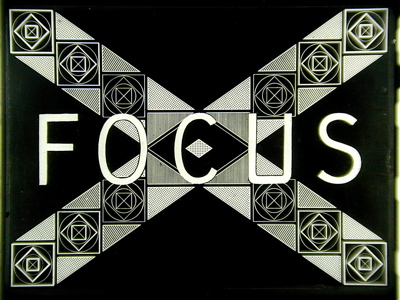

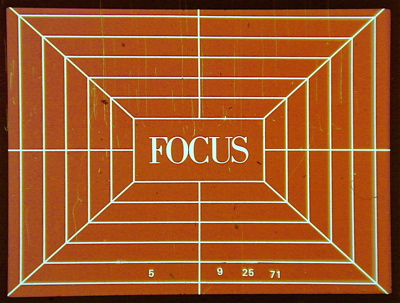
Focus is the AV Monitor’s First Priority
In my own grade school, there were no facilities for such sophisticated presentations in the individual classrooms — any multimedia presentation had to be done in the main auditorium. So this required not only setting up the projection and sound equipment, but also the chairs. It was a big deal to have everyone shuffle in for a filmstrip, and often multiple classes would congregate so as to take the most advantage of the effort. The pressure was always on the AV Monitor, and the audience was always completely unforgiving.
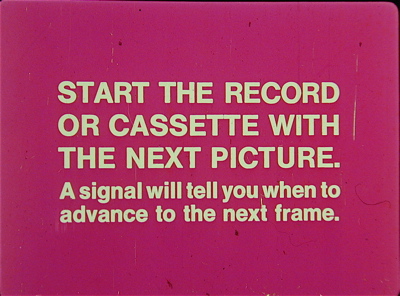
After testing the sound, lining up the projector, and getting the film threaded properly, all that was left was to do continual focus adjustments, and advance the slide at each beep tone on the narration. And, of course, a keen AV Monitor had to learn the subtle difference between a “real” beep, and the “fake” beeps put forth by wise-ass students trying to confuse. If you fell for one of the fake beeps, your career as an AV Monitor could be ruined.
Fortunately my father was an 8mm home-movie buff, so by the time I could talk I was already learning how to thread a projector and knew better than to touch the light bulb when it was hot. I would bring my own editing cement to school to fix broken filmstrips should the need arise, and was brought in to other classrooms for restoration of badly-handled film. Some kids just didn’t respect the emulsion — something my father was very strict about.
And even though I wore thick glasses, my vision was corrected well and I believe no one could hold a sharper focus than I, though at times with a troublesome filmstrip, it was nearly impossible to avoid a few wise cracks from the audience.
The Smell of Vinegar in the Morning
My favorite part of being the film guy was smelling the film before threading it in the projector. Some kids preferred the slight high achieved from deeply sniffing the purple “mimeographed” tests and worksheets the nuns would hand out, hot off the press. But I was always a sucker for that vinegar smell that comes from cheap, decaying film stock. When you opened the AV Closet (with a special key entrusted only to AV Monitors), the smell of the many filmstrips and few token 16mm movies was strong.
I don’t know if we learned any more by making some subjects such a special occasion. I was rarely paying attention to the subject matter myself, and I have a feeling that no matter how you present it, information about the Suez Canal is only so memorable for a nine year old.

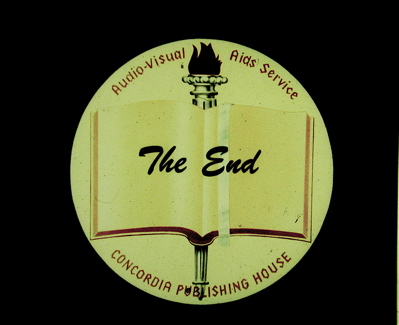

But if I hadn’t been the AV Monitor, I wouldn’t have taken an interest in filmmaking and photography, which ultimately lead to the things that have defined my life. I probably wouldn’t have gotten beaten up as much, either, but then that’s another story, and it’s hard to tell what role the AV thing played in that.
So even though I can’t point you to the Aswan Dam on a map, or tell you what the national export of Ecuador is, I can change a burned out projector lamp in under a minute, and never once fell for the fake beep trick.
Read more by Gene Gable.
This article was last modified on May 19, 2023
This article was first published on February 18, 2005
Commenting is easier and faster when you're logged in!

Recommended for you
Using the Gradient Panel in Illustrator
A quick introduction to creating, modifying, and outputting gradients in Illustr...

TypeTalk: Italic vs. Oblique
Most designers and related creative professionals are familiar with the terms It...
How to Use Illustrator’s Star Tool
Learn how to make stars and starbursts using Illustrator's appropriately named S...