


Electric Image Universe, the Sequel


The Electric Image Animation System — EIAS — was one of the first desktop 3D animation packages to make it to the cinematic big time, boasting special-effects credits for blockbusters such as “Terminator 2: Judgment Day.” The latest release comes not from Play, Inc., where it foundered for several years, but from Electric Image, which has re-formed and re-acquired the software and most of its original development team. Users who have anticipated this release won’t be disappointed.
Electric Image has given the product a new name — Universe 3.0 (recently upgraded to 3.1) — and in ways Universe really is a new product: EIAS was, and is, known for its clean animation interface, top-of-its-class rendering speed, and excellent image quality. Despite its modest feature set, many film and broadcast animators have come to rely on the fluid interface and extreme rendering speed of the software. The animation module of Universe builds on the EIAS, but Universe is much more than a Macintosh-only scene builder and renderer. The software has been re-engineered to include a powerful NURBS-based modeler and to run on Mac, Windows, and even Sun’s Solaris operating systems.
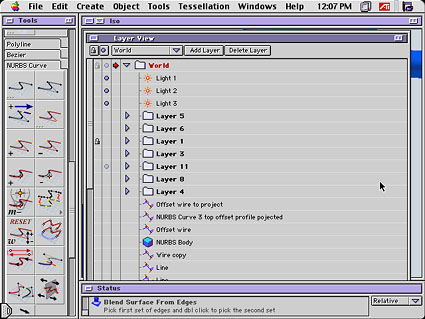
The Universe 3.0 Modeler ranks among the best NURBS modelers in the business, both for its powerful features set and clean, modern interface.
Universe emerges as a complete 3D modeling and animation system aimed at broadcast and film rendering, but with its price of only $1,999, it remains within reach of many print and multimedia designers. Though at the low end of the pricey domain of broadcast animation tools, it competes squarely with NewTek’s LightWave 3D, Discreet’s 3D Studio Max, Maxon’s Cinema 4D, Avid’s SoftImage XSI, and Alias-Wavefront’s Maya. We tested Universe on a dual-processor 450MHz G4 Macintosh running OS 9.1.
Four Corners of the Universe
Universe works as four separate modules: Animator, Modeler, Renderama, and Camera. Animator is the re-designed- and re-engineered-version of what long-time users will recognize as EIAS. It allows you to import models and apply textures, lighting, animation, and special effects, such as particle systems for smoke or fire. The interface in this version is streamlined, which is mostly a good thing, but this is one of the few times I’ve encountered software that has truly lost features for the sake of simplification. The changes may well make the program less intimidating to new users, but I did find places where the much-loved baby — such as the import option to fix an object’s smooth shading — has been tossed out with the bath water. (In this instance, I found it impossible to open a model built in Autodessys formZ with smooth shading intact, something the previous release of Electric Image Animation System did with ease.)
On the other hand, some new features are welcome, such as the capability to apply any setting to any object in the scene by holding down the control key while pointing at dialog box options. In general, Universe’s animation interface is easier to understand and use, and its outline-style Project Window for managing scenes is unmatched for simplicity. I was able to manage a model with about 1,000 objects and nearly 1 million polygons without difficulty. By choosing to hide all objects but those you’re working on, you can maintain crisp performance.
Animator managed to crash my G4 Mac consistently if I was careless enough to let it attempt to render a massive model in hardware mode on the Mac’s pokey ATI Rage 128 graphics card, which has only 16MB of texture RAM. (Mac users take note: Older 3D graphics cards, still shipping on some new Macs, are extremely underpowered with this type of software and may require an upgrade, if you can find one.) Fortunately, Universe lets you specify software rendering for individual windows, which is slower but stable. Both Modeler and Animator in Universe 3.0 suffered from too-frequent, less explainable crashes during our testing, but Electric Image shipped a bug-fix release (version 3.1) shortly before this went to press that seemed to alleviate some problems and that actually boosted rendering performance by about ten percent.
This article was last modified on January 18, 2023
This article was first published on August 14, 2001
Commenting is easier and faster when you're logged in!

Recommended for you

Editor’s Picks for CreativePro Week 2022
Our Editor in Chief lists his seven can't-miss sessions from the upcoming Creati...

Discretionary Line Breaks
There are so many new features in InDesign CS3 that it’s easy to lose trac...

Media Bakery Enters into Its First Rights Managed Representation Deal with Index Stock
Media Bakery (www.mediabakery.com) announced it will begin offering Rights Manag...