


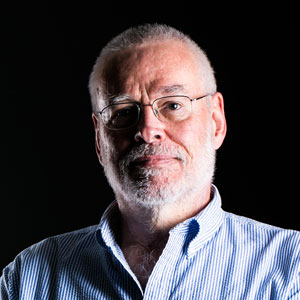
dot-font was a collection of short articles written by editor and typographer John D. Barry (the former editor and publisher of the typographic journal U&lc) for CreativePro. If you’d like to read more from this series, click here.
Eventually, John gathered a selection of these articles into two books, dot-font: Talking About Design and dot-font: Talking About Fonts, which are available free to download here. You can find more from John at his website, https://johndberry.com.
At the Experiment conference held by the Friends of Calligraphy near San Francisco a couple of weeks ago, Brody Neuenschwander raised the question of “letters in motion.” Although he talked, of course, about his most high-profile activity—working with Peter Greenaway on the films “Prospero’s Books” and “The Pillow Book”—he didn’t just do a greatest hits show, or a “brush with film fame” routine; he had an idea, a thesis, about type and lettering and how it gets used (and misused) onscreen. (Mostly misused.)
As a calligrapher, Neuenschwander is lively and apparently spontaneous, with a wealth of styles under his belt—or in his pen. He supplied the lettering that figures so prominently in “Prospero’s Books,” and he supplied the calligraphy written in our Latin alphabet on people’s bodies in “The Pillow Book.” (Another calligrapher did the Chinese lettering in the latter film.) Neuenschwander is a very tall, self-deprecating man with a quiet but pointed wit. He is originally from Texas, although he lives in Bruges and works primarily in Europe.
The presentation he made to a hall full of calligraphers became a multimedia talk punctuated with slides, films, and videos in several non-compatible formats. There was a certain tension in the air (which he deftly exploited) about whether all of the things he wanted to show would appear on the screen. They did.
Static Motion
Neuenschwander’s thesis was that not too many people are actually using type in motion very well.
“There are three kinds of screens on which you can have moving type,” he said: “films, television, and computers.” He made the usual acknowledgment of the pioneering creativity of Saul Bass in movie titles, and he showed a more recent work that has been wildly influential: the opening titles to the film “Seven.” He told us that he never personally wanted to see the film, since he has a low tolerance for movie gore; he recommended just seeing the titles and skipping the rest. But as he pointed out, the titles used writing as an integral part of the development of the story, and did it in a variety of media with strikingly different techniques—from blotting out words and phrases on a page to scratching letters in the film stock itself.
“Of course now,” he said, “we’ve got lots of imitations of ‘Seven.'”
Most of the type that moves on a computer or TV screen, said Neuenschwander, is amazingly unimaginative. Too often, the people producing it seem to be slaves of their software; the motion, for instance, tends to be all vertical or horizontal, because that’s what’s easy to do. “And the use of motion is so literal,” he said with exasperation. “If the narrative is about speed, you see slanted type.” Instead of commenting on or interacting with the sound or the other visual effects, the words on screen just repeat them in a different format. (He didn’t say so, but this is not unlike the kind of slide presentations that plague business meetings—where the speaker shows a series of headings and bullet points, and then proceeds to repeat them exactly.)
Good Examples
After showing some bad examples, Neuenschwander showed us what he considered a good one: some identity spots for the British television channel BBC-2, which did imaginative and totally unexpected things with a giant numeral 2. But as he pointed out, these were not done as pure computer animation; they were actual, physical models, created and then shot in motion, which were then manipulated on a computer after the fact. This, he thought, was a more promising creative method than pure computer effects.
Then he showed some of his own work, to illustrate his point about using lettering allusively rather than literally—although he allowed that setting his own work up as a standard might be self-indulgent or egotistical. He showed part of a multilayered video done by Greenaway that counted down through the alphabet, each letter standing for a concept, while naked models danced or interacted in ways that were thematically connected with the subjects; a discordant singer, whose face appeared at the top of the screen, sang about each subject, while Neuenschwander’s disembodied calligraphy, commenting but not reproducing the lyrics, appeared across the screen.
On the Set with Peter Greenaway
Working with Peter Greenaway, said Neuenschwander, is vastly creative but sometimes an ordeal. Even on the larger films, the budget is never on Hollywood scale, so corners have to be cut. There are rarely multiple takes. In “Prospero’s Books,” the close-ups of Prospero’s hand writing were really shots of Neuenschwander’s hand, made up with artificial wrinkles to look like the hand of the 80-year-old Sir John Gielgud. In order to get the right camera angle, so the camera could “see” the page through Prospero’s eyes, Neuenschwander would have to hold his head off to the side while he wrote. (“You can imagine what this did to my writing angle,” quipped Neuenschwander to an audience who clearly appreciates calligraphic technique.) The hot lights made the ink tend to dry out too fast, but they also threatened to spatter the page with the writer’s dripping sweat.
This would all be done in one take, with the director giving Neuenschwander verbal instructions as he wrote the text—”Oh, that word’s important; make it big.” Neuenschwander showed excerpts from the film, including one of these scenes, with his own running commentary. He said it was amazing, considering the process, that it all turned out as well as it did.
Living Parchment
Working on “The Pillow Book” was even more complex, since it involved writing on the actors’ bodies. Writing on bare skin required special ink, and making corrections was awkward; it tended to make the skin redden, which had to be countered by applying white powder. The texts that appeared on various actors playing messengers in the film would take a couple of hours to complete; after all that meticulous work, you wouldn’t want to have to do it all over again because the shooting continued to a second day. One scene did take two days, because the messenger was a huge sumo wrestler; with more skin to cover, the writing took longer than expected, which threw off the day’s shooting schedule. The sumo wrestler, said Neuenschwander, refused to sleep that night; he stood in his hotel room all night long, rather than lie down and smudge the writing.
Returning to his theme of multilayering and type in motion, Neuenschwander showed another scene from “The Pillow Book,” a sequence where the camera plays over Vivian Wu’s body, on which the Lord’s Prayer has been written, while jumping, floating calligraphy records the words to a French children’s song that is being sung simultaneously in a voiceover. The effect is to make it impossible to concentrate on only one thing; the input to the viewer is too complex.
Multiple Takes on History
Neuenschwander finished off his presentation with a new video that he had just done with Greenaway for the Italian city of Bologna, which was just celebrating a historic anniversary. He showed slides of Bologna’s central square, where written texts on the city’s history were projected on the façades of buildings in a sound-and-light extravaganza. (“Imagine this calligraphy four stories high on the side of the cathedral!”)
The video, reflecting the four-sided square, featured a screen broken into four quadrants, each of which showed a slightly different combination of sound and action and calligraphy in the act of being written. The narrative, a witty and impressionistic history, chronicled Bologna from its founding under the Romans to the 20th century, while a kaleidoscope of images illustrated and amplified the story. The styles of calligraphy reflected the handwriting styles of the various eras. Neuenschwander said that in this video, for the first time since he started working with Greenaway, he’d been able to do some modern styles of calligraphy in addition to period styles.
He’d meant to present only a little of this video, to illustrate his own point, but the audience wouldn’t let him turn it off; even though few of them could follow the Italian, they demanded to see it through. In the end, Neuenschwander did pull the plug, saying that the last bits weren’t quite complete yet.
He had accomplished his purpose: to show the potential for truly imaginative use of lettering on screen. Once you’ve seen examples like this, you’ll never settle for the boring or the trite again.
This article was last modified on April 7, 2022
This article was first published on August 17, 2000
Commenting is easier and faster when you're logged in!

Recommended for you

dot-font: A Few Preconceived Notions about Type
dot-font was a collection of short articles written by editor and typographer Jo...
dot-font: Faux Fonts
dot-font was a collection of short articles written by editor and typographer Jo...