




dot-font was a collection of short articles written by editor and typographer John D. Barry (the former editor and publisher of the typographic journal U&lc) for CreativePro. If you’d like to read more from this series, click here.
Eventually, John gathered a selection of these articles into two books, dot-font: Talking About Design and dot-font: Talking About Fonts, which are available free to download here. You can find more from John at his website, https://johndberry.com.
“The art of typography has leapt off the page and onto the screen. Since we’re going to be reading off screens more and more in the future, we might as well use all our skills to make the experience rewarding, creative, and sustainable.”
So begins the Type Directors Club introductory text for its upcoming conference on type on screen—”It’s Alive!”—which I mentioned in my last column. The subject of type on screen is a huge one, running the gamut from movie title sequences to the text type in electronic books. Because in today’s postmodern, digitized, post-20th-century, media-saturated environment, screens are everywhere—and so is type.
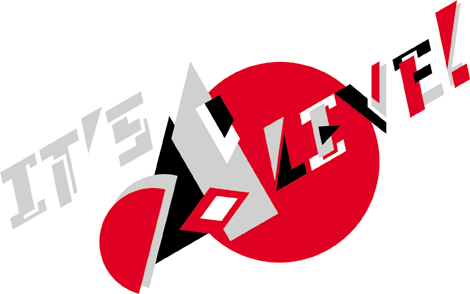
The logo for the Type Directors Club’s April conference about type on screen.
Feeling the Curse
In the present world (at least in its technologically advanced portions), we look at screens all the time. Not just the ubiquitous television, but the computer monitor on our desk, the silver screen when we go to a movie theater, the glowing LCD of our laptop, the display of a game player, of a personal digital assistant, of a cell phone, of a digital watch. Every one of them has letters on it.
Most of us communicate quite a bit through e-mail—and that, by definition, is something the great majority of us view on screen. (I have a friend, a talented and idiosyncratic writer, who lives in a fishing shack by the side of a trout stream and writes astounding fiction. He refuses to have even a telephone, much less a computer, and he writes out his stories longhand, in student composition notebooks. “If you can’t write me a real letter,” he says, “why don’t you just write me some e-mail, then print it out and put a stamp on it.” He’s one person who doesn’t read his mail on a screen.)
I’ve already written about the insane limitations imposed on e-mail by the fantasy of “plain text”—text that’s somehow free of typography. The broken, brain-dead typography we see on the screen in our e-mail programs is a curse we live with every day. And sadly the same sort of typography characterizes much of the other content one finds on screen.
The Magic Potion
This problem needs to be addressed seriously if the next step is going to happen—or at any rate if that next step isn’t going to be a stupendous stumble that sends us falling flat on our high-tech faces. That step is to leave more trees standing and start publishing digitally, on a screen. (No, printed books won’t go away; they’ll just be supplemented by electronic books and other publications.)
The appeal for publishers is obvious: It’s much, much cheaper to publish virtually, without the trouble and expense of printing on paper and distributing the printed result. The appeal to readers is somewhat less obvious, since most of us hate to read from a screen. The challenge for designers working in this medium is immense, but if you can do it—if you can really design a screen that’s comfortable to read—you’ll have the world at your feet.
You Can Take it With You
Digital publishing has taken a lot of forms. The wonderful CD-ROM reproductions of rare classic volumes from Octavo are a specialist’s dream; you can page through a First Folio of Shakespeare or Bodoni’s Manuale tipografico on your laptop, and all the text is searchable. Leaving CDs behind, the various manufacturers of eBook readers are scrambling to put both current bestsellers and out-of-copyright classics into your hands, and virtually every book publisher is jumping on the bandwagon. “You can have an entire library in your pocket!” they say, and if they can make the reading experience palatable, it will indeed be a wonderful thing.
The big buzz at the moment is how to redirect “content” (you know, the stuff you actually read) to various kinds of electronic media, so that you can look at a webpage, say, with lots of whiz-bang graphics and flashy animation, or view the same basic information in a stripped-down version with your Palm Pilot.
I think the real future is what might be called “streaming info”—periodicals that you download to your handheld or your augmented cell phone on the fly, so that you can read the latest news, gossip, feature stories, short fiction, opinions, or even cartoons even when riding the subway or holding the strap in a crowded bus.
Who, Where, What, When
The TDC conference will take place at Drexel University in Philadelphia, on Saturday, April 21, 2001. The keynote speaker is science fiction writer Bruce Sterling, who gives great rants and has a way of sparking unexpected ideas about just how we will navigate our hands-on future. He also has a new book on design coming out between now and then. The other speakers include Roger Black on Web-site design, Matthew Carter and Tom Rickner on types for the screen, Brody Neuenschwander on letters in motion, Deborah Ross on the typography of film titles, and Erik Spiekermann on interface design. The day will finish off with a panel on electronic publishing with representatives from Adobe, Microsoft, Simon & Schuster, Linotype, and Agfa Monotype. You can expect a highly visual event, as well as one that is exciting and intellectually challenging.
And a Reminder
For all you type designers and folks who run digital type foundries, don’t forget that the deadline is coming up for submitting typefaces to TDC2 2001, the Type Directors Club’s competition for the best type designs of the year 2000. As I mentioned in an earlier column that discussed the competition in more detail, any typeface that was either completed or released between Jan. 1 and Dec. 31, 2000, is eligible, and the deadline is January 5, 2001.
This article was last modified on April 1, 2022
This article was first published on December 22, 2000
Commenting is easier and faster when you're logged in!

Recommended for you

dot-font: Logo Designer Jim Parkinson Sets Type First
dot-font was a collection of short articles written by editor and typographer Jo...

dot-font: Stop Stealing Sheep—Again
dot-font was a collection of short articles written by editor and typographer Jo...

dot-font: Language Culture Type
dot-font was a collection of short articles written by editor and typographer Jo...