


Design Doyenne: Branding in Motion

The venture capitalists behind Maveron (whose unconventional stance in approaching investments is highlighted with the reversed “e” in its logo) asked HADW to add “passion” to its Web site along with hard-hitting information. These clients wanted to push their commitment as well as their expertise in attracting entrepreneurs and new investors.
A teaser for a start-up company was the idea behind the Web site for another client — Impli. The company was positioning itself for a launch and recruiting staff for its specialist software services

This relatively simple site for Impli hinted at better things to come for the client, which was then preparing to launch.
In the same mode, HADW introduced Gettuit as a Web presence, suggesting the full potential of a company still in the planning stages.
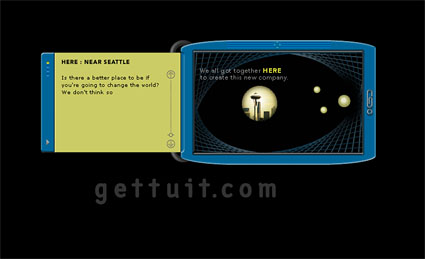
This HADW site for Gettuit, then a start-up company, also pointed promisingly toward the future.
Chris Sallquist makes the point that HADW extends the experience of the brand in on-line design, and then provides clients with the tools and guidelines they need for the upkeep of the site; seldom does the company have maintenance contracts with its clients. What HADW does provide, he emphasizes, is the expertise of the HADW multimedia teams, where, as he puts it, everyone from engineers, programmers, developers, and designers has creative input.
Jack Anderson still scrutinizes the role of the Web for what he calls the “Universal Studios” model of Web sites — that is, the artificial semblance of something that isn’t there, referring to the facades without actual buildings that are common on studio sets. He reiterates that the HADW team involvement with clients begins first and foremost with the premise that if the business model is good, the brand can be developed effectively, and the Web site can implement the brand and tell the client’s unique story.
Unsurprisingly, Anderson quotes the futurist and international business strategist Rolf Jensen’s recent book, “The Dream Society: How the Coming Shift from Information to Imagination will Transform your Business” (McGraw Hill). For Anderson, the transition from an information society to the next phase, a society where psychology and emotion play an important role, is key to branding. “We have to not only create a brand, but to effectively tell the story behind each brand, to convey emotion as well as meaning for each product or service.” Some might say HADW has been doing this for almost two decades.
I’ll be back home in Portland and checking in on your friends and mine at Plazm Media Collective next.
Warm regards,
Margaret
This article was last modified on January 8, 2023
This article was first published on August 20, 2001
Commenting is easier and faster when you're logged in!

Recommended for you

ID Preflight captures an obscure Illustrator error
I’m not saying this is wrong, but InDesign’s new Preflight feature w...

SmileOnMyMac Releases TextExpander 1.4, The Customizable Typing Timesaver Tool
SmileOnMyMac has released TextExpander 1.4, the customizable typing timesaver to...

Enfocus Instant PDF 09 Now Available
Press Release Enfocus has launched Instant PDF 09, the latest version of its eas...