


Decoding the Recycling Symbol


This story courtesy of PaperSpecs.com.

It seems like the recycling symbol is everywhere and on everything. Whether in the office, kitchen, garage, or yard, the icon is immediately identifiable: three chasing arrows in the shape of a triangle (Figure 1).
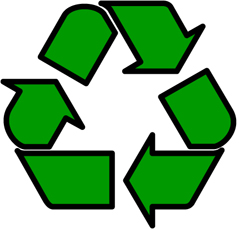
Figure 1.
Remarkably, this international icon was created by a student for a contest sponsored by the Container Corporation of America, now part of Smurfit-Stone Container Corp.
Gary Anderson, who at the time was a senior at the University of Southern California, won the contest to design an icon that symbolized the recycling process, a development that grew out of the back-to-the-earth movement of the 1960s and was showcased at the first Earth Day in 1970.
Anderson’s simple and expressive design was based on the Mobius loop, a discovery by 19th Century mathematician August Ferdinand Mobius that a paper twisted once over and joined at the tips formed a continuous single-edged, one-sided surface.
The symbol’s outline is stamped on packaging and products, or it is printed with a green fill. With both the filled and outline versions in use and numerous interpretations of what the recycling term means, there is confusion about how and when the recycling symbol can be used.
Green Guides from the FTC
Over the past two decades, the symbol has been adopted industry-wide and the Federal Trade Commission has set up guidelines for its use in the United States. The FTC’s Environmental Guides, also known as “Green Guides,” identify the following:
Products that are recyclable
According to the FTC, using the recycling symbol to make a claim that a product or package is “recyclable” requires that recycling collection programs are available in a substantial majority of communities for that product or package.
Products made with a percentage of recycled fiber
The recycling symbol is also used for products or packaging made with only a percentage of recycled fiber and must identify the total percent (by weight) of recycled fiber. An appropriate label might read “XX% total recycled fiber.”
Products made from 100% recycled fiber
Products or printed materials using 100% recycled fiber should use either the recycling symbol or, in the case of paperboard, the trademarked symbol of the Recycled Paperboard Alliance. Use of the RPA symbol is only permissible with a special licensing agreement in place.
Using the Recycling Symbol
Used alone, the recycling symbol communicates that a paper product or package is both recyclable and made entirely from recycled material. As few products or packages, such as brown paper bags, can make both claims, use of the symbol alone is limited. In most cases, qualifying statements must accompany the recycling symbol.
The recycling symbol can convey to consumers that the product is environmentally superior to other products. To avoid confusion and exaggeration, the FTC has issued guidelines for wording to be used with the symbol.
Display qualifying claims prominently
Qualifications or disclosures must be clear, prominent, and understandable to prevent deception. Symbols and language should be used in close proximity to each other and large enough for consumers to identify and read.
Example: “This magazine’s pages are printed on 100% post-consumer recycled stock. The cover is a combination of 50% pre- and 50% post-consumer waste.”
Be clear about what’s included in the claim
Specify whether the environmental attribute refers to the product, the product’s packaging, a service, or a portion or component of the product, package, or service.
Example for poster: “Printed on 50% total recycled fiber.” On the mailing tube: “Contains 100% recycled fiber, containing 97% post-consumer waste.”
The use of the recycling symbol graphically advanced an environmental awareness that is continually expanding into our personal and professional lives.
The symbol is now as recognized worldwide as the Apple Computer symbol or the MTV logo and it helped define both a movement and an industry with a profound global impact.
For more information, visit the Federal Trade Commission Web site and the American Forest and Paper Association Web site.
This article was last modified on January 4, 2023
This article was first published on October 26, 2007
Commenting is easier and faster when you're logged in!

Recommended for you

Batch Process Images with PhotoBulk
If you work on a Mac and regularly have to process images to size, optimize, or...
Illustrator Basics: Using the Magic Wand Tool
Use the Magic Wand tool to select similar objects with just one click!

10 Essential Tips for Working With Color Swatches in Illustrator
1. Creating Swatches. To create a process color swatch, select an object with th...