


Create and Collaborate: Adobe DesignTeam Brings Project Management Online


Whether you choose the basic annotation tool or Acrobat, this online review is vastly more efficient than sending individual PDFs to multiple reviewers via email. As comments are uploaded and downloaded, the reviewers can see one another’s comments (see figure 4). And because all of the comments are stored in a single file there is no need to reconcile multiple (and sometimes contradictory) requests.
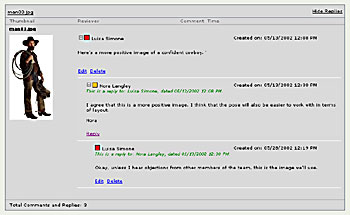
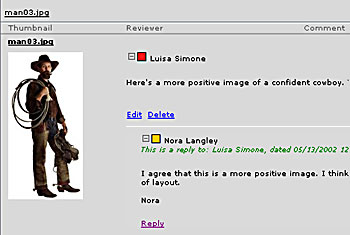
Figure 4: Adobe DesignTeam automatically stores comments from different team members in a single file (top). This makes it easy to view a conversational thread, as shown here (close-up, bottom).
Adobe DesignTeam also takes advantage of the PDF format when the time comes to deliver your files to a third party, such as a service bureau. Basically, the delivery process sets up an FTP site (see figure 5). An email notification instructs the recipient to log onto Adobe DesignTeam in order to download the document. Adobe DesignTeam supports a host of delivery options that ensure the security of your files. For example, all file transfers employ Acrobat 5’s 128-bit encryption. In addition, you can assign an expiration date to the download-permission setting, prevent edits to the Acrobat file, or restrict downloads to a single computer.
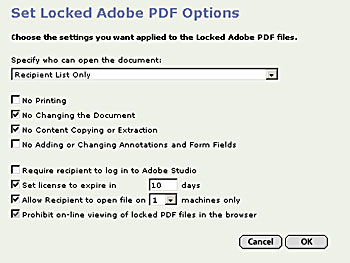
Figure 5: When setting up an FTP transfer, you can choose several high-level PDF security options. Here, for example, only the recipient can open the document, which can be printed but not altered.
Cost and Frustration
Our enthusiasm for Adobe DesignTeam is tempered by several small shortcomings. While we appreciate the fact that you can integrate Adobe Acrobat into the review process, we wish that the functions were built into Adobe DesignTeam (at either no extra charge or for a nominal fee). Right now, you must purchase Adobe Acrobat separately.
In an attempt to reach the broadest possible audience, Adobe DesignTeam’s initial installation delivers a basic toolset. If you want more advanced (and we think essential) functions, such as batch file transfer or screen capture, you must perform a second, separate installation for the supplemental toolkit.
During our testing we experienced difficulties logging onto the Adobe DesignTeam site. While frustrating, clicking the log in button three or four times is not a major obstacle. It does, however, point out the biggest drawback to an online service. Performance and reliability are dependent upon a number of factors, including the stability of remote servers and the speed of your Internet connection. For example, Adobe strongly recommends that you access Adobe DesignTeam over a persistent Internet connection, such as DSL, a cable modem, or a T1 line.
Currently Adobe DesignTeam offers three levels of service. All three levels include an unlimited number of reviews, invited reviewers, projects, and deliveries. The Basic subscription for $39.95 per month allows you to invite one workgroup member and store up to 100 MBs of data on the server. The Select subscription for $174.95 per month provides for 5 simultaneous workgroup members and 500 MBs of storage. The Premium subscription for $449.95 per month increases workgroup members to 15 and storage to 1.5 GBs. Adobe DesignTeam is currently offering a free 30-day trial membership. And periodically Adobe offers aggressive discounts. When we reviewed Adobe DesignTeam it was possible to receive a diccount of 66 percent for the first three months of service for either the Select or Premium subscriptions (there is no guarantee that this offer is still available).
We are convinced that the collaboration functions offered by Adobe DesignTeam deliver real benefits to designers. In fact, we think the ability to share files, review proofs on line, and deliver secure documents would benefit a much wider audience comprised of corporate and small business users. But, with a yearly commitment of approximately $500, $2,000 or $5,000 for the Basic, Select, and Premium services we believe that the subscription price will slow the adoption of Adobe DesignTeam.
This article was last modified on January 3, 2023
This article was first published on August 15, 2002
Commenting is easier and faster when you're logged in!

Recommended for you

Creative Cloud Assets New Web Interface
An important part of the infrastructure of Adobe Creative Cloud applications is...

Intelligently Resize Images with iResizer
Content Aware Scale, which allows you to resize photos disproportionally without...

Image Editing in Lightroom 5: Correcting Overexposed and Underexposed Images
The following is an excerpt from The Adobe Photoshop Lightroom 5 Book: The Compl...