


America 24/7: Shoot-to-Plate in Real Time


Selection Workflow
More than a quarter-million images streamed into five terabytes of networked storage on the Apple Xserve/Raid boxes. At Cnet, 30 editing workstations with Photo Mechanic were used to access images for browsing, annotating and recategorizing. The editors periodically projected their work onto large screens to aid discussion and collaborative decision making.

Sifting and winnowing. As the pictures arrived, photo editors began the seemingly endless task of selecting the best photos from the batches of digital images submitted by the thousands of photographers.
During the shoot, rotating shifts of photo editors (flown to San Francisco courtesy of JetBlue Airlines) previewed the photographs daily on a state-by-state basis, selecting approximately 25,000 images for further preview. These images were ingested into Webware’s Active Media digital asset management system, where low-resolution proxies of images (used for desktop browsing, cataloging and basic manipulations) were kept in synch with the high-resolution production images located on the server.
Book production. Once the 1,200 best images were selected, editors used Webware’s central image library to track, distribute and reformat the images for Adobe’s InDesign editingsystems, which was being used for production of the books. The images were grouped and, using Adobe Photoshop, massaged for camera bias and final cropping specs, then saved in Acrobat as press-ready PDF separations. Reference prints were made using Epson’s 960 and 2200 printers.
The team tackled the National Book first, using a custom-written script created by Premedia Systems to automate “pouring” images into the InDesign templates based on coordinated catalog descriptions. InDesign page templates were set and grouped into the layout for the first book, and then copied for each of the 52 subsequent book sets.
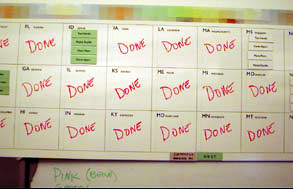
Mission control. This scoreboard showed at a glance which states were done and which ones were still “in play.”
Some of the images will be selected for exhibits, supported by Epson Printing, while others will be selected for Web sites and television coverage.
The project team came up with a novel gimmick for personalizing the books for both the photographers involved in the project and the general public. When the book is published in late October, any photographer will be able to go to the project’s Web site and design a book jacket displaying his or her own photograph, and then receive a copy of the book with that custom cover.
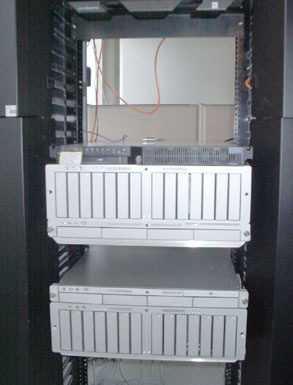
Server rack. Central file storage for the project was provided by two Apple X servers, an IBM Linux server and 5 TB of RAID disk arrays.
The national edition is expected to hit the stores on October 27, 2003. Production of the remaining 52 books is expected to take nine months.
A Day in the Life of America 24/7
I visited the project headquarters near the end of the initial selection process, while the book team was hard at work designing the first volume. Cnet had generously donated a portion of the first floor of its building-space that, in this post-dot-com office glut, it happened to have available. A dozen editors from Time, Newsweek, National Geographic, The New York Times, Rolling Stone, etc., were lounging around pods debating the merits of a new batch of images, while the editorial team huddled in a conference room and tried to figure out how to streamline a system to design the books as quickly as possible.
Food was trucked in daily, which made the gig seem like a quaint reminder of the excesses of the dot-com era, when all start-ups treated staff to free lunches-and even dinners-to keep them on the job more hours. Clearly, as with most Smolan-Cohen projects, this one was running on Internet time, long after most people had forgotten that there once was such a construct.

Keep the cartons. All the borrowed equipment will have to be returned at the end of the project-and where better to store the boxes for all the borrowed equipment than the sysadmin’s office?
The biggest technical challenge was that the entire workflow was, in effect, beta tested in real time during the project itself. Technical issues with the system configuration had to be debugged live while editors waited impatiently-never a pleasant scenario. But by the end of the first week, most of the system’s bugs had been worked out. The quick borrowing of the IBM Linux server that we mentioned above was the only major kludge.
The artistic challenges stemmed from the project’s dedication to producing books of images from all 50 states, the District of Columbia and New York City. Image quality (artistic, not technical) varied by state, leading one editor to quip that his team was busy “saving Alabama.” The editor hoped that the amateurs would save the day. Still, with hundreds of thousands of images to choose from, the team was generally optimistic that they’d be able to find more than enough good images to produce all 53 books.
Conclusion: It’s a Digital World After All
Smolan commented that the full ramifications of America 24/7 being a digital-imaging project didn’t really set in until the daily screening of the images for final selection. “Digital images have no bleed, so you can’t find another 10 percent of the image under the mount, the way you can with a slide. You also don’t have to worry about an image fading from being projected too long-you can leave an image onscreen as long as you like and the quality doesn’t change. If an image appears out of focus, it really is. You can’t simply refocus the image using the projector’s lens the way you can with slides. What you see is what is there, period. As photographers used to film, the world of digital imaging still seems weird. But after America 24/7, no one again will challenge whether digital photography is ready for prime time.”
Smolan worried that the book printing-maintaining the quality of the images as they are translated from RGB to CMYK-is now was the most formidable aspect of the project. The day I was there, they were still trying to select the best printer for the job. (Toppan in Japan won the printing contract, an unheard-of 500,000-copy first printing!) Eventually, of course, they did it, as evidenced by Smolan’s late-night call to me.
Smolan and his team will be hard at work on the state books for months to come. But this hasn’t stopped Smolan from dreaming about his next project. Whatever it is, I bet it will be even bigger and more ambitious than before. It’s part of this team’s fabric that they believe that nothing is impossible to those willing to make the impossible possible. I eagerly await the phone call I will receive from Smolan in the (I hope) not-too-distant future.
Craig Cline is Vice President of Content for Seybold Seminars.
© 2003 by Seybold Publications
All rights reserved. Reproduction in whole or in part without written permission is strictly prohibited.
This article was last modified on January 3, 2023
This article was first published on September 10, 2003
Commenting is easier and faster when you're logged in!

Recommended for you
Photography Fundamentals: Work the Scene
Excerpted from The Passionate Photographer: Ten Steps Toward Becoming Great by S...
Scanning Around with Gene: Barbecues, Bar-B-Ques, or BBQs — We Love 'Em All
The New York Times recently ran an article called “Pimp My Grill” ab...

Bringing Out Shape and Detail in the Darkest of Colors
Light Hogs “Is there detail in the blacks?” If you ever asked this question when...