



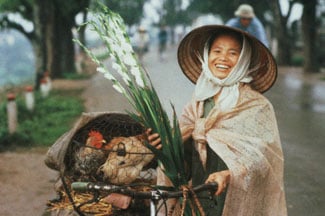
Mark Edward Harris’s photography career has thus far proved so diverse as to defy classification. He has “been there, shot that” across a wide spectrum of subjects and genres: From traveling through more than 60 countries capturing travel/documentary shots; to shooting newspaper work for the New York Times and Los Angeles Times, to helping adorn the pages of magazines such as Elle and Vogue. Harris’s work for Mexicana Airlines won a Clio Award in 1989, and his book, Faces of the Twentieth Century: Master Photographers and Their Work (1998, Abbeville Press), won the prestigious New York Book Show “Photography Book of the Year” and “Best of Show” awards in 1999. Mark is currently working on a second book, and on an image series of traditional Japanese baths. He has a growing collection of images available from Stone.
creativepro.com: Was it your goal to become a professional photographer, or did you just happen upon it?
Mark Edward Harris: I wanted to be a baseball player or a golfer! What really brought me to photography was my love of travel.
creativepro.com: The first thing I noticed about your work on the Stone Web site is that there are pictures from every corner of the globe, from the Caribbean to Europe and Asia, from Alaska to Mexico and Argentina.
Mark Edward Harris: That’s really what I love. My dad did public relations [photography] for KCBS Radio in New York. He would shoot publicity stills and I was around all that. On trips with him when I was a kid, I would keep a diary and collect postcards from wherever we went. Now, in a sense, I’m doing the same thing in traveling around the world. The documentary stuff I do is in a documentary style. I have a master’s in Pictorial Documentary History, a major I put together myself, combining history and photography.
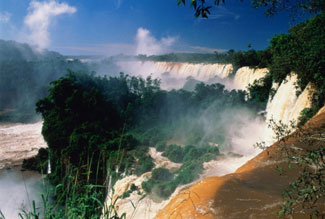
creativepro.com: So when you go to these exotic places — Iguazu Falls, Cuba, Vietnam — do you go for the purpose of photography, or do you just happen to take a camera with you wherever you go?
Mark Edward Harris: It’s specifically to shoot images. Sometimes I’m there on assignment, sometimes on my own. I just got back from Japan for a book I’m working on. I went to Vietnam to shoot the 25th anniversary of the end of the war.
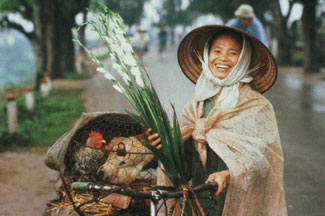
creativepro.com: When you were shooting in Vietnam, did you find people receptive or were they reluctant to be photographed?
Mark Edward Harris: They were very receptive. People there are very friendly and warm. Sometimes people are shy — in Vietnam or anywhere — but I rarely encounter hostility.
creativepro.com: I noticed that there is more variety among your work than that of most others featured at Stone. You seem equally comfortable with landscapes and people and architecture. And you seem to shoot equal amounts of black and white and color.

Mark Edward Harris: I prefer black and white, though I’ve got a newly emerging interest in color. Obviously for some clients I have to shoot color. I think I had a resistance to it for a while because I really love the fine art world, and color just isn’t accepted the same way there.
creativepro.com: Your colors seem rather muted. Is that because of your affinity with fine art, such as the impressionists?
Mark Edward Harris: Well, it is, but I think it’s a combination of things. A lot of [my images] are done as Polaroid transfers, which makes them muted anyway, or as hand tints. Actually, my father does the hand tinting. I don’t have the patience for that sort of thing.
creativepro.com: What can you tell our readers about how you got started with the transfer images and how you go about the process?
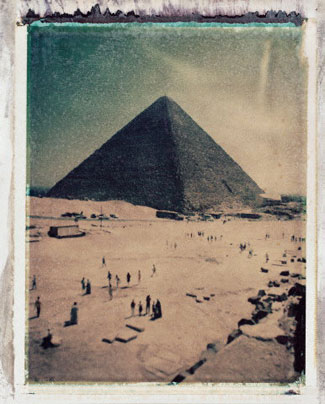
Mark Edward Harris: I just happened to be in Japan in ’91 during a photography convention and that was the first time I saw Polaroid transfer being done, and I was just fascinated by it. I use a Vivitar Instant Slide Printer to project a slide onto a Polaroid [substrate]. I wait about 10 seconds, then pull it apart and burnish the Polaroid negative onto a damp piece of watercolor paper. The dyes migrate onto the paper. I give this to Stone and they scan it.
creativepro.com: Tell me about hand tinting.
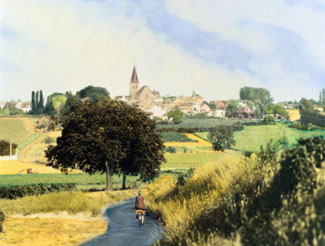
Mark Edward Harris: My father did the hand tinting because of his background in the arts. He’s more accustomed to doing art by hand than I am. It’s the same style as the postcards you used to see in the ’30s, using Marshal oils and painting the photograph to give a soft look. The St. Leger image (in France) is a good example of hand tinting.
creativepro.com: Do you digitally enhance any of your pictures?
Mark Edward Harris: I would say very few. There are a lot that are “cleaned up” though. I guess that would count, wouldn’t it? I use Ulead PhotoImpact a lot to do small things. Sometimes Stone will do it. There are some things, especially with color, that you just can’t do in the dark room, so the computer is unbelievable for that.
creativepro.com: The colors in your Chichen Itza picture are beautiful. Did you digitally enhance this image or did you shoot with filters?
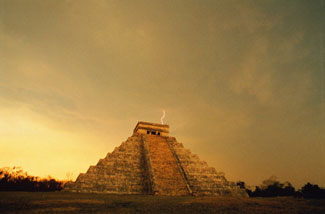
Mark Edward Harris: Stone brought it up — in terms of making it lighter — but they didn’t really alter colors too much. It was daytime and I put on just about every filter in the bag — a fluorescent filter and a warming filter and so on — so I could get the exposure long enough to increase my chances of getting lightning in the shot [which I did]. Funny enough, just after I shot that picture another bolt of lightning came down about 60 yards from me!
creativepro.com: I noticed several images with feet in the foreground — the Statue of Liberty, the woman on the beach — is this a signature style of yours?
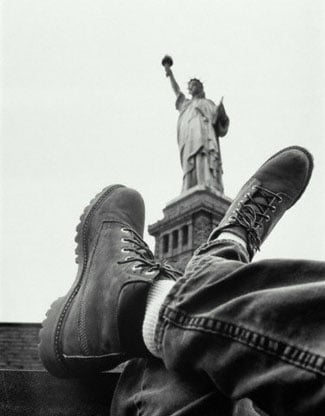
Mark Edward Harris: Those were done for the Gap. They just gave me shoes and said, Do what you want to do. The reportage style is definitely part of my signature.
creativepro.com: I particularly like your silhouetted images — like the kids on the diving board. How do you achieve those?
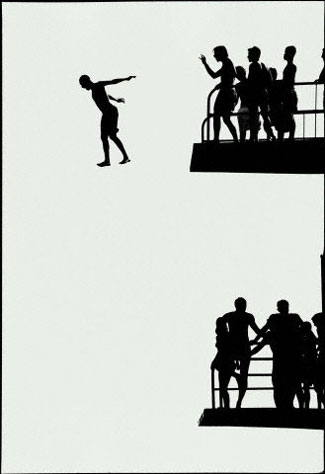
Mark Edward Harris: I just happened to be [on a layover] in Geneva, Switzerland, and a buddy and I were taking a walk along Lac Leman. We saw these people diving off a platform into the lake. I thought “This will work as a silhouette,” so I purposely exposed it for that [and used] a fairly long lens. Then we printed it at high contrast.
creativepro.com: What direction do you see your work taking in the near future?
Mark Edward Harris: I’ve been to over 60 countries and I’d like to continue more of the same, building up a body of my reportage travel work. I’m also doing some books. I have a show opening June 8 in New York at the SOHO Triad Fine Arts Gallery, based on my book, “Faces of the Twentieth Century: Master Photographers and Their Work.”
Read more by Marty Beaudet.
This article was last modified on March 12, 2022
This article was first published on June 1, 2000
Commenting is easier and faster when you're logged in!

Recommended for you

Palettes to Toolbars and Vice Versa
Microsoft Office is a toolbar-centric set of programs. Adobe Creative Suite has...

Making Hidden Characters More Subtle
How to change the color and tint of hidden characters in InDesign and Illustrato...
Scanning Around With Gene: The Pioneering Look Magazine
Even if you didn’t read Life magazine when it was in print, you’ve p...