


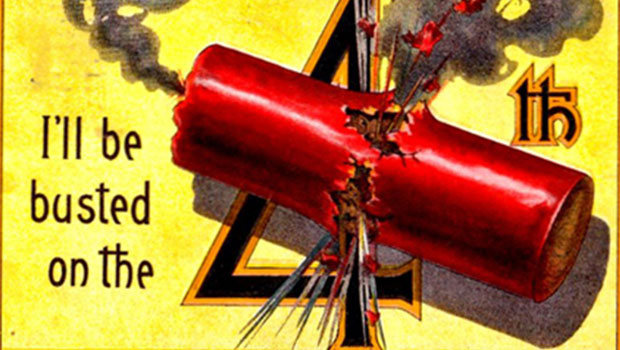
I suspect every American kid, especially every boy, has vivid memories of Fourth of July fireworks and can, at the mere mention of sparklers, pinwheels, firecrackers, snakes, or roman candles, conjure up the smell of burning sulfur. For me, growing up in a state where fireworks were sold legally for only one week a year, Fourth of July was always the highlight of summer. Every penny and dime I had saved throughout the year went to purchase fireworks, and I had no problem whatsoever watching my hard-won cash go up in smoke. That was the whole point.
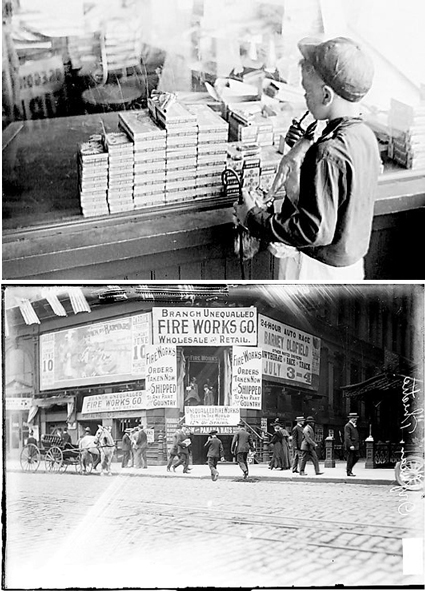
Figure 1: Every boy covets fireworks, as shown in this 1941 Russell Lee photograph (top) of the Fourth of July in Vale, Oregon, part of the Farm Security Administration photography series. The bottom photo is a turn-of-the-century view of fireworks for sale in Philadelphia.

Figure 2: This ad for Wildcat fireworks is from 1974 and shows that $12.95 isn’t what is used to be.
With names like Red Devil, Wildcat, Freedom, and Phantom, fireworks stands would spring up all over town a few weeks before the Fourth. My buddies and I would ride our bikes to the nearest stand several times a day to see if the merchandise had arrived yet. When it did, we’d drool over the screamers, colorful fountains, and flashing ray guns, and wonder if this would be the year our families would spring for the giant “Block Party” assortment package. We didn’t care if they were only the “safe and sane” variety of pyrotechnics. All that mattered was that you could light them and they would flame, spin, smoke, or spew. Even the matches were fun at a certain age, and if all you could afford was a box of 10-cent sparklers, well, you made the best of them. You could measure the number of kids in a neighborhood by the number of black spots on the sidewalk left by growing ashen snakes.
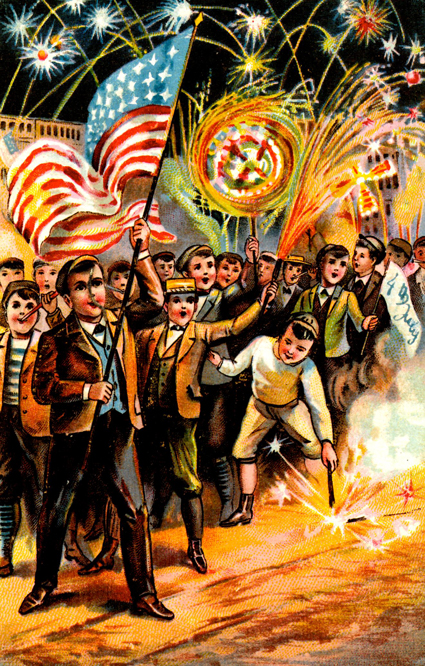
Figure 3: An early postcard image of boys having some fireworks fun. Date unknown.
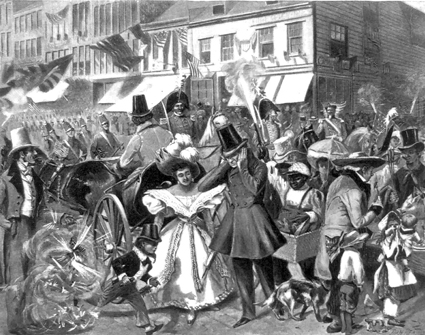
Figure 4: An 1894 drawing by Daniel Carter Beard (1850-1941) showing the pandemonium of a New York fireworks parade.
And of course, each year it was always a gamble as to who would get hurt or if one of the neighbor’s houses would catch on fire from a sparkler thrown into the air or an illegal bottle rocket gone astray. I ended up in the emergency room more than once myself, but it still all seemed very harmless to my young mind. These days fireworks are taken more seriously and restrictions are greater. That’s good, I suppose, but I’m sure kids find ways to circumvent the rules now just as we did then.
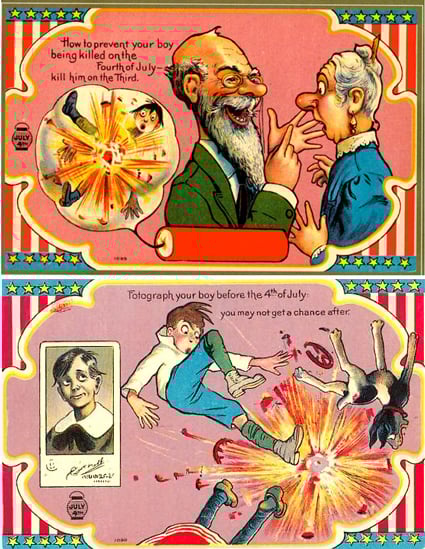
Figure 5: Firecracker safety was taken pretty lightly in the time of these images from turn-of-the-20th-century postcards, exact dates unknown. Boys will be boys, and sometimes the best way to save them is to kill them!

Figure 6: Two more postcard examples of the fun that could be had by placing firecrackers close to people.
I even had my first moral dilemma around fireworks. I can’t remember how old I was, but I had just opened my first savings account and, without my parents’ permission (which was not legally necessary but certainly expected), withdrew $3 and spent it on fireworks. As a victim of Catholic schooling I knew, of course, that God had seen my transgression. Eventually the guilt got to be too much, so I admitted my transgression both to my parents and to God through my parish priest. I can’t remember how many Hail Marys or Our Fathers I had to say but they were worth it, I’m sure. That $3 bought a number of choice fireworks and even the fear of God didn’t minimize the fun of setting them off.
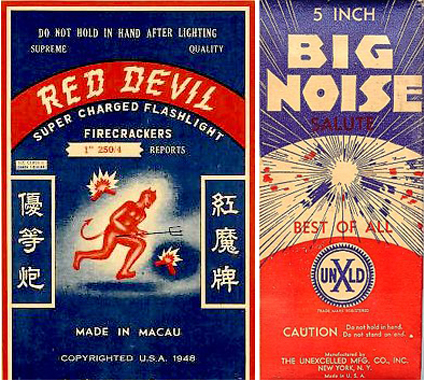
Figure 7: Red Devil firecracker package from 1948 (made in Macau, China), and Big Noise firecrackers (made in New York). Both images are from the terrific web site www.crackerpacks.com, which has a huge collection of vintage firecracker labels.

Figure 8: More postcard images showing fireworks in close proximity to humans. The bottom image is drawn by New York cartoonist Gene Carr, who is considered one of the pioneers of multiple-panel comics. His comic strip Lady Bountiful featured the first woman protagonist in modern cartooning.
A Long-Standing Tradition
Fireworks have long been used to celebrate special occasions and are, by no means, special to Americans. But from the very beginning of our country, they have held a unique place in celebrating the Fourth of July. In fact, Thomas Jefferson said in 1776 that Independence Day “will be the most memorable in the history of America. I am apt to believe that it will be celebrated by succeeding generations as the great anniversary festival… it ought to be solemnized with pomp and parade… bonfires and illuminations [the term for fireworks at that time] from one end of this continent to the other from this day forward forevermore.”
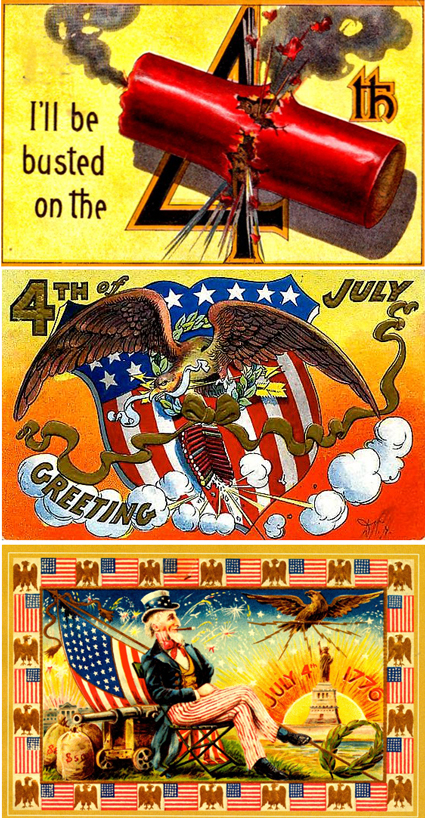
Figure 9: More postcard images showing America’s fascination with fireworks and the close association with the Fourth of July. The bottom card is from printers Gottschaulk and Dreyfuss, which, ironically, was printed in Germany.

Figure 10: These two images are among my favorite, though their origin is unknown. Using flames, firecrackers, sparklers or other incendiary devices as type designs is a common element of early Fourth of July postcard art.
It is only the association with freedom and independence that has allowed consumer fireworks to survive into the present days of our overly safe country. Several states, mostly in the South, still allow year-round sales of fireworks. Even in states like California (that severely limit firework sales), the banning of fireworks is right up there with gun control in triggering heated debates. We don’t have a constitutional right to ignite fireworks, but it almost seems that way. This despite the more than 6,000 people each Fourth who end up in the hospital with burns, eye injuries, or other damage, and the millions of dollars in losses caused each year by fires blamed on pyrotechnics. Fireworks don’t cause fires, as we all know. People do!

Figure 11: Kids love a parade! Children in Southington, Connecticut, stage a Fourth of July parade in 1942 (top) and bottom right (photos by FSA photographer Fenno Jacobs). Bottom left, a young girl photographed by E. W. Kelley in 1906.

Figure 12: Everyone gets in on the fireworks bandwagon, as shown in these three tantalizing images. “All Up in the Air Over the Fourth of July” (top) is of movie actress Marion Shilling in 1930. The pin-up girl lighting a firecracker (bottom right) is by artist Gil Elvgren, and Bud Fraker photographed Virginia Welles (bottom left) for the movie “Blue Skies” in 1946.
Sadly, more communities are banning fireworks in exchange for publicly funded, professional firework shows. And while these can be spectacular and elicit many ohhhs and ahhhs, they aren’t the same as setting off your own. It is, in fact, the possible danger and risk that makes fireworks so much fun.

Figure 13: This poster showing a wide selection of fireworks from British manufacturer Standard is from another great fireworks web site, www.fireworkmuseum.co.uk.
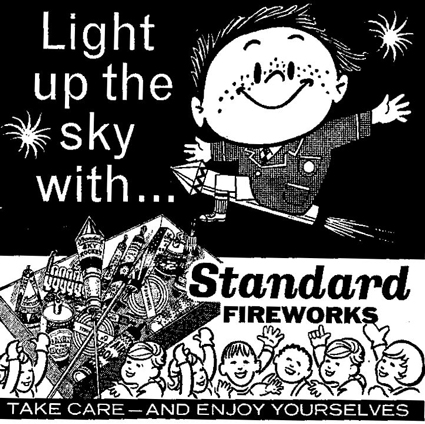
Figure 14: And an ad from Standard, which formed in 1891 and still operating today.
Keep reading “When Sparks Fly.”
This article was last modified on May 18, 2023
This article was first published on July 2, 2007
Commenting is easier and faster when you're logged in!

Recommended for you

How to Increase Image Dimensions and Maintain Quality in Photoshop
Learn best practices for increasing dimensions of an image while maintaining as...
10 Essential Tips for Working With Color Swatches in Illustrator
1. Creating Swatches. To create a process color swatch, select an object with th...

How to Shoot Raw Photos on Your iPhone (and Why You’d Want To)
You don’t need a DLSR camera to reap the benefits of the raw image format.