



It’s nice to have friends with hard-to-find talents. I have such a friend — a skilled carpenter and furniture maker who actually returns telephone calls and shows up when he says he will (well, most of the time). My friend has done a lot of work on my house through the years, including building the deck off the kitchen. About a week ago, he came over to complete the best home-improvement project I’ve ever had him do. He built bookshelves.
Now, I realize that most people don’t get excited about bookshelves. I don’t either, usually. I get excited about books — seeing books, touching books and, yes, reading them. The custom bookshelves brought a smile to my face and a jig to my step because I get to put books on them. Lacking good shelves in my house, I’d resorted to keeping books in cupboards, in drawers, and in boxes. I’d had a few bad experiences with the pasteboard and laminate shelves you get in office supply and big discount stores. I was ready for the real thing.
I’d been planning this project for months, and finally the time came when the amount of money in my home-improvement fund coincided with a suitable time slot in his busy schedule. I decided to take one entire wall of a small room that adjoins my office — a room I’m now calling the library, but was formerly known as the guest room — and fill the wall with floor-to-ceiling built-in bookshelves.
Although I didn’t go for the oak shelving and trim he suggested — I like the idea but the budget wouldn’t stretch far enough — these shelves are real wood with real wood trim. He built the shelving units (three in all) in his workshop and then brought them to my house for the installation and trim out.
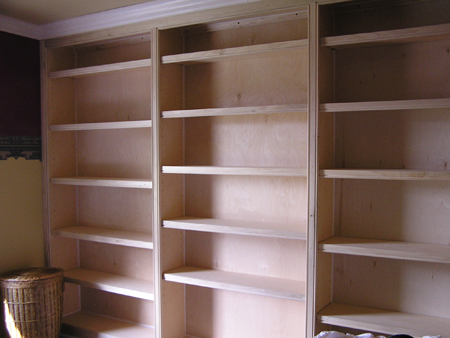
The finished shelves. So much room for so many books!
After he’d finished the job and packed up his truck, I took a few pictures to send to some other friends. Snapping away, I felt a bit odd about how gleeful I was about having the shelves, but the book geek in me was utterly delighted.
Expanding My Collection
My friend is a carpenter — not a painter — so it was up to me to paint the shelves after he installed them. I debated staining versus painting and decided paint was more practical. For a few days I questioned whether to paint the shelves at all because I was so eager to haul all the books out of their hiding places.
The painting part of the project slipped further behind schedule after I pulled out some graphic arts books. I realized that if I got rid of some business-related books, I could make room for more books on design and printing. That realization prompted me to make a shopping trip to some of those look-before-you-buy places for books — otherwise known as public libraries.
Bookstores let you look before you buy, too, but I like public libraries better because they let you take the books home without paying for them. If you try that in a bookstore you can end up perusing your selections while sitting in a police station waiting to be booked (pun intended) on a shoplifting charge. Plus, libraries have older books as well as newer ones, and some of the older graphic arts books are real treasures.
I already own a couple of books I consider graphic arts classics, such as The Smithsonian Book of Books by Michael Olmert. Published in 1992 by the Smithsonian Institute, it has more than 300 color photographs and images, and many fill an entire page. The paper is coated, heavy, and just the right shade of white to set off the colors in the images. Oh yes, the subject matter — the subtitle describes it well, “The book lover’s guide to the craft, history, and mystery of books and bookmaking.”
Another favorite is A History of Graphic Design, third edition by Phillip B. Meggs. I have a few of his books, but this large reference book with more than a thousand illustrations deserves every bit of shelf space it will occupy. I also have and enjoy the author’s book on how to mix images and text, Type & Image: the Language of Graphic Design.
One book I don’t own but want to add to my collection is The Visual Display of Quantitative Information by Edward R. Tufte. I haven’t seen the second, and most current edition, but I bet it’s as good or better than the first edition. A colleague introduced me to the first edition years ago. He pulled it off his bookshelf after listening to my blistering criticism of the design of a chart in USA Today. Impressed by what I read, I wrote the publisher a letter suggesting the newspaper make a few copies available for the staff.
Determined to find other interesting books for my collection, I spent the better part of a day in various libraries looking at books related to graphic arts and design. I am fortunate enough to live in an area that has many libraries within an hour’s drive, and I have borrowing privileges at all of them.
After a few blissful hours of searching and browsing, I found a few I thought worth lugging home for extended review purposes, including a book on doing calligraphy with Photoshop. I’ve done calligraphy with a pen, so I’m eager to learn how to do it on the computer. I figure it’s got to be every bit as much fun, but easier, and I won’t run the risk of spilling ink everywhere.
I also picked up a design book I’d requested from another library. I was amused to find stamped inside the cover the phrase “dead storage.” I guess that’s where librarians put books they can’t bare to part with yet no one has borrowed in years. I’m glad they hung onto Art and Visual Perception: A Psychology of the Creative Eye by Rudolf Arnheim. The book is hard to describe — it’s an intriguing mix of scientific analysis and philosophy designed to convey how the author thinks humans are able to perceive and understand shapes, forms, and art.
I ran across a reference to this book while researching my last column on jumpstarting creativity. The edition I got on interlibrary loan was published in 1954. I doubt there are many from the 1954 printing around for purchase, but there are more recent reprints available. I like the look and feel of the older hardcopy, so I think I’ll see if the library will sell it to me. If not, I’ll just have to make do with one of the hardcover reprints that I can purchase online.
Your Suggestions, Please
I’ve got some time between now and the day I can put my budding collection on the shelves — I’ve got to paint the shelves first, remember? I’d appreciate hearing from you, the readers, what books you have, or would like to have, in a graphic arts collection and why. I’ll take your suggestions seriously, so go ahead and encourage the book geek in me! Just post your suggestions by looking for the icon VoxBox to the left of this story and clicking on the phrase “Respond to this article.”
This article was last modified on July 11, 2023
This article was first published on April 21, 2005
Commenting is easier and faster when you're logged in!

Recommended for you

The Riddle of the Hidden Characters: Contest Answer and Winner!
It’s time to reveal the solution—and the winner—for this month’s InD...

Quark Launches Dynamic Publishing Solution
Quark Inc. announced today that it is leveraging its existing desktop publishing...

Script of the Month: InDesign to Photoshop Layers
This script can be used to convert InDesign documents to layered Photoshop files...