


Greetings from Midtown Manhattan.
Today I partook of two half-day tutorial sessions. These are my amplified notes from the morning session on eBooks: Business Models and Strategy. There’s not much InDesign info here, but it’s good background for what’s to come tomorrow with Adobe, Quark, et al.
The panel of speakers covered a list of topics from the perspectives of four publishing markets: trade, higher education, research, and STM (science, technical, medical). The speakers took a novel approach to the session “handout.” Instead of a paper book, PDF, etc, the notes are posted to a GoogleDocs wiki that they collaborated on putting together. It has a lot more info from the session and links. One of the hosts jokingly asked us not to edit the wiki while he was presenting. I was tempted, but listened to the angel on my right shoulder rather than the devil on my left.
First and foremost for eBooks, epub is the format to know about. It is an open standard XML-based file format that allows text to reflow and adjust to the size of various screens. epub is generally thought of as an intermediary format between the authoring/composition tool and the eBook itself. Think of epub as the eBook version of a press-ready PDF. Not the final product, but a necessary step. Amazon’s Kindle and the SonyReader use proprietary file formats which are basically epub wrapped in DRM. Though others, like Adobe with their Digital Editions and the Stanza app for the iPhone use straight-up epub. The epub standard is maintained by IDPF, the International Digital Publishing Forum. Happily, InDesign CS4 can export to epub through the Export to Digital Editions command. I’m sure you’ll be hearing more about that feature around these parts in the future. Here are some of the options for exporting to epub in InDesign CS4.


There was much talk about the problem of college textbook prices. These books are very expensive and change little from year to year. This engenders a good deal of resentment from students who feel like they’re being gouged. They either end up buying books used, downloading them from a filesharing site, or just going without. We were told that 20% of students now don’t buy the books assigned by their professors. This in turn, pressures the publishers to charge even more per unit to recoup their costs. It’s a “pricing death spiral”, so something’s gotta give. There was mention of the trend being toward courseware and services as the model going forward, now that content itself is increasingly viewed as “worthless.” Ouch.
Social networks are big and getting a whole lot bigger. Shelfari is an interesting social network built around books. You build a virtual bookshelf to display the books you’ve read, are reading, or want to read. You can rate and review books, see what’s on your friends’ shelves, create book discussion groups, download your book lists, and so on. I made a page for myself.
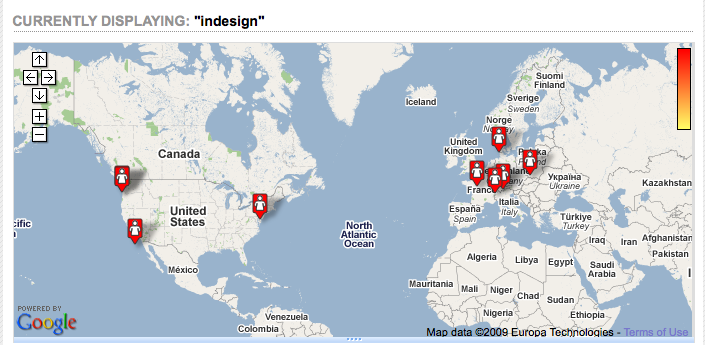
Geospatial is a big buzzword in publishing now. I’ll have more on that when I write up this afternoon’s session on XML in Practice. The eBook session mentioned Authormapper, which uses geotagging for journal articles. You enter a search term and it returns the articles plus a map of where they came from. Here’s a map of articles that mention InDesign. Not exactly sure of the value here, but it is interesting. I think I can see David and Bob. But who’s that down in San Diego?
Being an eBook session, lots of folks were anxious to hear Amazon’s announcement of the Kindle 2. Here a good run-down on the Kindle 2 from Wired. I like how thin it is 1/3 inch (.85 cm to everyone outside Americaland). Still seems a little goofy looking, but much better than the old version. I might actually be tempted to plunk down the $370 bucks for something like this. Amazon says there are over 230,000 titles available for the Kindle, with the eventual goal of “every book ever printed, in any language.” Slackers.
Symtio is a means of selling eBooks in good ol’ fashioned brick and mortar book stores. The deal is you buy a thing like an iTunes gift card with an access code and use it on the Web to make your book purchase. This is an attempt to cut the brick and mortars in on the action of eBooks. How kind. I can see the niche, especially when it comes to gift giving. Intangible items like digital content make lousy stocking stuffers. Still, Symtio has a ways to go. When I plug in my zip code to see the nearest retailer with Symtio, it’s 137 miles away.
Extra Points on Piracy and Pricing
- When it comes to the issue of piracy, some markets are very concerned (college textbooks), and others totally unconcerned (journals). Some fall in the middle (trade). The trade publishers monitor the bit torrent sites to see what users are doing with their content, but they are not wasting a lot of time worry about it.
- eBook pricing is all over the place. There is a huge disparity, everywhere from the same price as a hardcover print edition, all the way down to free. Amazon set a price point of $9.99.
- When content is “free”, publishers are trying to move to a services model to generate revenue. To create a service model, they must first find out how the material is being used. Then they can design applications around the content to give people what they want. To that end, publishers are starting to think outside of the silo of an individual book, and looking to connect their content to other books, or the world at large. One example of this is “open indexing” where a secondary index of the eBook is generated by the readers, in something similar to a blog’s tag cloud.
Finally, the other day I mentioned that I would be posting TOC-inspired content on my Twitter page, without actually describing what Twitter is. For those who haven’t heard of it (or just don’t see the point), The Content Wrangler has an article called Ending the Twitter Mystery, which does a nice job of explaining why someone would want to participate in microblogging phenomenon.
Much more to come…
This article was last modified on December 19, 2021
This article was first published on February 9, 2009
Commenting is easier and faster when you're logged in!

Recommended for you
Quickly Create Yearbook-like Image Spreads
Learn the fastest ways you can quickly lay out page after page of same-sized ima...
Track Down That Layout
Are you sure you're working on the right version of the layout? Here are a coupl...
Easter Egg Stroke Styles
Hey, it's Friday. Time for a little fun easter egg involving stroke styles (incl...