

How to Be a Better Designer: Be a Perpetual Student
Learning and sharing will keep you growing—not just as a designer, but as a creative human being.

This article appears in Issue 52 of CreativePro Magazine.
We are what we eat, and creatively speaking, we are the sum of everything we’ve seen, read, heard, and experienced. Every film, book, or song becomes part of the raw material you bring to your work. Every play you sit through, every painting you look at (even the bad ones) is grist for your mill of creative output. So don’t nibble; be a glutton. Be greedy for inspiration—it may be one of the few things that you can’t have too much of. The more you feed your creativity, the more you’ll have to draw from when it’s time to design.
Start with the obvious: museums, galleries, design conferences, and podcasts about design. But don’t stop there. Wander through a science exhibit, watch documentaries on architecture, listen to a podcast about psychology, or read a book on storytelling. Sometimes the best ideas come from outside the echo chamber of design. Those unexpected inputs are what make your work distinct.
A Living Resource
While you’re soaking up everything you can, build a design library of your own. Not just the books every designer is supposed to own, but also the ones that speak to your particular interests. Type, color theory, photography, semiotics, printmaking, creativity, business—the shelf should be eclectic. This isn’t about collecting trophies. It’s about creating a living resource that you’ll come back to again and again, one that will keep you sharp, informed, and inspired.
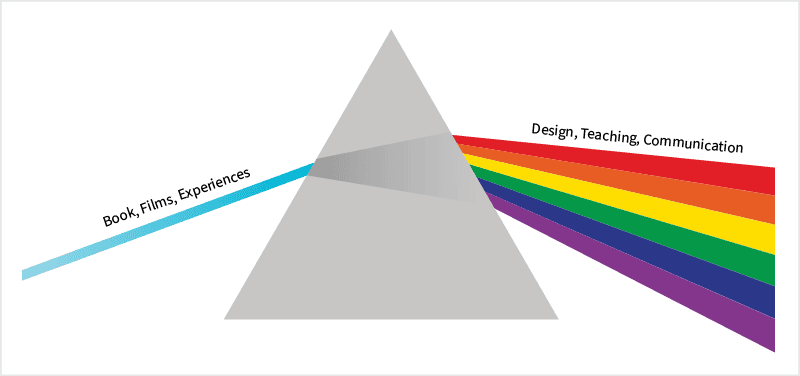
You are a sponge and the more you soak up, the more you’ll have to squeeze out later. Thankfully, graphic design is a broad enough field that almost anything can relate to it in some way. Take a letterpress or screen-printing class. Try calligraphy, life drawing, or photography. Study creative writing or film editing. Every skill you add finds its way into your work consciously or otherwise—sometimes in obvious ways, sometimes in subtler shifts of tone or rhythm. Varied inputs make for richer outputs (Figure 1).
Don’t underestimate the practical side of this. If you’ve developed a skill that overlaps with design, make sure it shows up in your résumé or portfolio. A potential employer or client may see photography, motion design, or illustration not as a sideline, but as the tie-breaker that makes you the better hire. In a competitive field, versatility gives you an edge.
Teach It to Learn It
Being a perpetual student naturally leads to the flip side: being a perpetual teacher. The two roles are closer than you might think. Any experienced teacher will tell you that having to explain a subject forces you to understand it on a deeper level (Figure 2).
As the old adage goes, the best way to learn something is to teach it. When you prepare to explain a concept—whether it’s kerning, grids, color theory, or Photoshop masks—you have to organize your own understanding. You have to strip away the fuzziness and make the logic clear. Gaps you never noticed suddenly reveal themselves, because a student’s question will shine a spotlight right where you’re least confident. Teaching exposes the holes in your knowledge. Filling those holes will make you a better designer.
You don’t have to stand at the front of a classroom to make this happen. Mentoring a colleague, writing a blog post about a design principle, giving a short talk at a local meetup, even walking a friend through how to use InDesign—all of these count as teaching. The format matters less than the fact that you are communicating something you know (or are even just learning) clearly to someone else.
One Step Ahead
Don’t wait to feel like an expert before you start. You don’t need to be the world authority on a topic—you just need to be one step ahead of your students. In fact, there’s real value in remembering what it’s like to not know something. When you’re new to teaching, the struggle is fresh in your mind, and that empathy can be more helpful than expertise alone. You know which concepts are confusing because you’ve recently been confused yourself. Your authenticity can help students feel understood, and it builds trust.
If you’ve ever tried to teach someone to use the Pen tool, you’ll know what I mean. When you remember the frustration of clicking too many anchor points or getting tangled up in handles, you can guide your students through the same traps with patience. They’ll learn faster, and you’ll reinforce your own skills at the same time.
History gives us plenty of examples of designers who grew by teaching. Josef Müller-Brockmann, one of the giants of Swiss Modernism, sharpened his own thinking about grids and clarity not only through his work, but through decades of teaching in Zurich. Paul Rand taught at Yale while still producing iconic corporate identities, and his lectures were as influential as his logos. Paula Scher, partner at Pentagram, has said that teaching at the School of Visual Arts keeps her plugged into how young designers think—and that exchange influences her own practice. In every case, teaching wasn’t a sideline; it was part of how they continued to evolve.
Sharing Makes You Visible…
Another benefit of teaching is that it forces you to practice communication—a necessary skill for every designer. Clients don’t just hire you to push pixels; they hire you to explain ideas, persuade audiences, and guide decisions. Teaching builds those muscles. The more you practice making complex concepts simple, the better you’ll be at presenting your work, writing proposals, or defending a design choice in a meeting.
Teaching also expands your professional network. When you write, present, or mentor, you connect with people who may later become collaborators, clients, or colleagues. Sharing your knowledge makes you visible. It demonstrates not only what you know, but also your willingness to help others grow. That generosity has a way of circling back.
…And Vulnerable
Of course, teaching isn’t always easy. It requires patience, humility, and a willingness to admit what you don’t know. But those qualities are strengths, not weaknesses. They make you relatable. They remind your students that learning is a process, not a performance. And when your students are genuinely invested, the dynamic becomes less about hierarchy and more about shared discovery.
So make teaching part of your creative practice. Host a workshop, lead a lunch-and-learn at your workplace, or volunteer to review student portfolios. Write an article about your design process, or record a quick tutorial. Mentor someone just starting out. None of these require you to be perfect; they just require you to be open and adaptable.
A Loop to Keep You Growing
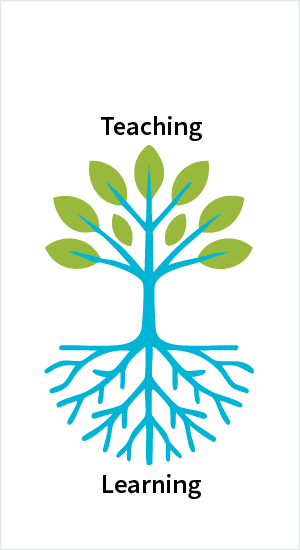
Because the truth is, you never stop being both student and teacher. Each role feeds the other (Figure 3). The more you learn, the more you’ll want to share. The more you share, the more deeply you’ll learn. It’s a loop that keeps you growing—not just as a designer, but as a creative human being.

So stay curious. Stay generous. Never stop learning, and never stop teaching. The design world doesn’t need more isolated geniuses. It needs engaged, thoughtful practitioners who keep the cycle going—absorb, create, share, repeat—and inspire the next wave to do the same.
Commenting is easier and faster when you're logged in!

Recommended for you
How to Be a Better Graphic Designer: Sweat the Details
Nigel French reminds us how much the little things matter in design.

How to Be a Better Graphic Designer: Do It Yourself
Doing it yourself pushes you to move beyond your usual tools and deepen your und...
How to be a Better Designer: Design on a Grid
When you design on a grid, it helps you decide what goes where, so you can spend...